

More news on this day
Japan is preparing to introduce some of the world’s toughest aviation safety rules on mobile batteries, with authorities confirming that from April 2026 passengers on all international and domestic flights to, from and within the country will be barred from using portable power banks in the air, as regulators move to curb a rise in overheating and fire incidents linked to lithium ion cells.
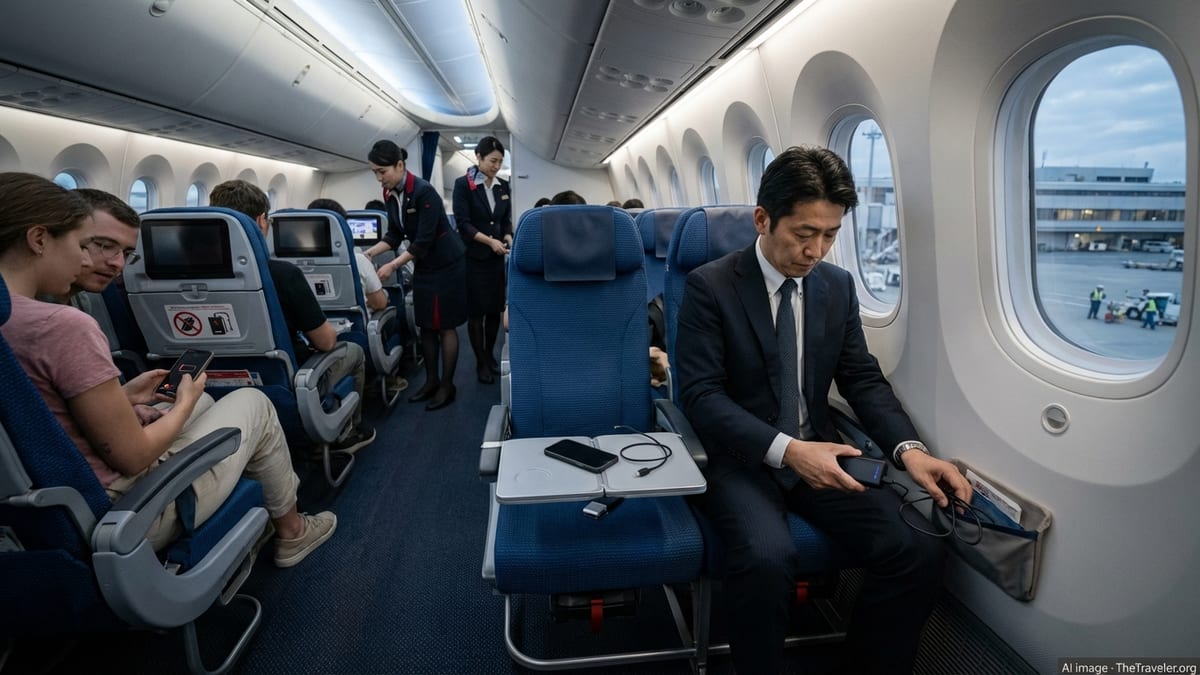
New Nationwide Restriction Targets In-Flight Power Bank Use
The Ministry of Land, Infrastructure, Transport and Tourism has notified Japanese and foreign carriers that the use of mobile power banks will be prohibited on every passenger flight touching Japanese territory from April 2026. The measure applies to domestic services, as well as international routes departing from or arriving in cities including Tokyo, Osaka, Nagoya, Sapporo and Fukuoka.
Under the revised rules, passengers may still carry a limited number of approved power banks in their cabin baggage, but they will no longer be allowed to use them to charge phones, tablets, laptops or other devices during the flight. Charging the power banks themselves via seat outlets or USB ports will also be banned once the aircraft doors are closed.
Aviation officials describe the move as a tightening of Japan’s already stringent 2025 rules, which required mobile batteries to remain within sight and barred storage in overhead bins. The 2026 framework keeps those restrictions in place while adding an across the board ban on in-flight usage, making Japan one of the first major markets to implement such a comprehensive curb.
The order will cover all carriers operating in Japanese airspace, meaning that foreign airlines flying into the country will have to brief crews, update safety manuals and modify pre flight announcements to reflect the new restrictions.
What the Ban Does and Does Not Cover
Despite some early confusion on social media, the new regulation does not outlaw power banks entirely. Passengers will still be allowed to bring them on board, subject to strict capacity and quantity limits already embedded in Japanese and international safety rules. The ban is focused on how the batteries are used once the aircraft is airborne, not on whether they can be transported in the cabin at all.
Current guidance, which is expected to remain in force under the 2026 regime, allows unlimited quantities of batteries rated under 100 watt hours, provided they are for personal use and properly protected from short circuit. Batteries between 100 and 160 watt hours are typically capped at two per traveler, often requiring airline approval, while higher capacity units are not permitted on passenger aircraft.
Officials indicate that the new directive will reinforce these thresholds while making it clear that even compliant batteries must remain switched off and disconnected throughout the flight. Airlines will be instructed to confiscate or isolate any power bank that is found connected to a device or being charged, treating it as a safety non compliance similar to smoking in the lavatory or tampering with a smoke detector.
Laptops, smartphones and other electronics powered by their internal batteries remain allowed, as long as they follow standard cabin rules, such as being switched to flight mode where required and stowed appropriately during taxi, takeoff and landing. The critical change is that passengers will no longer be permitted to top up those devices with external battery packs while in the air over Japan.
Safety Concerns Driving the 2026 Crackdown
Regulators point to a sharp rise in incidents involving lithium powered devices as the primary catalyst for the tougher stance. Japan’s product safety authorities recorded well over one hundred battery related accidents in 2024, a marked increase over early decade figures, with a significant share linked to mobile batteries igniting or emitting smoke while charging smartphones or tablets at home, on trains and on board aircraft.
Several high profile cases have underscored the risk in the aviation context. In one instance, smoke from a portable battery on a domestic flight forced cabin crew to deploy fire extinguishers and divert passengers away from a smoldering seat row. Internationally, emergency diversions have been triggered when batteries in overhead bins overheated, filling the cabin with smoke and prompting rapid response from flight crews.
While such events remain rare when measured against the millions of flights operated annually, authorities stress that even a single uncontrolled fire in a pressurized aircraft cabin can have catastrophic consequences. Lithium ion cells are prone to thermal runaway, a chain reaction in which an overheating battery ignites neighboring cells, producing intense heat and potentially toxic fumes.
By eliminating the in flight use of power banks, Japan’s regulators aim to remove common triggers such as faulty cables, incompatible fast charging protocols and physical damage sustained while devices are wedged under armrests or seat cushions. Officials argue that this pre emptive step will significantly lower the probability of a battery incident at 30,000 feet, where evacuation options are limited and response time is critical.
From Overhead Bin Bans to Full In-Flight Prohibition
The 2026 decision is the latest step in a multi year tightening of Japan’s rules on mobile batteries. In July 2025, the Japan Civil Aviation Bureau introduced a ban on storing power banks in overhead lockers and required passengers to keep them within sight, such as in seat pockets or under the seat in front. That framework also clarified capacity limits and emphasized that batteries must remain accessible to crew in case of overheating.
Those earlier restrictions followed a series of global accidents involving batteries stowed in overhead compartments, where smoke was detected only after other passengers noticed a smell or alarms sounded. Safety experts warned that fires in closed storage spaces are harder to locate and fight, since crew might have to open a bin already filled with hot gases or flames.
At the time, Japan stopped short of banning the in flight use of power banks, instead insisting that passengers monitor their devices and avoid leaving them unattended while charging. However, regulators now say that compliance has been uneven and that the proliferation of cheap, untested devices has outpaced public awareness campaigns. Reports of fires and near miss incidents in other countries throughout 2025 added momentum to calls for stronger action.
The new 2026 directive therefore represents a shift from managed use to outright prohibition during flight. Carriers will be expected to update safety videos, boarding announcements and inflight magazines to reflect the change, and airport signage is likely to be revised to highlight that charging via portable batteries is prohibited once passengers are on board.
How the Rules Affect Domestic and International Travelers
Because the ban applies to all flights departing from or arriving in Japan, its impact will be felt by a broad cross section of travelers, from business passengers commuting between Tokyo and Osaka to international tourists flying into Narita, Haneda, Kansai or regional gateways. Anyone taking a domestic hop or a long haul connection via a Japanese hub will encounter the same restrictions on using portable chargers en route.
Travelers will need to adjust habits shaped by years of relying on external batteries to keep devices powered through multi hour journeys. Long haul passengers who depend on smartphones for entertainment, work or digital health monitoring will be encouraged to fully charge devices at the gate or plug into certified seat power where available. On older aircraft without seat outlets, planning ahead will be essential to avoid being left with a dead battery mid flight.
The rules will also affect transfer passengers who begin their journey in countries with looser policies. Even if a traveler boards an outbound leg from another country where in flight power bank use is permitted, the ban will still apply as soon as the aircraft falls under Japanese operational control on routes operated by Japanese carriers or operated into Japanese airports.
Airlines and travel agents are expected to step up communication in the months ahead, incorporating the new guidance into booking confirmations, mobile apps and pre departure emails. Frequent flyers who are accustomed to regional differences in baggage allowances and security screening will now have to add power bank rules to the list of country specific factors to check before departure.
Alignment and Tension with Global Battery Safety Standards
Japan’s move comes as international organizations refine guidelines around lithium powered devices. Global aviation bodies already recommend that spare lithium batteries and power banks travel only in cabin baggage and not in the hold, and that damaged or recalled units be barred from aircraft entirely. Many jurisdictions also limit watt hour ratings and require terminals to be protected from short circuit using cases, covers or tape.
What sets Japan apart is its decision to extend controls beyond transport and into active use. While some airlines abroad have introduced carrier specific bans on power bank use, particularly on routes that have previously experienced battery incidents, few national regulators have codified a blanket in flight prohibition covering every airline operating in their airspace.
Industry observers say the policy could become a reference point for other safety conscious markets weighing similar measures. Regulators in regions that have faced high profile battery fires, whether on aircraft or high speed trains, are watching how Japan balances passenger convenience with risk reduction over the first year of implementation.
At the same time, harmonization challenges are likely. Airlines operating complex multi leg networks must reconcile varying rules from different authorities, ensuring that crew procedures and safety announcements remain accurate while not confusing passengers who transit through multiple regulatory regimes in a single journey.
Enforcement on Board and at the Airport
Airlines will bear primary responsibility for enforcing the power bank rules on the front line. Cabin crew are expected to be trained to spot connected external batteries during boarding and cabin checks, and to instruct passengers to disconnect and stow them. Repeat violations could be escalated, with batteries temporarily confiscated for the duration of the flight or stored in dedicated fire containment bags.
Airport security staff will continue to screen power banks separately at checkpoints, verifying capacity markings and confiscating units that lack clear labels or show signs of physical damage. Informational posters and public address announcements are likely to remind passengers that in flight use is banned, even though carriage in cabin baggage remains permitted within defined limits.
In the event of an overheating incident, standard procedures will remain in place. Crew are trained to cool affected devices with water or non alcoholic liquids, isolate them in fire resistant containers and monitor the surrounding area for re ignition. The hope among regulators is that by reducing the number of active charging events on board, the overall probability of needing those emergency protocols will drop.
Penalties for serious non compliance have not yet been spelled out in detail, but industry lawyers note that existing aviation law already gives authorities wide latitude to sanction passengers who ignore crew instructions or create safety hazards. In practice, travelers who refuse to unplug power banks when told to do so could face the same consequences as those who decline to follow seatbelt or electronic device rules.
Preparing Travelers and the Industry for the 2026 Shift
With the new regulations only weeks away, airlines, airports and tourism bodies are moving quickly to prepare both domestic and inbound visitors. Carriers are reviewing cabin inventories of seat power and considering whether to accelerate retrofits that add certified USB outlets, particularly on high frequency domestic routes popular with business travelers who rely heavily on mobile devices.
Travel industry groups are also updating guidance, advising passengers to check their device batteries, avoid traveling with older or visibly damaged power banks and to invest in higher capacity internal batteries for key devices where possible. Hotels and rail operators may see higher demand for charging points as travelers adapt by doing more of their recharging on the ground before and after flights.
For Japan’s tourism sector, which has benefited from a strong rebound in international arrivals, clear messaging will be critical to ensuring that the new rules do not become a source of frustration at the start or end of a trip. Guides, tour operators and online booking platforms are expected to highlight the regulations in pre travel briefings, particularly for first time visitors who may be unfamiliar with Japan’s reputation for strict but predictable safety standards.
As April 2026 approaches, Japan’s decision to ban in flight power bank use underscores a broader shift in how the aviation industry views everyday electronics. What began as a convenient travel accessory has become a focal point of risk management, and the world will be watching to see whether this tough new line delivers on its promise of safer skies.