

More news on this day
Japan will prohibit passengers from using mobile power banks on all domestic and international flights from April 2026, introducing some of the world’s toughest aviation rules on portable batteries after a rise in incidents involving overheating and onboard fires.
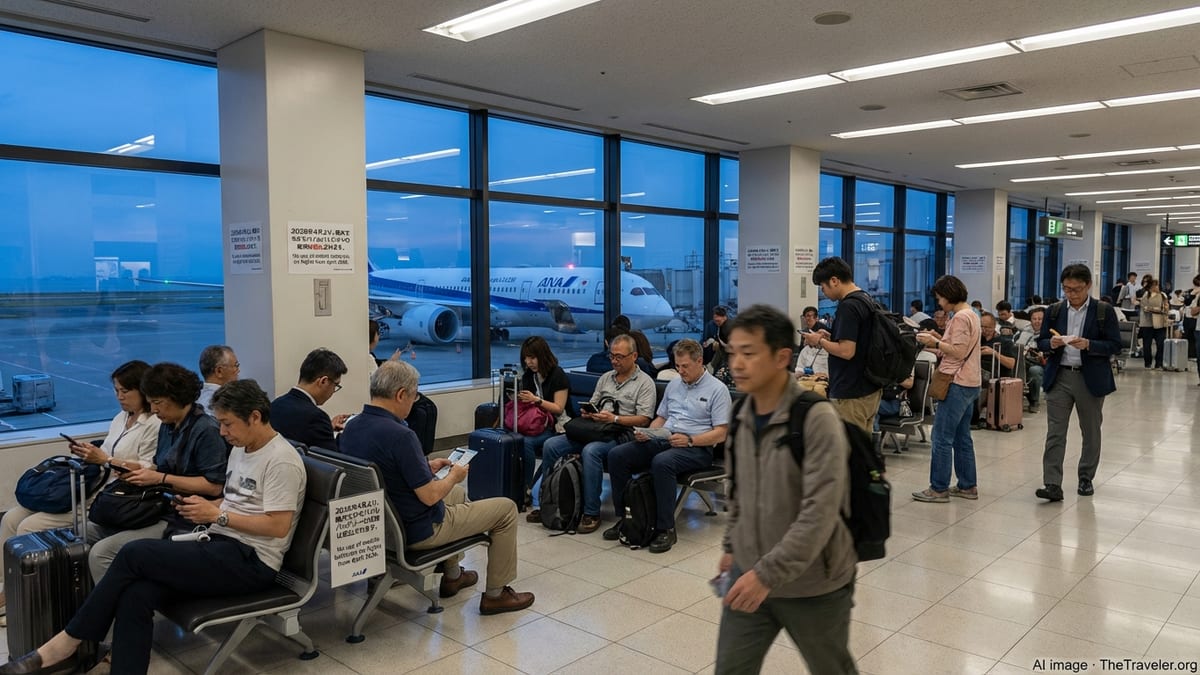
New Nationwide Ban Targets In-Flight Use, Not Carriage
Japan’s Ministry of Land, Infrastructure, Transport and Tourism has confirmed that from April 2026 passengers on any flight departing from or arriving in Japan will no longer be allowed to use mobile power banks during the journey. The ban covers using a power bank to charge phones, tablets or other devices, as well as charging the battery pack itself from in-seat outlets.
Crucially, the rules do not amount to a complete prohibition on carrying power banks. Travelers will still be permitted to bring them into the cabin within strict quantity and capacity limits. Regulators have emphasized that the focus is on eliminating inflight charging scenarios that have repeatedly triggered smoke and small fires in recent years.
The measure effectively standardizes what had been a patchwork of airline-specific practices into a single nationwide standard that applies across all carriers operating to, from and within Japan. Officials say the move aligns the country with the most conservative interpretations of international lithium battery safety guidance.
Japan’s decision comes amid a broader tightening of rules in Asia and Europe. Individual airlines in South Korea, Germany and elsewhere have already blocked the use of power banks in the cabin, but Japan is among the first countries to implement a universal ban across its entire commercial aviation network.
Capacity Limits and Quantity Rules for Travelers
While passengers will no longer be able to plug in a portable charger inflight, they will still be allowed to carry up to two compliant power banks per person in their hand luggage under the new regime. Each unit must be rated at 160 watt-hours or less, consistent with longstanding international limits on lithium-ion batteries in air transport.
Batteries above 160 watt-hours will remain prohibited entirely, both in checked baggage and in the cabin, a restriction already in force under existing Japanese rules. Devices between 100 and 160 watt-hours will continue to be subject to stricter oversight, typically limited to two units per passenger and often requiring airline approval at check-in.
Power banks must not be placed in checked luggage under any circumstances. That rule predates the 2026 update and reflects concern that fires in the cargo hold are harder to detect and suppress. Instead, all external batteries must travel in the cabin, where cabin crew and passengers can see and respond quickly to any signs of overheating.
Officials also stress that labeling and condition will matter. Power banks are expected to display clear factory-printed capacity markings in watt-hours or milliamp-hours, and damaged, swollen or unbranded units are more likely to be refused at security or at the gate. Passengers may be asked to remove power banks from their bags for separate screening, similar to laptop checks.
From “Keep It in Sight” to “Do Not Use at All”
Japan’s 2026 decision builds on a series of progressively tighter measures introduced over the last two years. In July 2025, authorities required passengers to keep power banks within sight throughout a flight, banning storage in overhead lockers and reinforcing existing rules that already kept the devices out of checked baggage.
That earlier step was intended to ensure that any early signs of thermal runaway, such as swelling or smoke, would be visible to the owner and nearby crew, allowing for swift action with fire-containment equipment carried on board. Under that policy, passengers could still charge devices, provided the battery remained in a seat pocket or on their lap and was never left unattended.
However, a string of high-profile incidents involving lithium batteries in aircraft cabins and other public transport systems prompted regulators to go further. In several cases overseas, flights were diverted or delayed after power banks ignited in overhead bins or under seats, filling cabins with smoke and triggering emergency responses.
The new 2026 regulations effectively close the gap between “visible but allowed” and “not to be used,” removing ambiguity for both crew and passengers. Once on board a flight linked to Japan, power banks must now remain switched off, disconnected and stowed in a way that keeps them accessible but not in active use.
Safety Concerns Behind the Crackdown
At the heart of the policy shift is concern over the inherent volatility of lithium-ion cells when subjected to impact, manufacturing defects or improper charging conditions. Thermal runaway, where a cell overheats and triggers adjacent cells in quick succession, can result in intense localized fires and dense smoke in a confined aircraft cabin.
Japan’s product safety authorities have tracked a rise in battery-related accidents in recent years, including several dozen incidents linked to mobile batteries and power banks. Many involved overheating while charging smartphones or other personal devices, particularly when the batteries were used intensively or left wedged in soft furnishings that impeded ventilation.
Regulators argue that even if most events remain small and quickly contained, the consequences of a serious inflight fire are severe enough to justify precautionary rules. By removing in-flight charging from the equation, they aim to reduce the chances that a defective or poorly made power bank will fail at 10,000 meters, where evacuation is impossible and smoke can rapidly fill a pressurized cabin.
Officials also point to the proliferation of low-cost, counterfeit or non-certified power banks sold online and in tourist districts. These devices may lack robust safety circuits, reliable cell balancing or quality control, raising the risk of short circuits and internal failures when connected for long periods. The blanket in-flight use ban sidesteps the challenge of distinguishing safe from unsafe models at the checkpoint.
Impact on Airlines, Airports and Cabin Procedures
For Japanese and foreign carriers alike, the new regulations will trigger changes in pre-flight announcements, cabin crew training and onboard procedures. Airlines are expected to update safety videos and briefing cards to include specific references to power banks, ensuring that passengers understand they may carry but not use the devices.
Cabin crew will be trained to spot and stop in-flight charging early in the boarding and taxi phases, much as they already do with loose seatbelts or improperly stowed baggage. The rules will also clarify how staff should respond if a device is seen connected to a cable; in most cases, they will ask passengers to disconnect and store it under the seat while keeping it in sight.
On the ground, airport security checkpoints in Japan are likely to adjust their screening procedures to highlight the updated rules, possibly adding signage in multiple languages near baggage inspection lanes. Carriers may also send email reminders and app notifications to passengers before departure, particularly on long-haul routes where reliance on portable chargers is greatest.
Aviation analysts note that Japanese airlines have already invested in specialized fire-containment bags and training to handle lithium-battery incidents. Those tools will remain essential, as smartphones, laptops and other built-in batteries are still permitted on board. However, officials hope that taking power banks out of active use will reduce the overall number of high-risk charging situations that crew must manage.
What International Travelers Need to Know in 2026
For visitors planning trips to Japan in 2026, the headline advice is simple: arrive at the airport with devices fully charged and do not expect to top up from a power bank once on board. This applies whether they are flying on a Japanese carrier or a foreign airline, as long as the flight either departs from or lands in Japan.
Passengers can still pack power banks in their cabin bags, provided they stay within the permitted watt-hour and quantity limits and keep the devices in good condition. Travelers who rely on mobile boarding passes, translation apps or transit tickets are encouraged to save offline copies or print documents in advance in case their battery runs low en route.
Transit passengers who merely connect through a Japanese airport without passing through immigration will also be subject to the inflight restrictions, since the rules apply to aircraft operations rather than immigration status. That means a traveler flying from North America to Southeast Asia via Tokyo must follow the no-use rule on the Japan-bound segment and on any onward flight departing from Japan.
Frequent flyers may want to invest in alternative strategies, including using in-seat USB ports and AC outlets where available to power devices directly, or planning work and entertainment offline to conserve battery. Travel agents and booking platforms are beginning to flag the new rules in their Japan-related itineraries, and industry observers expect airlines elsewhere to watch closely as the policy rolls out.
Global Trend Toward Stricter Battery Rules
Japan’s 2026 move aligns with a global trend among regulators and carriers who are tightening rules around portable batteries. In recent months, several Asian and European airlines have announced their own bans on the use of power banks during flights, even while still allowing them to be carried in the cabin for use after landing.
These steps build on longstanding International Civil Aviation Organization guidance that already restricts where and how lithium batteries can be transported, particularly in bulk. National aviation authorities are now going further, translating technical advisories into clear-cut passenger rules that can be enforced consistently across fleets.
In practical terms, that means travelers can expect a more restrictive environment for personal batteries worldwide, with Japan’s comprehensive approach serving as a reference point. While some regions may continue to permit supervised power bank use on board, others are likely to follow Japan in treating any inflight charging as an unnecessary risk rather than a convenience.
For the travel industry, the challenge will be balancing safety with passenger expectations in an era when smartphones and laptops are central to navigation, entertainment and border formalities. For regulators, Japan’s new rules are a bet that firm, uniform restrictions today will prevent more serious incidents tomorrow, keeping confidence in air travel strong even as the number of electronic devices per passenger continues to climb.