

More news on this day
Japan is moving toward a major overhaul of its border procedures, preparing to introduce a mandatory digital pre-screening system for all visa-exempt foreign visitors from fiscal 2028, in a shift that will bring its entry rules in line with destinations such as the United States and European Union.
Get the latest news straight to your inbox!
From Optional Web Forms to Mandatory Pre-Authorization
Japan has spent the past several years digitizing its arrival procedures through platforms such as Visit Japan Web, which allow travelers to pre-register passport data, flight details and customs declarations to speed up processing. These tools started as convenience features and were not universally required, with paper forms still available at airports.
According to published coverage in domestic Japanese media and recent policy summaries, the government now plans to move beyond these optional systems and require advance online clearance for short-term visitors from visa-waiver countries. The initiative is often described as Japan’s answer to the United States’ ESTA and the European Union’s upcoming ETIAS, both of which oblige travelers to secure electronic authorization before boarding a flight.
Reports indicate that Japan’s new platform, widely referred to as the Japan Electronic System for Travel Authorization, or JESTA, is being designed to screen travelers before they reach the country’s airports. Early outlines suggest that the program will be phased in during the latter half of the decade, with a target of full implementation by fiscal 2028.
Publicly available explanations of the reform emphasize that visa-exempt tourists will, in practice, lose the ability to arrive in Japan without prior digital clearance. Instead, airlines will be expected to confirm a valid online authorization in much the same way they currently verify visas or residence cards at check-in.
How the New Digital Pre-Screening Will Work
Information released through policy briefings and secondary analyses indicates that JESTA will operate as an online portal where travelers submit a short application prior to departure. Applicants will likely be asked to provide personal data such as full name, date of birth, passport number and nationality, alongside basic trip information including flight details, intended length of stay and accommodation in Japan.
In line with comparable systems overseas, travelers are expected to answer security and immigration-compliance questions, for example about prior overstays, criminal records or previous deportations. The collected data will then be checked against Japan’s immigration and security databases to identify individuals who may be ineligible for visa-free entry before they board a plane.
Media reports suggest that most applications will be processed automatically within a short time, with approvals delivered electronically and linked to the traveler’s passport. Once authorization is granted, it is expected to remain valid for multiple trips within a certain period, similar to the multi-year validity of the U.S. ESTA, although the exact duration and fee structure have not yet been finalized in public documentation.
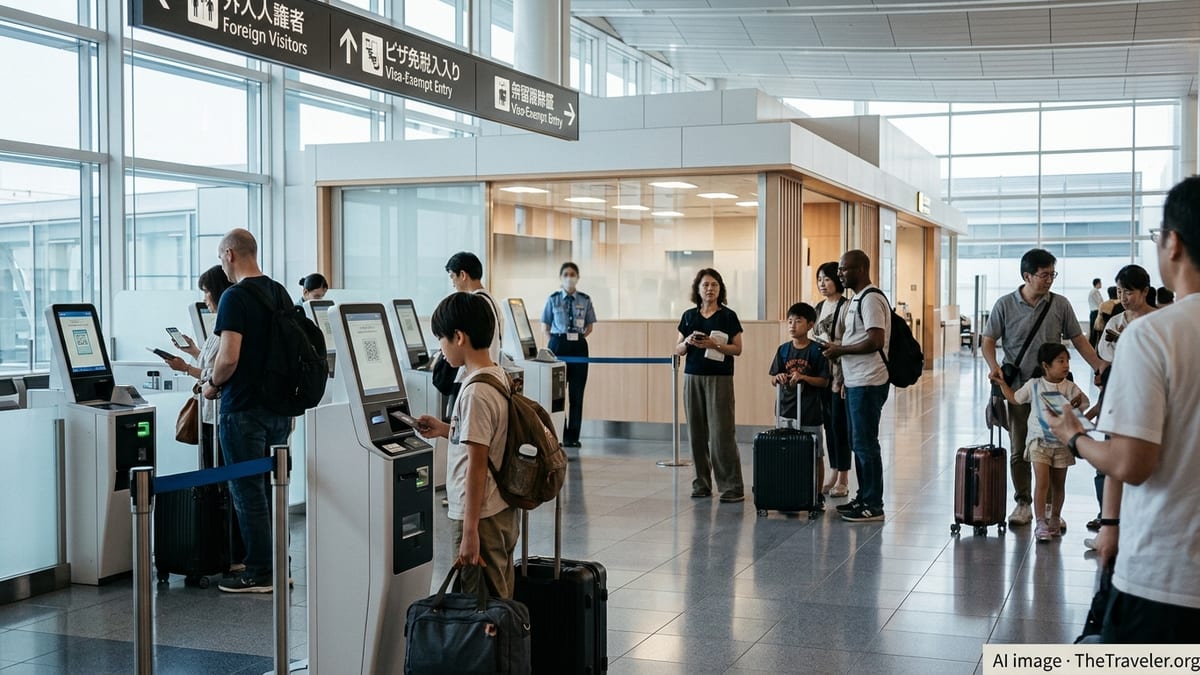
For travelers, the most visible change will be at the pre-departure stage. Airlines are likely to integrate a JESTA check into online check-in and airport counters, and travelers who fail to secure authorization beforehand may be denied boarding. At the border itself, Japan is expected to pair the new system with further expansion of automated gates and QR-based processing already trialed through Visit Japan Web.
Security, Overstay Control and Smoother Airport Flows
Japanese policy papers and independent commentary indicate that the push toward mandatory digital pre-screening is driven by a mix of security, migration control and operational concerns. By shifting key checks from the arrival hall to the pre-departure stage, authorities expect to reduce the risk of admitting travelers who may pose security concerns or who previously violated immigration rules.
Analysts note that advance vetting is also intended to support Japan’s goal of reducing the number of long-term overstayers. With foreign visitor arrivals reaching record highs in recent years and further growth expected in the run-up to major events and tourism campaigns, immigration planners are seeking tools that allow closer monitoring of who enters, on what conditions and for how long.
Equally significant is the pressure on airport infrastructure. Major hubs such as Tokyo’s Haneda and Narita, along with Kansai International Airport, have reported congestion at peak times as inbound travel has rebounded. Publicly available government materials and expert commentary suggest that a fully digital pipeline, from pre-travel authorization to automated gates at arrival, is seen as a way to keep queues manageable without dramatically expanding staff headcounts.
Some observers point out that Japan has already taken incremental steps in this direction through its use of biometric systems at immigration and the digitization of customs and health forms during the pandemic. The planned JESTA rollout would knit these disparate elements into a more comprehensive, data-driven border management framework.
What Visa-Exempt Travelers Need to Prepare For
For tourists from countries that currently enjoy visa-free entry to Japan, the shift to mandatory digital pre-screening will mark a clear change in trip planning habits. Instead of focusing solely on flights and hotels, travelers will also need to build in time to complete an online authorization, likely at least several days before departure.
Various explanatory articles and guidance notes suggest that travelers should expect to pay a modest processing fee, mirroring practices in the United States, Canada and Europe. While no official fee range has been universally confirmed in public English-language materials, prior commentary has pointed to benchmarks abroad where electronic travel authorizations cost the equivalent of several U.S. dollars per person.
Once JESTA becomes operational, travelers may also need to pay more attention to the validity of both their passports and their electronic authorization, since an expired document could disrupt boarding even if other aspects of the trip are in order. Families and group travelers are likely to face additional administrative steps, such as submitting separate applications for each traveler, including children.
Industry observers expect travel agencies, airlines and online booking platforms to embed JESTA reminders into their workflows as the launch date approaches. Tourists planning visits in or after 2028 are being advised, in early commentary, to monitor official Japanese government information channels to ensure they understand when the system becomes a firm requirement for boarding flights.
Balancing Frictionless Tourism With Data Protection Concerns
The expansion of digital border controls worldwide has prompted debates about privacy, data security and potential discrimination, and Japan’s move toward mandatory pre-screening is expected to generate similar scrutiny. Civil society groups and academics who follow border technology trends have already raised questions in commentary about how long personal data will be stored, how it might be shared between agencies, and what recourse travelers will have if their authorization is refused in error.
Observers note that systems like JESTA, by design, collect a rich set of data points on millions of visitors, from biographic information to travel histories. While this can assist law enforcement and immigration authorities in identifying patterns of abuse or security threats, it also raises the risk of data breaches or misuse if protections are insufficient.
Public discussions in Japan around digital government initiatives more broadly have highlighted the importance of transparent rules, clear explanations in multiple languages and accessible appeal procedures. Commentators suggest that the success of the new travel authorization system will depend not only on its technical reliability, but also on the degree to which travelers feel that their data is handled fairly and that the application process is predictable and user-friendly.
For now, the outline of Japan’s 2028 digital pre-screening regime points toward a future in which spontaneous, paperwork-free trips from visa-exempt countries become a thing of the past. As details are refined in the coming months and years, travelers and the tourism industry alike will be watching closely to see how Japan balances its ambition for high-tech border management with its longstanding appeal as a welcoming, easy-to-visit destination.