

More news on this day
Japan is preparing to debut a new chapter in its famed rail travel story with Gran Tenku, a four-car luxury sightseeing train that will whisk passengers from urban Osaka to the sacred peaks of Mount Koya on a 90-minute scenic journey starting in April 2026.
A New Flagship for Pilgrims and Scenic-Train Fans
Gran Tenku is the latest project from Nankai Electric Railway, the private rail operator that for decades has linked Osaka with Mount Koya, one of Japan’s most important Buddhist centers. Announced as a new-generation sightseeing service and now entering its final development phase, the train is scheduled to begin regular operations on April 24, 2026, on the Nankai Koya Line between Namba Station in Osaka and Gokurakubashi Station at the foot of Mount Koya.
The service is designed to turn what has long been a straightforward transfer into a high-end travel experience. The journey, which typically takes around 90 minutes from Nankai Namba to Gokurakubashi, will be reframed as an immersive approach to the World Heritage landscape of the Kii Mountain Range, with large windows, curated interiors and onboard hospitality aimed at both domestic travelers and international visitors.
Gran Tenku will replace Nankai’s existing Tenku sightseeing train, which has operated primarily between Hashimoto and Gokurakubashi since 2009. The new train extends the sightseeing experience all the way from central Osaka, eliminating the need for a mid-route transfer and aligning Nankai with a broader trend in Japan of premium, end-to-end rail journeys that double as moving lookout decks.
Capacity on Gran Tenku will be limited to about 70 passengers per departure, positioning the service at the premium end of the market. Nankai officials have indicated that ticket pricing will reflect the added-value experience, including dedicated car concepts, enhanced comfort and the option of onboard dining built around regional ingredients.
From Neon Osaka to Cedar Forests in 90 Minutes
The Gran Tenku route begins at Nankai Namba, a major terminal in the heart of Osaka’s entertainment and shopping district. From there the train will follow the Nankai Koya Line south, initially gliding past dense neighborhoods and elevated expressways before the city gradually gives way to low-rise suburbs, river valleys and wooded hills.
Timetabled at roughly 90 minutes between Namba and Gokurakubashi, the journey is plotted as a visual transition from the modern metropolis to the spiritual landscapes that have drawn pilgrims to Mount Koya for more than a millennium. As the train climbs into Wakayama Prefecture, the scenery tightens into mountain curves, tall cedar stands and deep ravines, with the line threading through a series of tunnels and bridges originally engineered to tackle demanding terrain.
Gokurakubashi serves as the mountain gateway and terminus for regular rail services on the Koya Line. Here, Gran Tenku passengers will transfer to the Nankai Cable Line, a short but steep funicular that ascends through forested slopes to Koyasan Station. From the cable-car terminus, local buses connect visitors directly to temple lodgings, historic precincts and key sacred sites on the plateau.
For visitors unfamiliar with Japan’s rail geography, the integrated route is likely to be marketed as a seamless corridor from Osaka’s city center to the heart of the Koyasan temple town, wrapped in a continuous scenic and cultural narrative rather than a purely functional commute.
Four Distinct Cars, One Luxury Sightseeing Concept
Gran Tenku has been conceived as a four-car train set, with each carriage offering a distinct interior concept and travel style. Early outlines from Nankai indicate that one car will prioritize deeply reclining seats and long-view perspectives, while another will be configured around large picture windows that transform the passing landscape into a near-continuous panorama.
A third car is expected to adopt a lounge-style layout, giving passengers space to relax, socialize or simply change vantage points during the 90-minute ride. The remaining car is being prepared with sofa-style seating that can support dining and tasting events, anchoring the train’s culinary program and hosting set-course meal services on selected departures.
Design details are still being finalized, but the overall focus is on spacious seating, warm materials and clear sightlines. Compared with conventional limited express services on the same line, Gran Tenku will sharply limit capacity to preserve a sense of quiet and exclusivity, with a seat count that ensures every passenger benefits from generous legroom and access to the windows.
Onboard attendants are planned to provide personalized service throughout the journey, from guidance on the views and landmarks outside to explanations of Mount Koya’s religious heritage and practical information on transfers, cable cars and buses once the train reaches Gokurakubashi.
Designing a Train to Bridge City Life and Sacred Space
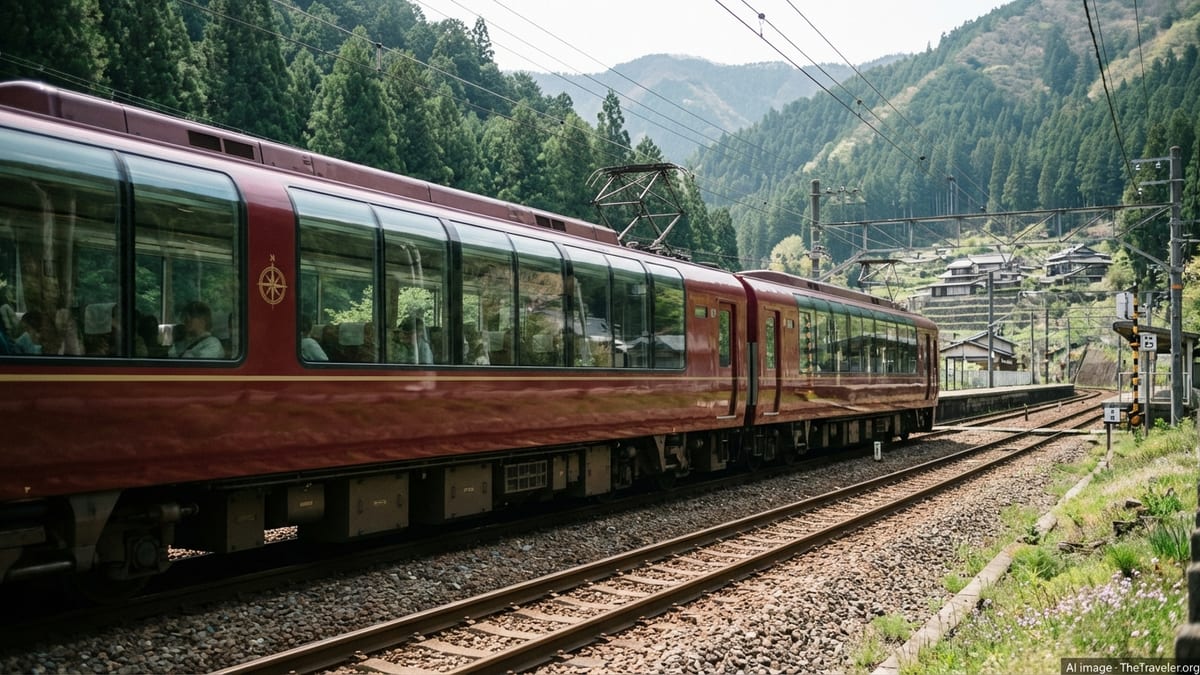
While full interior photography has yet to be released, Nankai has revealed the train’s deep red exterior livery along with an emblem inspired by a compass motif. The design, the railway says, is intended to symbolize both direction and time, expressing the idea that travel on Gran Tenku is not only about physical movement but also about tracing a journey between eras and states of mind.
The concept language used by the company emphasizes the contrast and continuity between the bustle of Osaka and the quiet, monastery-lined avenues of Koyasan. Marketing materials describe the corridor between Namba and the mountain as a tapestry of history, industry and craftsmanship, suggesting that the scenic ride will highlight not just remote forested slopes but also the lived-in landscapes and small communities that line the Koya Line.
Inside the train, the design brief leans on natural tones and textures that echo the wooded environment of Wakayama’s interior. Large windows are being treated as a central architectural element, with seating arranged to maximize the visual impact of the mountain curves rather than the conventional rows found in commuter rolling stock.
By framing Gran Tenku explicitly as a bridge between the everyday and the extraordinary, Nankai is aligning its new service with the increasingly popular idea of rail journeys as slow-travel experiences. The train is pitched not just as a way to reach Mount Koya more comfortably, but as a way to emotionally and visually prepare for arrival at one of Japan’s most hallowed religious landscapes.
Gateway to a UNESCO World Heritage Monastic Town
Mount Koya, or Koyasan, is part of the Sacred Sites and Pilgrimage Routes in the Kii Mountain Range, a UNESCO World Heritage inscription that encompasses ancient paths, shrines and temple complexes across Wakayama, Nara and Mie prefectures. Founded in the early ninth century by the monk Kukai, also known as Kobo Daishi, Koyasan developed into the headquarters of the Shingon Buddhist school and remains an active religious community today.
Visitors arriving via Gokurakubashi and the cable car find a mountaintop basin dotted with temple compounds, cedar-lined lanes and stone lanterns. Among the most significant sites are Okunoin, a vast cemetery and mausoleum approach believed to house the eternal meditation of Kukai, and Danjo Garan, a central temple complex with striking pagodas and halls that reflect centuries of architectural evolution.
For modern travelers, Koyasan is as much about immersion as sightseeing. Hundreds of temples offer shukubo temple lodgings, where guests can stay overnight, join morning services and sample shojin ryori, the refined, plant-based cuisine rooted in Buddhist traditions. Nankai’s new train is expected to cater to this style of slow, reflective travel by providing a calm, contemplative prelude to time spent in the temples and forests at the top of the mountain.
The focus on pilgrimage routes is also likely to resonate with walkers exploring sections of the historic Koyasan Choishi Michi, a stone-marker path that has guided pilgrims to Mount Koya for centuries. With Gran Tenku handling the mainline journey from Osaka, visitors will be able to devote more time and energy to these final approaches on foot or by local transport.
Culinary Partnerships and Local Flavors on Board
In keeping with the trend among Japanese luxury trains to spotlight regional gastronomy, Nankai has announced that Gran Tenku’s onboard dining program is being developed in collaboration with acclaimed chef supervision. Menus will focus on seasonal ingredients from the wider Kii region, integrating produce, seafood and traditional flavors into courses served in the dedicated dining car.
The railway has already confirmed its initial food menus for the launch phase of operations, signaling that meal service will be a core part of the product rather than an optional add-on. While detailed pricing and reservation structures for dining plans have not yet been fully disclosed, advance-booking systems are expected, particularly during peak seasons when both domestic and international demand for Mount Koya travel rises sharply.
Food and beverage offerings will be curated to align with the sense of journey and transition embedded in the train’s overall concept. That could mean lighter dishes and tea pairings on certain departures, or more elaborate meal sets on others, all calibrated to fit within the 90-minute travel window without feeling rushed.
By highlighting local producers and culinary traditions, Nankai is also positioning Gran Tenku as an economic conduit for the broader region. The train is likely to collaborate with artisans, farms and food businesses located along the Koya Line, adding another layer of regional storytelling to the onboard experience.
Part of Japan’s Growing Network of Luxury Scenic Trains
The launch of Gran Tenku comes as Japan’s rail operators continue to invest in premium sightseeing trains aimed at leisure travelers seeking experiences beyond the country’s famous shinkansen. In recent years, railways around the country have introduced or refreshed upscale services that pair distinctive rolling stock with curated routes, from coastal journeys to inland onsens and mountain resorts.
Unlike multi-day cruise trains, which often command very high fares and limited departures, Gran Tenku is anchored to a core pilgrimage and tourism corridor already served by regular limited express and express services. This positions it as a more accessible premium upgrade, particularly for international visitors staying in Osaka who wish to add a special-occasion rail experience to their trip without committing to an overnight rail itinerary.
Industry observers note that such trains serve several purposes at once. They tap into demand for photogenic journeys, help disperse visitor flows beyond headline cities and provide railway companies with new revenue streams in an era of changing commuter patterns. For operators like Nankai, a high-profile sightseeing flagship can also reinforce brand identity and draw attention to other services across their network.
Gran Tenku’s focus on Mount Koya, a site that blends cultural heritage, nature and spiritual tourism, gives it a distinctive place in this growing ecosystem. It combines the draw of a UNESCO-listed destination with the allure of a purpose-built luxury train, a pairing likely to feature prominently in future Kansai-region travel itineraries.
Timelines, Bookings and What Travelers Can Expect Next
Nankai Electric Railway has set April 24, 2026, as the official start date for Gran Tenku operations, timed to capture the spring travel season when cherry blossoms and fresh greenery attract large numbers of visitors across Japan. Ticket sales are expected to begin about one month in advance of launch, with the company encouraging early reservations, especially for departures aligned with weekends, holidays and peak blossom-viewing periods.
Exact fare levels, seat classes and frequency of departures have yet to be fully detailed, but Nankai has indicated that the train will run as a limited-capacity sightseeing service rather than a high-frequency commuter option. Prospective passengers can expect reserved seating for all travelers, with separate booking categories likely for standard sightseeing seats and dining plans in the lounge and sofa-style cars.
For overseas visitors planning 2026 itineraries, Gran Tenku will offer a straightforward way to integrate a signature rail experience into a broader Kansai stay. Travelers will be able to board in central Osaka, enjoy the curated 90-minute ride into the mountains, connect seamlessly to the cable car and buses, and then settle into temple lodgings or day-trip explorations on the plateau.
As launch approaches, further information on schedules, onboard amenities and language support is expected from Nankai and regional tourism bodies. What is already clear is that Gran Tenku is being positioned as more than a new train: it is a carefully designed prelude to one of Japan’s most atmospheric sacred landscapes, inviting passengers to slow down, look outward and arrive at Mount Koya in a different frame of mind.