

More news on this day
Japan’s premium long-haul market is entering a new chapter as Air France begins rolling out its next-generation La Première suites on Tokyo routes, bringing one of the world’s most exclusive first-class products to Japanese skies.
Get the latest news straight to your inbox!
A Landmark Moment for Japan’s Premium Aviation Market
Japan has long been a fiercely competitive arena for high-end international air travel, with flagship first and business class cabins from Japanese and foreign carriers vying for affluent travelers. The arrival of Air France’s latest La Première suites on services between Paris–Charles de Gaulle and Tokyo–Haneda is being viewed in industry coverage as a significant escalation in that contest, aligning Japan with the airline’s most prestigious long-haul destinations.
Publicly available information from Air France’s network updates indicates that the new suites are being progressively introduced on a small subfleet of Boeing 777-300ER aircraft, with Tokyo–Haneda joining New York and Los Angeles among the early routes to receive the upgraded first-class product. For Japan, this represents not only a new option for ultra-premium travel to Europe but also a signal that the Tokyo market remains central to global aviation strategies despite recent shifts in business travel demand.
Analysts note that the move comes as carriers increasingly concentrate their most luxurious cabins on routes with a strong blend of corporate contracts, high-net-worth leisure travelers, and connecting traffic to other premium-heavy markets. Tokyo, with its mix of finance, technology, luxury retail, and tourism, fits this profile, making it a natural stage for Air France’s most ambitious first-class concept to date.
For Japanese travelers accustomed to the refined first-class offerings of local airlines and select Middle Eastern and Asian carriers, La Première’s enhanced privacy and personalized environment add another layer of choice at the very top of the market, reinforcing Tokyo’s role as a showcase city for next-generation cabin design.
Inside the Suite: Space, Privacy, and Tailored Comfort
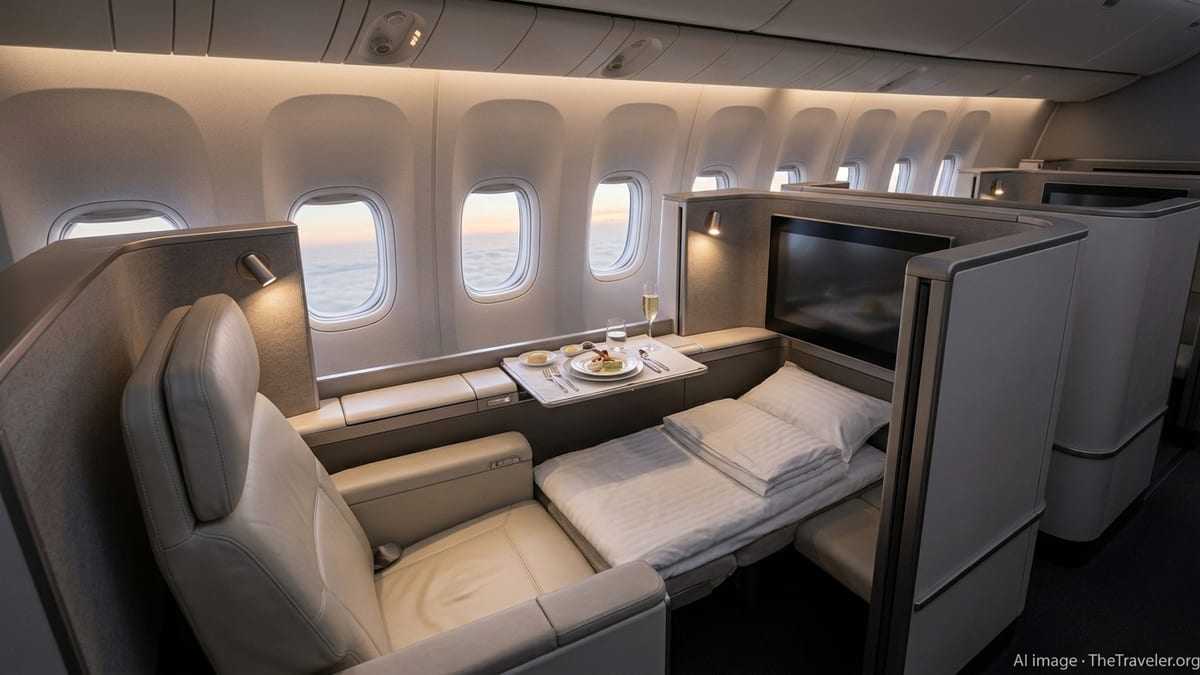
The new La Première suite is being described in airline and aviation trade coverage as one of the most spacious first-class products currently flying, with each suite occupying around 3.5 square meters of floor area. The design extends over five windows along the fuselage on window-side suites, creating an unusually generous sense of length and outward visibility for a commercial aircraft cabin.
The layout centers on three distinct living spaces within a single suite: an adjustable, forward-facing seat for takeoff, landing, and dining; a chaise longue that doubles as a relaxation area; and a full-length bed created when both elements are combined. Reports highlight that the bed can extend to around two meters, with a separate mattress topper, duvet, and high-quality linens intended to mirror the feel of a luxury hotel stay rather than a traditional aircraft seat.
Privacy has been elevated with high walls and sliding panels, allowing guests to create a near-fully enclosed environment when desired. The suite also incorporates individualized lighting zones, personal storage for handbags and small items, and integrated wardrobes for clothing. Materials such as full-grain leather, wool, and refined textiles, detailed on Air France’s Japanese-language La Première pages, emphasize tactile comfort and a subdued, residential aesthetic that contrasts with more overtly high-tech designs seen elsewhere in the industry.
Beyond physical comfort, the in-flight entertainment and connectivity package has been upgraded to match the spacious environment. Each suite features large 4K screens, with reports indicating dual 32-inch displays in some configurations, controlled by a personal tablet. Bluetooth connectivity, noise-reducing headsets, and high-speed connectivity options are designed to support both productivity and entertainment throughout the long transcontinental journey between Paris and Tokyo.
Paris–Tokyo as a Flagship Stage for French Hospitality
Industry observers view the deployment of La Première to Tokyo–Haneda as a strategic alignment of French hospitality with Japanese expectations of precision and discretion. Air France’s broader La Première journey, which begins at Paris–Charles de Gaulle with dedicated check-in spaces, private transfer options, and an exclusive lounge environment, is marketed as a seamless, end-to-end experience. When paired with Tokyo’s reputation for efficient, high-touch airport services, the route becomes a natural showcase for this holistic approach.
The airline’s investment in ground and in-flight enhancements has intensified in the run-up to and aftermath of major global events in Paris, with new check-in lobbies and private airport suites introduced to strengthen the first-class proposition. For Japanese travelers, particularly those connecting through Paris to other European capitals or onward to Africa and the Americas, the expanded La Première ecosystem offers a consistent standard of service across multiple journey stages.
Food and beverage have become another area where Air France is working to differentiate its first-class offering. Recent coverage has highlighted partnerships with Michelin-starred chefs and a curated cocktail program developed by a French mixologist exclusively for La Première. On Japan-bound flights, this emphasis on gastronomy resonates strongly with a market that places high value on culinary quality and presentation, and it positions the cabin as a mobile extension of contemporary French fine dining.
The Paris–Tokyo corridor also benefits from strong cultural and business ties, including fashion, luxury retail, and tourism flows in both directions. By assigning its most limited and high-cost cabin to this market, Air France is signaling confidence in sustained demand from Japanese and international travelers willing to pay a premium for heightened privacy, personalization, and comfort.
Competitive Ripples Across Japan’s Luxury Air Travel Landscape
The introduction of Air France’s new La Première suites into Japan’s long-haul mix is expected to add fresh competitive pressure to an already sophisticated premium cabin landscape. Japanese carriers have invested heavily in their own first and business class products in recent years, and several global airlines offer suites with doors, enhanced bedding, and restaurant-style dining on Japan routes. La Première now adds another benchmark for what ultra-luxury can look like at 30,000 feet.
Market watchers suggest that the move may encourage further refinement of existing products as airlines seek to differentiate on details such as seat dimensions, storage, bedding, and cabin ambience rather than purely on ticket price. For corporate travel managers and premium leisure travelers in Japan, this shift could translate into more choice and more targeted offerings, as carriers fine-tune cabins for specific origin-and-destination markets like Tokyo–Paris rather than applying a uniform global standard.
From a network planning perspective, deploying such a low-density, high-yield cabin is a calculated bet. La Première typically comprises only a handful of suites at the very front of the aircraft, meaning that each seat must justify its footprint with strong fares or ancillary revenue from upgrades. The decision to prioritize Tokyo suggests that Air France sees continued strength in Japan’s luxury outbound travel, as well as inbound demand from European and global travelers using Paris as a gateway to Japan.
For travelers, the impact will be felt most directly in the overall experience: more personal space, higher privacy, and a curated environment that aligns with the expectations of guests who are often used to five-star hotels and private car services on the ground. In a market as exacting as Japan’s, the success of La Première on Tokyo routes will be closely watched as an indicator of how far airlines can push the boundaries of comfort and exclusivity in commercial aviation.
Japan’s Skyward Future in Ultra-Luxury Travel
As global aviation continues to evolve after several years of disruption, the reemergence and expansion of top-tier first-class products underline a broader trend: airlines are doubling down on the very highest-yield segment of their customer base. Japan’s embrace of Air France’s new La Première suites sits squarely within this pattern, reflecting a belief that there is enduring demand for ultra-luxury, highly personalized air travel.
The presence of these suites in Japanese airspace also has symbolic significance. It reinforces the country’s status as a destination where international carriers feel compelled to present their most advanced products, and it complements domestic innovations in airport service, hospitality, and ground transportation that already cater to discerning travelers.
Looking ahead, observers expect competition at the top end of the market to intensify, particularly on routes linking Japan with Europe, North America, and key hubs in the Middle East and Asia. In that context, Air France’s decision to showcase La Première on Tokyo–Haneda flights can be seen as both a vote of confidence in Japan’s premium travel demand and an early marker in the next phase of global first-class evolution.
For passengers stepping aboard a La Première-equipped aircraft in Japan, the experience begins not with the aircraft door but with a carefully orchestrated journey spanning airport, cabin, and connection. In pairing that philosophy with the Tokyo market, Air France is helping define what the future of ultra-luxury commercial aviation will look like on one of the world’s most important long-haul corridors.