

More news on this day
Japan’s 2026 cherry blossom season is unfolding as one of the most closely watched travel phenomena in the world, with early blooms, record-breaking visitor momentum and new crowd-control measures combining to reshape how global travelers plan spring in Asia.
Get the latest news straight to your inbox!
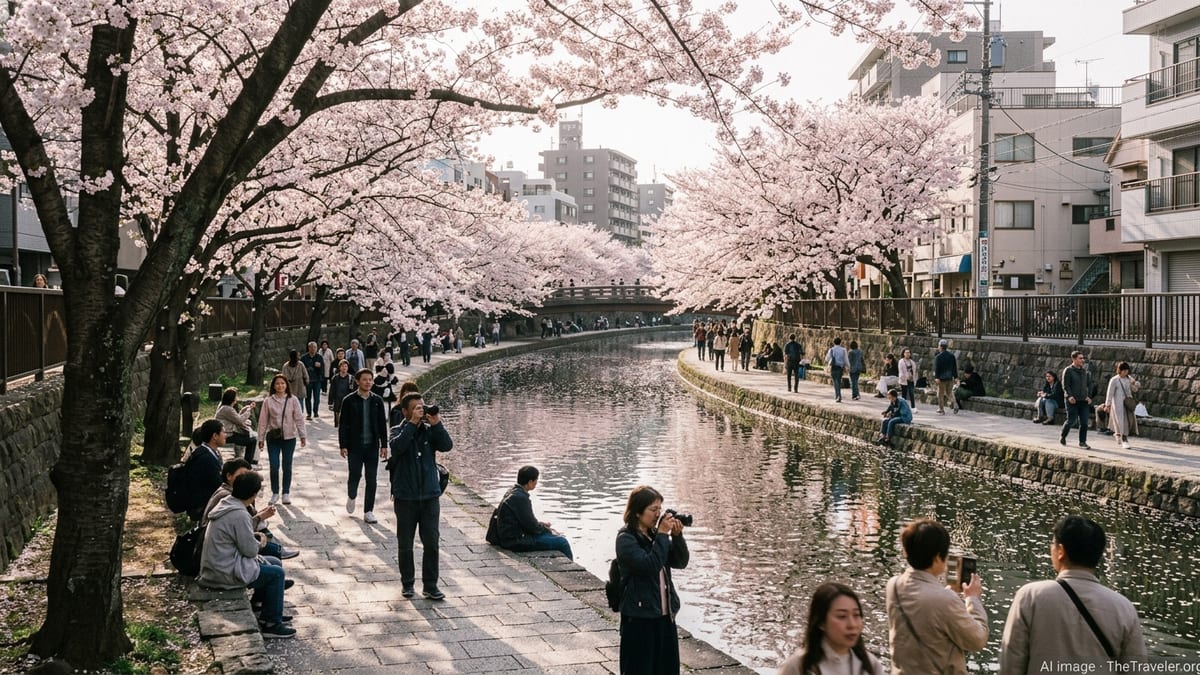
Early Blossoms Signal an Intensifying Sakura Season
The official start of Japan’s 2026 cherry blossom season in mid-March, marked by first flowering in cities such as Kochi, Gifu and Yamanashi, has reinforced expectations that this year’s sakura period will again arrive earlier than historical norms. Publicly available information from the Japan Meteorological Agency indicates that benchmark trees in these locations bloomed between six and nine days ahead of long-term averages, extending the practical window for hanami viewing but also lengthening the period of peak tourism pressure across major routes.
Cherry blossoms traditionally reach full bloom from late March into early April, aligning with Japan’s new school and business year. In recent years, a pattern of earlier flowering has encouraged travelers to front-load their visits into March, while tour operators have expanded itineraries that follow the “sakura front” northward from Tokyo and Kyoto to later-blooming regions such as Tohoku and Hokkaido. The result for 2026 is a more staggered yet more sustained season, drawing visitors over nearly six weeks instead of a compressed peak.
Communities around well-known viewing spots have reported rising concerns over littering, noise and congestion near parks and rivers, and local authorities have responded with a mix of signage, patrols and soft discouragement of problematic behaviors. These measures, combined with messaging from tourism boards encouraging weekday and early-morning visits, are shaping traveler expectations that sakura viewing now requires more planning and flexibility than before the pandemic.
Record Inbound Momentum Sets the Stage for 2026 Crowds
Japan enters the 2026 sakura season on the back of two consecutive record years for inbound travel. Data compiled by the Japan National Tourism Organization and summarized in multiple industry reports show that the country welcomed approximately 36.9 to 36.87 million foreign visitors in 2024, surpassing its pre-pandemic benchmark. In 2025, preliminary figures cited in tourism trade coverage indicate that arrivals climbed further to around 42.7 million, setting a new all-time high.
Monthly records through 2025 underscore how critical spring has become. Statistics released by JNTO and reported in business and travel media point to about 3.9 million foreign arrivals in April 2025 alone, the highest monthly total on record and a clear indication of cherry blossom season’s global drawing power. Additional coverage highlights more than 10 million foreign visitors in the first quarter of 2025 and around 21.5 million in the first half of the year, confirming robust demand even outside the very peak bloom window.
Analysts at travel research firms and major Japanese corporations project that total inbound visitors for 2025 reached or exceeded 40 million, with some forecasts prepared in early 2025 putting the figure just above that threshold. The sustained weakness of the yen has amplified Japan’s appeal as a high-value destination, and airline schedules into Tokyo, Osaka and regional gateways have continued to expand. Against this backdrop, 2026’s sakura season is widely expected to draw another wave of record-seeking travelers, particularly from North America, Europe and Southeast Asia.
Overtourism Hotspots Push Travelers to Look Beyond Tokyo and Kyoto
While Tokyo’s Ueno Park and Meguro River and Kyoto’s Philosopher’s Path remain iconic backdrops for blossom viewing, crowding at these sites has become a defining storyline in recent travel seasons. Online traveler reports from 2025 describe dense flows at immigration checkpoints in the Tokyo region’s main airports during April, with waiting times that can stretch well beyond pre-pandemic norms. On the ground, social media posts and travel forums depict shoulder-to-shoulder conditions at marquee spots during weekends and evenings.
At the same time, official tourism statistics suggest that international visitors are dispersing more widely across Japan. English-language summaries of JNTO and Japan Tourism Agency data for 2025 point to a double-digit percentage increase in foreign overnight stays in regional areas compared with the previous year, as well as a growing share of nights spent outside the country’s three largest metropolitan regions. Destinations such as Kanazawa, Matsumoto, Hiroshima, Fukuoka and Hokkaido’s urban centers have reported stronger spring demand, often tied to cherry blossom events in local castles, riversides and parks.
Regional festivals, including those in Aomori Prefecture’s Hirosaki Park and along northern rail corridors, have benefited from this diversification. Tour operators and rail companies have promoted “bloom-chasing” itineraries that move visitors from early-blooming cities to later phases of the sakura front, while local governments highlight less crowded riverbanks and historical districts. For 2026, this trend is expected to accelerate as repeat visitors actively seek quieter hanami settings and new travelers respond to messaging about spreading the tourism footprint.
Infrastructure Strain and Policy Experiments Around Sakura Hotspots
The scale of Japan’s inbound recovery has brought infrastructure and management challenges into sharp focus. Passenger growth at Tokyo’s Narita and Haneda airports, as well as at Kansai International, has tested immigration capacity at peak arrival banks, particularly on days when international flights, cruise ship calls and domestic holiday periods converge with optimal blossom timing. Local news coverage in 2025 documented instances of extended queues and congestion in airport arrival halls during April.
Urban transport and popular heritage districts also feel the seasonal strain. In Kyoto, long-standing concerns about visitor volumes in areas such as Gion and Arashiyama have resurfaced as 2024 and 2025 footfall data climbed back above pre-pandemic levels. Municipal strategies reported in domestic media include targeted signage discouraging disruptive behavior, voluntary route guidance to disperse crowds, and trials of timed entry and pedestrian-only streets on the busiest days of the sakura calendar.
Nationally, Japan’s tourism policy framework remains committed to a longer-term goal of 60 million annual international visitors by 2030, a target widely referenced in government and industry documents. Cherry blossom season is treated as both an opportunity and a stress test for this ambition. Debates in policy circles and local assemblies, as reflected in public reports, increasingly focus on how to manage short-term rental growth, protect residential neighborhoods and maintain the quality of visitor experience while supporting regional economies that now depend heavily on spring tourism revenue.
How 2026 Is Redefining Global Spring Travel Patterns
For travelers outside Japan, the country’s cherry blossom boom is reshaping how spring holidays are planned. Airline booking and travel agency reports referenced in international media show that flights into Japan during late March and early April often reach high load factors months in advance, prompting visitors to shift travel earlier into March or later into April and May. Some long-haul markets, including North America and Europe, now see sakura-related bookings extend into shoulder periods as visitors accept less-than-peak bloom in exchange for more manageable crowds and lower prices.
Japan’s positioning as a spring anchor for Asia-Pacific travel is also influencing neighboring destinations. Tourism boards in South Korea, Taiwan and parts of China with their own cherry blossom festivals are promoting alternative or complementary itineraries, while long-haul travelers increasingly combine Japan with side trips to other regional cities. Industry commentary suggests that global tour operators now treat sakura season as a distinct planning cycle, comparable in strategic importance to Europe’s summer or year-end festive periods.
As the 2026 season progresses northward through April and into early May, the interplay between early blooms, surging demand and evolving management strategies will continue to define Japan’s spring narrative. For international travelers, the country’s cherry blossom boom is no longer a niche or once-in-a-lifetime event but a central fixture in the global calendar, driving new patterns in how and when the world moves each spring.