

On a quiet stretch of test track west of Tokyo, Japan’s superconducting maglev has already pushed rail technology into uncharted territory, touching an astonishing 603 kilometers per hour and setting the stage for a new era of ultra-fast travel that could leave Europe’s flagship high-speed networks struggling to keep pace.
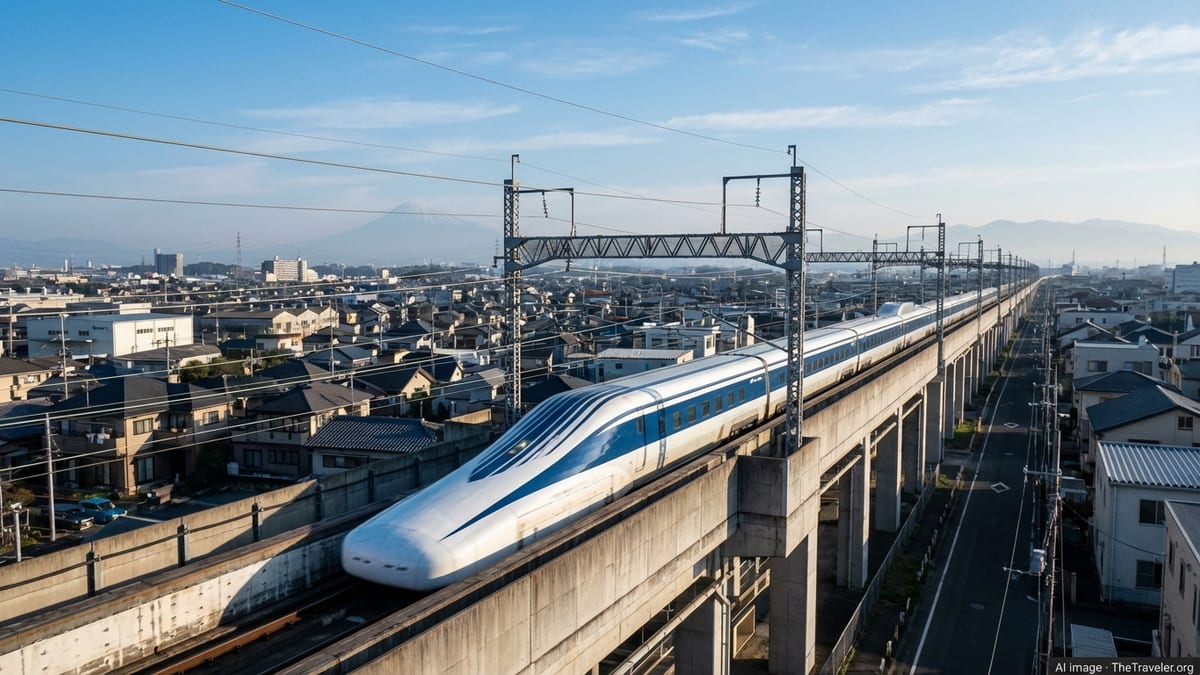
A Record-Breaking Train That Floats on Air
The train at the heart of Japan’s next rail revolution is the L0 series superconducting maglev, developed by Central Japan Railway Company, better known as JR Central. In April 2015, during trials on the Yamanashi test line in Yamanashi Prefecture, the sleek white-and-blue prototype set a world speed record of 603 kilometers per hour, a benchmark that still stands as the fastest speed ever reached by any rail vehicle in manned operation.
Unlike conventional trains, including today’s high-speed flagships, the L0 series does not rely on steel wheels riding on steel rails. Instead, it uses powerful superconducting magnets embedded in both train and guideway. At speed, these magnetic forces lift the train a few centimeters above the concrete track and propel it forward, effectively eliminating mechanical contact and drastically cutting friction.
That approach has long promised higher speeds and smoother rides, but until recently maglev systems remained either experimental or confined to short airport links. Japan’s project is different in scope and ambition. By marrying decades of laboratory research with full-scale intercity infrastructure, JR Central aims to create the world’s first long-distance maglev trunk line, capable of connecting the country’s three biggest metropolitan regions in times that would have been unthinkable even in the early Shinkansen era.
For travelers, the headline numbers are startling. The 286 kilometer stretch between Tokyo and Nagoya, which currently takes around 90 minutes on the fastest Tokaido Shinkansen services, is projected to shrink to about 40 minutes once the maglev opens. The full run from Tokyo to Osaka, now roughly two and a half hours by bullet train, is slated to drop to just over an hour.
Chuo Shinkansen: A Subterranean Super Corridor
The maglev line that will host these record-breaking trains is officially known as the Chuo Shinkansen. Rather than simply follow the existing coastal Tokaido corridor, JR Central is carving a new inland route through central Honshu, threading beneath the Japanese Alps in an alignment chosen to be as straight as possible to support ultra-high speeds.
From Tokyo’s Shinagawa Station, the line will dive underground almost immediately, spending the vast majority of its journey in long tunnels before surfacing again on approach to Nagoya and, later, Osaka. According to project documents, roughly 86 percent of the initial Tokyo to Nagoya section will run in tunnels, with some stretches burrowing 40 meters below densely built city districts and mountain terrain.
That tunneling intensity, combined with strict seismic standards and the complexity of maglev infrastructure, helps explain the project’s ballooning cost. What began in 2007 as a multitrillion yen vision has since grown into one of the most expensive transport projects on the planet, with JR Central now estimating around 11 trillion yen for the Shinagawa to Nagoya phase alone. The company insists that the long-term economic benefits and anticipated passenger demand will justify the outlay, but the financial stakes are considerable.
Even so, the logic behind the route is clear. By creating a second, largely independent spine between Tokyo and Osaka, the Chuo Shinkansen is designed not only to slash travel times, but also to provide critical redundancy to the saturated Tokaido corridor, which today carries a huge share of Japan’s passenger and freight traffic along the Pacific Belt.
Timelines, Delays and Political Headwinds
When JR Central first laid out its plans in the late 2000s, the company targeted a 2027 opening for the Tokyo to Nagoya section, with the extension to Osaka following by 2045. For years, that schedule framed public expectations and underpinned financial modeling. More recently, however, a combination of environmental concerns, local opposition and engineering challenges has pushed that timetable back.
The most visible flashpoint has been in Shizuoka Prefecture, where plans to tunnel beneath the Oi River basin triggered fears over possible impacts on water resources. The prefectural governor’s refusal to grant key approvals stalled work on a critical segment of the line, forcing JR Central to acknowledge that the 2027 target could no longer be met. Company officials now speak of an opening in the mid-2030s for the Tokyo to Nagoya section, with Osaka still many years beyond that milestone.
Those delays have coincided with sharp increases in material and labor costs, as well as the need for additional engineering measures to deal with difficult geology along the route. JR Central has repeatedly revised its construction cost estimates upward, most recently signaling that the total bill for the initial segment will be roughly double the original projection. While the railway maintains that it can finance the line through a mix of operating cash flow, debt issuance and government-backed loans, questions about profitability and long-term risk have grown louder.
Despite the setbacks, political and business leaders in Tokyo, Nagoya and Osaka remain largely united in their support. They argue that once operational, the maglev corridor will bind the three megaregions into a single super economic zone, making it easier for companies to recruit talent, for conferences and events to rotate between cities, and for domestic tourism to flourish across central Japan.
What 603 km/h Means in an Age of 300 km/h Trains
For decades, Europe has set the tone in high-speed rail, with France’s TGV and Germany’s ICE shaping worldwide expectations of what fast, reliable trains can do. Record attempts such as the TGV’s 574.8 kilometer per hour dash in 2007 demonstrated the potential of steel-wheel technology, even if regular services run at lower speeds for safety and maintenance reasons.
In day-to-day operations, Europe’s premier lines typically top out between 300 and 320 kilometers per hour. France’s TGV, Germany’s ICE 3, Spain’s AVE, Italy’s Frecciarossa and cross-border services like Eurostar all sit in this band. They have dramatically shrunk travel times across the continent, but their performance envelope remains bounded by the physical limits of wheels on rails, signaling systems and track geometry originally developed for lower speeds.
Japan’s SCMaglev, by contrast, is engineered around a 500 kilometer per hour design operating speed on the Chuo Shinkansen, with headroom proven up to 603 kilometers per hour in controlled testing. Even if JR Central chooses to run commercial services below their theoretical maximum for comfort and efficiency, the gap with European systems will be huge. A train cruising at around 500 kilometers per hour can cover in one hour what European high-speed services typically manage in closer to two.
That disparity will be felt most clearly on routes such as Tokyo to Nagoya and Tokyo to Osaka, where the maglev will effectively compress distances to the scale of regional commutes. Business travelers who currently plan day trips around multi-hour bullet train journeys or short domestic flights could find themselves moving between Japan’s largest economic centers in the time it takes to cross a single European country by train.
Tokyo, Osaka and Nagoya Prepare for a New Travel Reality
In Tokyo, planners have long envisioned Shinagawa as a major future gateway for both conventional and next-generation rail. The district is already a hub for the Tokaido Shinkansen, multiple JR lines and private railways. The arrival of the maglev would deepen its role as one of the country’s principal interchange points, concentrating flows of domestic and, potentially, international travelers into a relatively compact area south of central Tokyo.
Nagoya, Japan’s manufacturing heartland and home to automotive giant Toyota, stands to benefit from a dramatic shift in its geographic perception. With the maglev in service, central Nagoya would be less than 40 minutes from Tokyo’s Shinagawa and still within a short hop of Osaka once the western extension opens. That tri-city proximity could strengthen Nagoya’s appeal as a headquarters location and spur investment in offices, hotels and convention facilities aimed at a more mobile corporate clientele.
Osaka, historically the commercial rival to Tokyo and the anchor of the Kansai region, is looking to the Chuo Shinkansen as a catalyst for its broader urban renaissance. Paired with existing Shinkansen links and a raft of redevelopment projects around Osaka and Shin-Osaka stations, maglev service would reinforce the city’s ambitions as a global tourism and business hub, especially as it prepares to host major international events in the coming decade.
For travelers, the practical impact would be profound. A resident of central Osaka could feasibly attend a morning meeting in downtown Tokyo, drop by a factory or research center in greater Nagoya in the afternoon, and be back home by early evening without resorting to air travel. In tourism terms, itineraries that once demanded multiple nights and careful planning could be compressed into single-day excursions spanning some of Japan’s richest cultural and culinary destinations.
Engineering a Smooth Ride at Extreme Speed
Achieving 603 kilometers per hour with human passengers on board is not just about raw power. It also requires an extraordinary level of precision in aerodynamics, vibration control and safety systems. At such velocities, even small oscillations can cause discomfort, and pressure changes when entering tunnels or passing other trains must be carefully managed to protect ears and maintain cabin comfort.
Japan’s SCMaglev design addresses these challenges through a combination of streamlined nose profiles, rigid lightweight car bodies and sophisticated active suspension systems. The absence of mechanical contact between train and track reduces noise and wear, while onboard systems constantly monitor alignment and running conditions. Extensive testing on the Yamanashi line has allowed engineers to fine-tune everything from seating layouts to window sizes to create an interior environment that feels surprisingly normal at speeds more commonly associated with short-haul jets.
Safety is an equally critical pillar. The guideway is fully segregated, eliminating level crossings and sharply reducing the risk of intrusion by vehicles or pedestrians. Redundant braking systems, automatic train control and stringent earthquake detection protocols are built into the infrastructure. Japan’s experience operating the Shinkansen network, which has maintained an exceptional safety record for decades, underpins the design philosophy behind the maglev, even as it moves into a new technological regime.
Energy use is another area of focus. Maglev systems demand significant power to generate their magnetic fields, especially during acceleration. However, the frictionless ride at speed can deliver competitive or even favorable energy consumption per passenger kilometer, particularly on heavily used intercity corridors where high load factors are expected. JR Central argues that in a world seeking lower-carbon alternatives to short-haul air travel, a well-utilized maglev line could make environmental as well as economic sense.
Can Europe Catch Up or Take a Different Path?
The prospect of regular 500 kilometer per hour services in Japan inevitably raises questions for Europe, which has long celebrated its own high-speed prowess. For now, there is little sign that major European operators plan to leap directly into maglev. Projects such as the long-discussed Transrapid line in Germany have stalled, and current investment across the continent is largely focused on extending and upgrading proven steel-wheel networks.
There are practical reasons for that caution. Europe’s high-speed web is deeply intertwined with older conventional lines, allowing trains to run seamlessly from dedicated fast tracks onto legacy routes that fan out toward secondary cities. Maglev, by contrast, requires entirely new infrastructure, separate from existing railways, making it better suited to dense point-to-point corridors than to the more distributed pattern of European travel.
Instead of chasing raw speed records, European policymakers are increasingly emphasizing network reach, frequency and reliability. Cross-border projects aim to cut journey times between key cities into the three to five hour band seen as competitive with aviation, even at maximum speeds of 300 to 320 kilometers per hour. For many travelers, especially within compact regions such as Benelux or northern Italy, what matters most is the ability to board a fast train from a nearby city, rather than shaving an extra half hour off an already short trip.
Yet as Japan edges closer to commercial maglev service, the contrast will be hard to ignore. Tokyo to Osaka in just over 60 minutes would outpace almost any comparable city pair in Europe by a wide margin. Over time, that performance gap could prompt fresh debates in European capitals over whether incremental improvements are enough, or whether it is time to revisit more radical technologies for the busiest transnational corridors.
A Glimpse of the Future for Global Rail Travel
The story of Japan’s 603 kilometer per hour maglev is ultimately about more than national prestige or engineering bravado. It signals a possible new chapter for how people move between major cities in an era of climate concern and shifting work patterns. If the Chuo Shinkansen fulfills its promise, it will demonstrate that rail can compete not just with highways and conventional high-speed trains, but directly with short-haul aviation on speed, comfort and reliability.
That prospect is already attracting the attention of planners and policymakers well beyond Japan. Countries with dense intercity corridors, such as South Korea and China, are watching closely, weighing whether next-generation maglev might complement their own extensive high-speed rail fleets. In North America, where true high-speed rail remains rare, Japan’s achievement offers a tangible reference point for what could be possible on routes like Los Angeles to San Francisco or Toronto to Montreal, should political will and funding align.
For now, though, the focus remains squarely on central Japan, where tunnel boring machines, viaduct builders and systems engineers are slowly turning a decades-long vision into reality beneath mountains and city streets. Tokyo, Nagoya and Osaka are counting the years until the day travelers step aboard a commercial maglev for the first time and watch the countryside blur past at speeds that once belonged only to aircraft.
When that moment comes, the race that began with a record-setting 603 kilometer per hour test run on an experimental track will have reached a new phase. The benchmark for what constitutes high-speed rail will be rewritten, and the world’s other great rail powers, from Paris and Berlin to Beijing and beyond, will be forced to decide how far and how fast they are prepared to go in response.