

More news on this day
Japan’s major airlines are emerging as unexpected champions of comfort in the back of the plane, joining Singapore Airlines, Emirates, Delta, Qantas, and other leading global carriers in rolling out unusually spacious economy seats that challenge the long-term trend toward tighter cabins.
Get the latest news straight to your inbox!
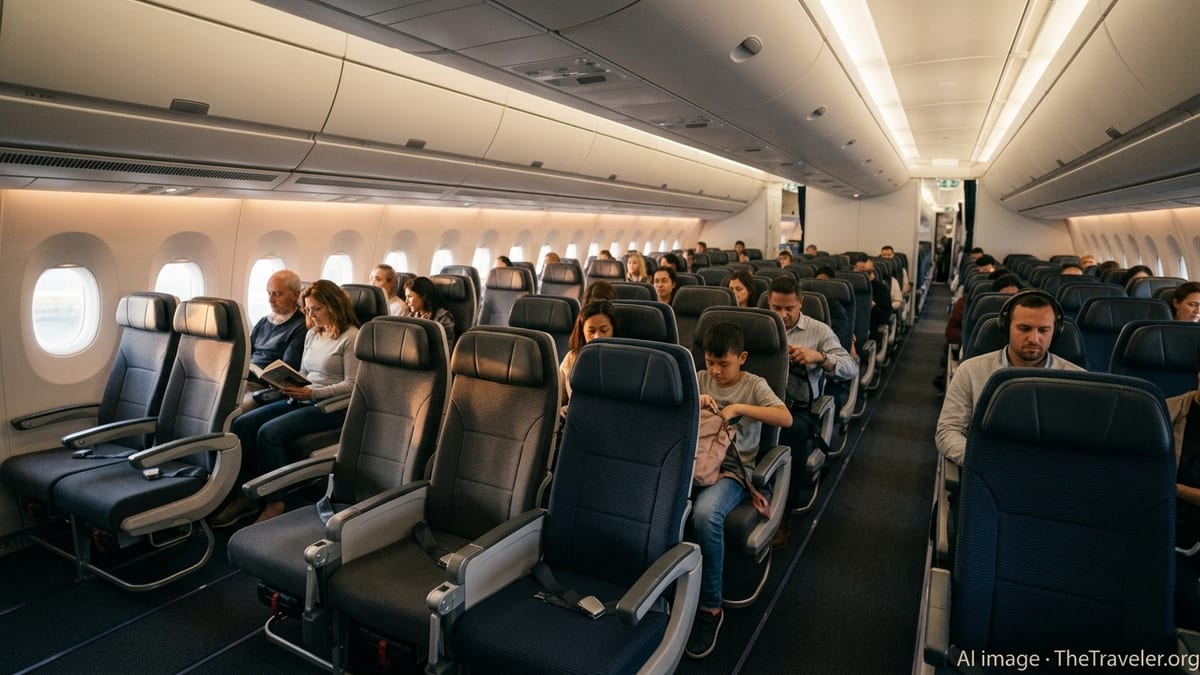
Japan’s Flag Carriers Turn Economy Into a Space Race
Publicly available cabin data indicates that Japan Airlines and All Nippon Airways now sit at the top of global rankings for legroom in standard economy, typically offering around 34 inches of seat pitch on key long-haul aircraft. That figure stands notably above the industry average of about 30 to 31 inches, which has gradually declined over recent decades as airlines have added more seats per cabin.
Japan Airlines has pursued a deliberate strategy of prioritizing space over density in economy, using its JAL Sky Wider concept on widebody aircraft such as the Boeing 787 and Airbus A350. These cabins are configured in a roomier 2-4-2 layout on the 787 instead of the denser 3-3-3 arrangement adopted by many competitors, with design tweaks that add several centimeters of extra knee room and seat width compared with typical layouts.
All Nippon Airways has followed a similar path, maintaining generous legroom on long-haul routes and introducing updated Recaro economy seats on aircraft like the Boeing 787-9. Recent fleet updates reportedly add about an inch of effective knee space and increased recline, keeping ANA in line with Japan Airlines and Emirates at the top end of economy-class legroom tables compiled by industry analysts.
These moves position Japan’s full-service carriers as standard-setters in what has become a new phase of competition: not just who can offer the biggest business-class suites, but which airlines are prepared to give back a few precious inches to economy passengers.
Singapore, Emirates, Qantas and Delta Push Premium-Like Comfort
Japan’s approach is part of a wider shift among leading global airlines. Singapore Airlines continues to be cited in independent reviews for offering above-average space in its long-haul cabins, with economy seats on aircraft like the Airbus A350 typically providing around 32 inches of pitch and seat widths that can reach or exceed 18 inches. The airline has long traded slightly lower seating density for a perception of quality and comfort across all classes.
Emirates has also aligned itself with the high-legroom cohort. Publicly available fleet information shows that the Dubai-based carrier offers around 34 inches of pitch in economy on many of its Boeing aircraft, matching the Japanese flag carriers and sitting well above the global norm. At the same time, Emirates is expanding its premium economy product, which pushes seat pitch toward the 38 to 40 inch range on refitted A380 and 777 aircraft, blurring the line between traditional economy and higher-fare cabins.
In the Pacific region, Qantas has adopted a layered cabin strategy that includes relatively generous economy configurations on long-haul jets alongside its own premium economy cabins. The Australian flag carrier’s latest long-range aircraft orders are tied to ultra-long-haul routes where passenger tolerance for cramped conditions is low, creating further pressure to maintain humane legroom and seat width, even at the back of the plane.
In North America, Delta Air Lines has been gradually refreshing its cabins with comfort-focused tweaks. Publicly available product descriptions highlight Delta Comfort Plus and newer sub-brands that add approximately 3 to 4 inches of extra legroom over standard main-cabin seats, typically moving from roughly 31–32 inches up to about 34 inches of pitch. While these seats are marketed as an upsell, the underlying trend mirrors that of the leading Asian and Middle Eastern carriers: more visible differentiation based on space.
Economy Legroom Becomes a Key Competitive Metric
Industry analysis from data-focused travel publications indicates that seat pitch has become a central benchmark in airline rankings, with economy-class legroom now tracked and compared in the same way that lie-flat beds and business-class suites once dominated attention. Recent visual and statistical breakdowns of seat pitch show Japan Airlines, All Nippon Airways and Emirates clustered at the top of the economy legroom charts, with several other Asian and Middle Eastern carriers not far behind.
These comparisons underscore how unusual a 34-inch pitch has become in standard economy. In many aviation markets, particularly in North America and Europe, 29 to 31 inches is common on short- and medium-haul routes, with some low-cost carriers going lower. Against that baseline, the extra three to five inches offered by the top-tier airlines can translate into noticeably more knee room, easier movement and reduced fatigue on flights that can stretch well beyond 10 hours.
Seat width and cabin layout also play a growing role in assessments of comfort. Configurations such as the 2-4-2 layout used by Japan Airlines on the Boeing 787, or nine-abreast seating on certain widebodies rather than the tighter 10-abreast standard, contribute to a perception of space even when raw pitch numbers are similar. For travelers comparing options on long routes across the Pacific or between Asia and Europe, these details increasingly factor into booking decisions.
As data on legroom becomes more widely available in consumer tools and media coverage, the airlines investing in more generous economy cabins gain a tangible marketing advantage. Their offerings stand out in charts and infographics, creating a visible contrast to competitors that have prioritized seat count over comfort.
Balancing Revenue Pressures with Passenger Expectations
The move toward more spacious economy seating comes despite intense commercial pressure on airlines to maximize revenue per flight. Each inch of pitch or additional centimeter of seat width often means giving up rows of seats, and therefore ticket revenue, on aircraft that can already cost hundreds of millions of dollars to purchase and operate.
Japanese carriers and their peers in Singapore, Dubai and Sydney appear to be betting that the trade-off will ultimately pay dividends through stronger brand loyalty, higher average fares and better performance on long-haul routes where passenger comfort is closely scrutinized. Reports from aviation analysts suggest that airlines with more generous economy cabins often score higher in independent passenger satisfaction surveys and premium traveler rankings.
There is also a health and wellbeing dimension to the debate. Airlines that maintain or increase seat pitch above 32 inches position themselves on the favorable side of emerging discussions about deep vein thrombosis risk, circulation and the physical strain associated with long-haul flights. While regulatory bodies have not mandated minimum seat dimensions, some medical research has highlighted the potential risks of prolonged confinement in tightly pitched seats.
For now, the strategy adopted by Japan Airlines, All Nippon Airways, Singapore Airlines, Emirates, Qantas and Delta reflects an effort to differentiate their brands from low-cost and ultra-dense competitors. By treating economy not as a purely commoditized product but as a tier with room for innovation, these carriers are redefining what passengers can reasonably expect in the most popular cabin on the aircraft.
What Travelers Can Expect on Board
For travelers booking with these airlines in 2026, the practical impact of these changes is most evident at the moment of sitting down. On Japan’s full-service carriers, the combination of 34-inch pitch, thoughtful seat sculpting and less-dense layouts yields noticeably more knee and elbow room than is typical on many transpacific competitors. On overnight flights in particular, this can mean more comfortable sleeping positions and less need to constantly adjust posture.
On Singapore Airlines and Emirates, long-haul economy cabins pair above-average legroom and width with modern cabin designs, personal screens and refined lighting systems intended to soften the impact of time zone changes. Qantas passengers on newer aircraft benefit from similar attention to ergonomics, especially on extended flights such as those linking Australia with North America and Europe.
Delta’s comfort-focused seats, while positioned as a paid upgrade or elite-status benefit, bring the legroom numbers closer to those of the leading Asian and Middle Eastern carriers, particularly on widebody aircraft used for transatlantic and transpacific routes. For travelers accustomed to tighter domestic layouts, the extra inches can feel substantial, especially on flights of six hours or more.
As more airlines highlight seat pitch and width in their marketing and as neutral comparison tools become more detailed, passengers are gaining clearer insight into the real estate they are buying. The willingness of Japan and several of the world’s top carriers to devote more space to economy suggests that the long-running squeeze on legroom may be facing new resistance from both travelers and the airlines most intent on keeping their premium reputations intact.