

More news on this day
Japan is preparing to unveil a new chapter in rail travel next spring, as Nankai Electric Railway readies the Gran Tenku, a luxury sightseeing train that will carry passengers from the heart of Osaka to the sacred slopes of Mount Koya starting April 24, 2026.
A New Era for the Journey to Mount Koya
The Gran Tenku service is set to operate between Namba Station in central Osaka and Gokurakubashi Station in Wakayama Prefecture, transforming what has long been a functional transfer route into a curated 90-minute experience. From Gokurakubashi, travelers will continue to the mountaintop via the Nankai Cable Line, a short but dramatic funicular ascent into the forests of Koyasan.
Operated by Nankai Electric Railway, the four-car Gran Tenku will replace the long-running Tenku sightseeing train that has linked Hashimoto and Gokurakubashi since 2009. The new service extends the premium experience all the way from Osaka’s main gateway station on the Koya Line, making it significantly easier for international and domestic visitors to step directly from the city’s dense urban core into a landscape shaped by more than a millennium of Buddhist practice.
Announced as part of a wider strategy to enhance tourism access to Mount Koya, the Gran Tenku aims to position the journey as a highlight in its own right, not just a prelude to temple stays and pilgrim trails. With ticket sales scheduled to open on March 24, 2026, demand is expected to be strong, particularly in the first months of operation when spring foliage and comfortable temperatures draw visitors into the mountains.
Design That Marries Luxury and Spiritual Symbolism
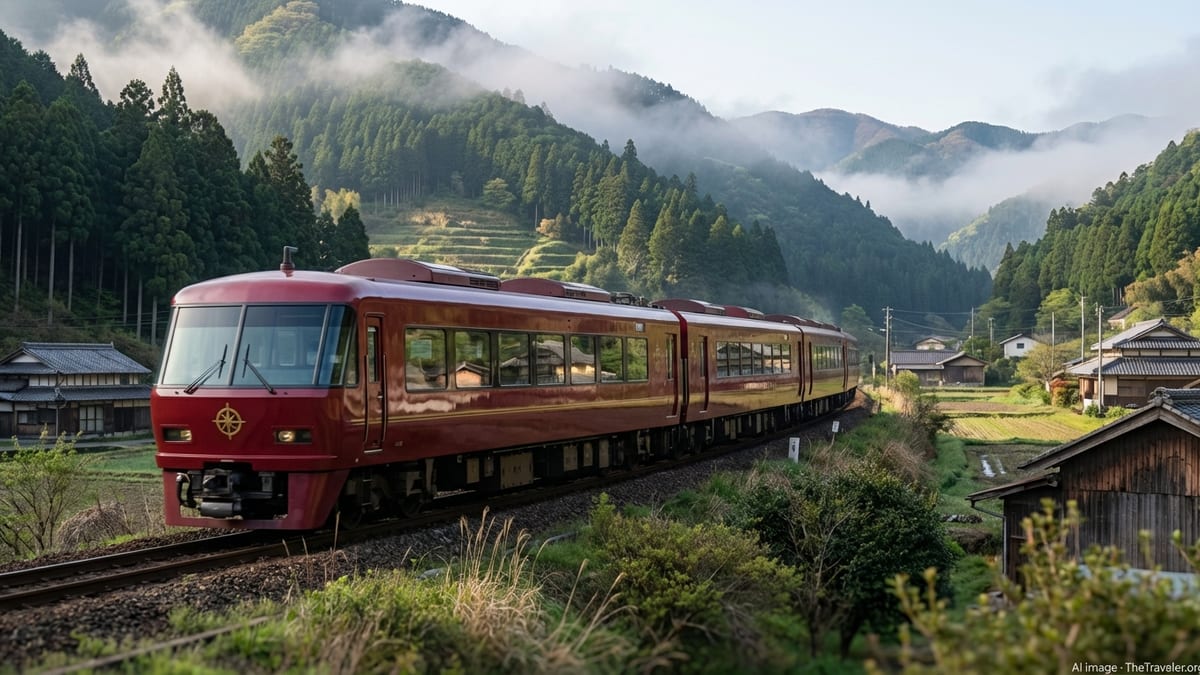
The Gran Tenku’s exterior is finished in a deep, dark red livery accented with gold, a palette chosen to echo the lacquered structures, temple gates, and monastic halls that define Mount Koya’s historic precincts. At the front of the train, a gold compass-inspired emblem incorporates the initials associated with Koya and Wakayama, underscoring the idea of pilgrimage, direction, and the passage of time.
On board, the four-car formation has been conceived as a series of distinct but complementary spaces. The first car focuses on reclining seats and personal comfort, allowing passengers to tilt back, watch the scenery, or simply rest after a long-haul flight or city sightseeing in Osaka. The second car prioritizes expansive views, with large windows, strategic seat angles, and unobstructed sightlines into the forests and valleys of the Koya Line.
The third and fourth cars are designed as social and dining spaces, where lounge-style sofa seating and small group arrangements encourage quiet conversation and shared appreciation of the passing landscape. Warm-toned materials, indirect lighting, and traditional design motifs subtly reference Japanese interiors, providing a sense of place without tipping into theme-park pastiche.
A Scenic Corridor Reimagined as a Moving Observatory
The route between Osaka and Mount Koya is one of Japan’s more dramatic regional rail journeys, threading from dense city blocks through suburbs, river valleys, and finally into deep cedar forests and steep mountain slopes. For years, much of this transition has slipped by behind standard commuter train windows. The Gran Tenku aims to reposition this stretch of track as a moving observatory on the geography and daily life of Wakayama Prefecture.
As the train departs Namba, passengers will see the dense lattice of Osaka’s low-rise neighborhoods give way to more open residential districts and then to fields, rivers, and wooded hills. The Koya Line runs across nearly 20 kilometers of increasingly rugged terrain punctuated by bridges and tunnels, some of which have long offered brief flashes of spectacular views that were easy to miss from standard rolling stock.
With enlarged windows, carefully aligned seating, and slower, more deliberate pacing through key viewpoints, the Gran Tenku turns these fleeting glimpses into sustained vignettes. The journey passes through traditional towns and farmsteads, where rice paddies, persimmon orchards, and tile-roofed houses unfold against the backdrop of rising mountains. In spring and autumn, the colors intensify, with cherry blossoms and later maple foliage framing the tracks.
Cultural and Spiritual Immersion on the Way to a Sacred Peak
Mount Koya, or Koyasan, is a UNESCO World Heritage site and the spiritual heart of Shingon Buddhism, first established in the early ninth century. The mountaintop basin, perched around 900 meters above sea level, is home to more than one hundred temples, monastic lodgings, and historic structures, as well as Okunoin, one of Japan’s most evocative cemeteries surrounded by centuries-old cedars.
For many visitors, reaching Mount Koya has traditionally been framed as a logistical step before the “real” experience begins: staying in temple lodgings, waking early for morning prayers, and walking lantern-lit paths at dusk. With Gran Tenku, Nankai Electric Railway is attempting to reframe the approach as the opening chapter of a spiritual narrative, easing travelers into a slower rhythm well before they arrive at the cable car.
On board, information and subtle storytelling are expected to play a larger role. Staffed attendants, multilingual materials, and potentially curated audio or printed guides will highlight the history, beliefs, and everyday life connected to the region. Rather than overloading passengers, the focus is on gentle orientation: pointing out rivers that once served pilgrims, villages linked to temple communities, and vantage points that situate Koyasan within the wider mountain landscape.
This approach aligns with broader trends in religious and cultural tourism, where visitors increasingly seek context and reflection instead of one-dimensional sightseeing. By the time passengers step into the funicular for the final ascent, they will have already begun a mental and emotional transition from Osaka’s bustle to the contemplative atmosphere of the plateau.
Onboard Gastronomy and Hospitality Showcasing Wakayama
The Gran Tenku will not only showcase landscapes but also local flavors. Plans call for meals and light dishes prepared with ingredients sourced from Wakayama Prefecture, known for its citrus fruits, plums, seafood, and mountain vegetables. Rather than a full-service restaurant car in the traditional sense, the concept leans toward a refined lounge experience where food and drink enhance rather than dominate the journey.
Passengers will be able to sample regional specialties and thoughtfully presented bento-style offerings designed to be eaten at leisure while watching the scenery. The emphasis is on seasonality and locality, mirroring the way many temple lodgings on Mount Koya serve shojin ryori, or Buddhist vegetarian cuisine, reflective of the surrounding forests and fields.
Service standards are expected to be high, with onboard attendants providing guidance, menu explanations, and assistance in multiple languages where possible. For international travelers new to Japan’s rail etiquette, this presence can be reassuring, turning the train itself into an accessible introduction to local customs, from quiet carriage behavior to the unhurried enjoyment of food and landscape.
Ticketing, Accessibility, and Target Travelers
Gran Tenku tickets are due to go on sale on March 24, 2026, one month ahead of the inaugural run. Nankai Electric Railway has indicated that fares on the route to Gokurakubashi will remain broadly accessible, with standard rail tickets supplemented by reserved-seat surcharges for the Gran Tenku experience. That positioning reflects a desire to attract not only high-end travelers but also families, small groups, and solo visitors willing to invest a bit more for a memorable journey.
From key stations such as Namba, Shin-Imamiya, and Tengachaya in Osaka, as well as several intermediate stops in Wakayama, travelers will be able to board the Gran Tenku directly, reducing the need for complex transfers. For international tourists arriving via Kansai International Airport, Nankai’s existing airport services create a straightforward connection into the Koya Line network, further simplifying access to Mount Koya.
Capacity will be limited to around 70 passengers per departure, spread across the four cars in configurations that avoid crowding and preserve a sense of calm. Given the modest seat count and the global interest in Japan’s luxury and sightseeing trains, early booking is likely to be advisable, particularly during Japan’s peak travel seasons in spring and autumn and around national holidays.
Revitalizing Regional Tourism and Japan’s Rail Prestige
The launch of Gran Tenku is part of a broader pattern in which Japanese rail operators deploy distinctive sightseeing trains to anchor regional tourism strategies. Just as services in Kyushu, Shikoku, and northern Japan have boosted travel to less-visited areas through design-led trains, Nankai is positioning Mount Koya as both a spiritual destination and a flagship example of experiential rail.
By extending the premium offering from Hashimoto all the way to Namba, the company is betting that more travelers will make the trip, stay longer, and explore deeper into Wakayama Prefecture. The combination of a photogenic train, immersive onboard amenities, and a globally recognized sacred site provides a strong platform for destination marketing, especially in international media and social networks where distinctive trains often become icons.
For Japan’s rail industry, the Gran Tenku reinforces the country’s reputation for harmonizing efficiency with aesthetics and hospitality. While high-speed services such as the Shinkansen dominate headlines, regional and private operators are increasingly using slower, more scenic trains to create the kind of emotionally resonant trips that keep travelers returning and exploring beyond the usual urban circuits.
What Travelers Can Expect in April 2026 and Beyond
As the April 24, 2026 launch date approaches, more detailed information is expected on specific timetables, interior layouts, and onboard programs. Early images and statements point to a train that emphasizes tranquility, regional storytelling, and quiet luxury rather than flashy gimmicks, making it well suited to the contemplative nature of its destination.
For travelers planning journeys to Japan in 2026 and beyond, the Gran Tenku adds a compelling new option for accessing one of the country’s most atmospheric regions. Paired with temple stays, forest walks, and visits to historic halls and cemeteries, the train ride can form the spine of a longer itinerary that combines Osaka’s urban dynamism with the stillness and ritual of Mount Koya.
In reframing the trip as a soul-stirring passage rather than a simple transfer, Nankai Electric Railway is betting that modern travelers value experiences that begin long before they arrive at their final stop. If the Gran Tenku delivers on its promise, the line between journey and destination on the route to Mount Koya may soon feel more blurred than ever.