

More news on this day
Japan’s iconic Shinkansen, long celebrated for whisking passengers between cities at breathtaking speed, is quietly taking on a second life: as a high‑speed freight corridor that is helping to stabilize an overstretched global logistics system.
Get the latest news straight to your inbox!
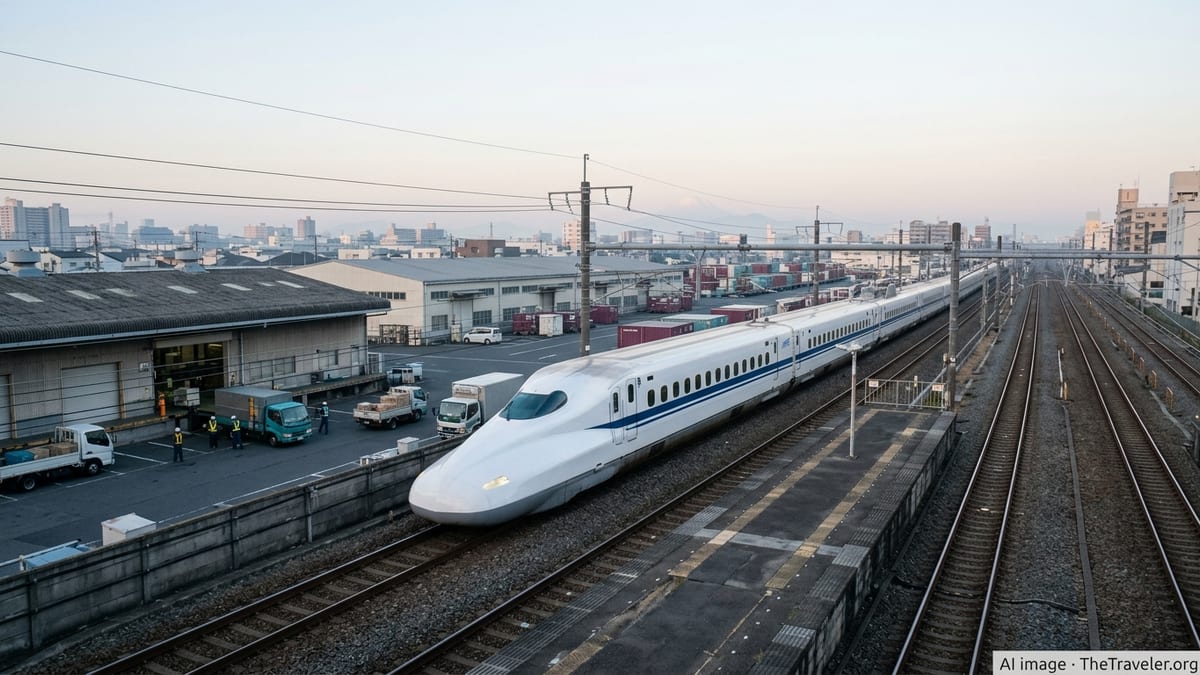
A Bullet Train Built for Parcels, Not Passengers
Japan’s high‑speed rail network is entering a new phase as operators convert passenger capacity into dedicated space for cargo. On the Tohoku Shinkansen, East Japan Railway Company has been running regular services in which entire cars have had seating removed to create room for time‑sensitive freight such as seafood, agricultural products and precision components. Publicly available information indicates that each run can handle hundreds of boxes between northern cities and Tokyo, using the same trains that once catered almost exclusively to commuters and tourists.
The shift will accelerate in March 2026, when Japan’s first cargo‑only Shinkansen is scheduled to begin service. Reports describe plans for trainsets configured entirely for freight, capable of carrying more than 17 tons per trip while maintaining the speed and punctuality associated with the country’s bullet trains. These services are designed around small parcels and unit loads, reflecting how e‑commerce and just‑in‑time manufacturing now dominate demand for fast transport.
Railway operators see freight as a way to offset long‑term declines in domestic ridership driven by Japan’s aging population. By putting underused late‑night and off‑peak paths to work for logistics, they are turning a looming challenge in passenger demand into an opportunity to build a new revenue stream that is tightly integrated with the wider supply chain.
The result is that the Shinkansen is no longer just a passenger symbol of modern Japan. It is becoming a rolling express distribution network that can move goods from regional hubs to major cities in a matter of hours, with arrival times precise enough for retailers to plan same‑day sales events around fresh deliveries.
Relieving Japan’s 2024 Logistics Crunch
Japan’s logistics sector has been under intense pressure since 2024, when tighter working‑hours rules for truck drivers heightened an already acute shortage of long‑haul drivers. Industry observers in Japan often refer to this situation as the “2024 problem,” a structural squeeze that threatened to slow parcel deliveries and disrupt just‑in‑time production. High‑speed rail is emerging as one of the country’s most visible responses.
By shifting the trunk leg of a journey from highway to rail, Shinkansen freight services allow trucking companies to redeploy drivers to shorter, urban distribution routes. Large parcel carriers such as Yamato Transport and Sagawa Express have expanded offerings that rely on bullet trains between cities like Tokyo, Kyoto, Osaka and Fukuoka, while trucks handle hotel‑to‑station and last‑mile segments. Travel industry coverage highlights new same‑day baggage services for visitors between major tourist hubs that depend on the Tokaido Shinkansen as the core link.
The model is now being extended through joint platforms that match shippers and carriers across modes. A digital trunk‑transport network launched by a Yamato Holdings subsidiary and Fujitsu aims to coordinate shared capacity across roads, rails and coastal shipping, signalling a broader shift away from single‑company, truck‑only solutions. The Shinkansen slots neatly into this ecosystem, offering a high‑reliability, low‑delay option at times when highways around megacities are most congested.
Industry analysts note that this multimodal approach is helping Japan absorb surging parcel volumes without a proportional increase in heavy truck traffic. With the domestic courier and express market projected to keep expanding through the 2030s, high‑speed rail is being positioned as a structural safety valve for a system that can no longer depend on endless additions of drivers and vehicles.
A Low‑Carbon Shortcut for Just‑in‑Time Supply Chains
For manufacturers and retailers, the Shinkansen’s growing logistics role is about more than speed. It is also about carbon accounting. Trains are significantly more energy‑efficient per ton‑kilometer than trucks or aircraft, and Japan’s high‑speed lines are powered largely by electricity from an increasingly diverse generation mix. That makes bullet train freight an attractive option for companies under pressure to report concrete progress on emissions reduction.
Rail operators are marketing Shinkansen cargo as a form of “green logistics,” highlighting the emissions savings from shifting express shipments off the road. Priority services such as JR East’s Hako‑based offerings emphasize not only punctuality but also the environmental benefits of using existing rail infrastructure instead of adding new trucks to already crowded expressways.
The sustainability angle is especially important for temperature‑sensitive and high‑value goods. In parallel with high‑speed passenger lines, Japan Freight Railway has begun operating larger, temperature‑controlled containers for pharmaceuticals on the conventional rail network, with plans to extend their use on long‑distance corridors. While these containers do not ride the Shinkansen itself, they form part of a broader rail‑first strategy that positions fast trains and freight lines together as a cleaner alternative to long‑haul road transport.
As global brands tighten supplier requirements on emissions reporting, the ability to route components and finished products over electrified high‑speed rail offers Japanese exporters a competitive pitch. For time‑critical deliveries into Asian markets, consignments can be moved by Shinkansen from regional plants to airports or seaports on schedules that match outbound flights and vessels, cutting both transit time and the carbon footprint of inland transport.
Air‑Rail Alliances Create a New Express Network
The most striking sign that Shinkansen freight is reshaping logistics comes from its growing links with aviation. In January 2026, Japan Airlines’ cargo division and JR East launched a combined service that packages bullet train trunk transport within Japan with international air freight. Under this model, parcels and temperature‑controlled goods are collected in regional cities, moved by high‑speed rail to major gateways such as Tokyo, and then flown onward to destinations across Asia and beyond.
According to published coverage, early trials of this combined air‑rail corridor between Sendai and Singapore demonstrated that the Shinkansen could reliably meet the tight cut‑off times required for international flights. This has encouraged partners to frame the bullet train not as a competitor to air cargo, but as a feeder network that can replace domestic flights and long truck hauls while preserving same‑day or next‑day delivery promises.
Hospitality and real‑estate groups are also tapping into this network effect. Large hotel chains have announced same‑day baggage transfers between properties in different cities using the Tokaido Shinkansen for the line‑haul segment. For international travelers, this creates a seamless experience in which luggage departs one hotel in the morning and is waiting at the next check‑in by mid‑afternoon, even when the journey spans several hundred kilometers.
As these services mature, the Shinkansen is effectively functioning as a domestic feeder layer for global logistics, plugging Japan’s regional economies more directly into international supply chains. The high‑speed network’s reliability allows operators to build precise time‑tabled connections between truck, train and plane without the buffers that add cost and delay in less predictable systems.
A Model Other Countries Are Watching
The transformation of Japan’s bullet trains into a logistics backbone is drawing interest from countries grappling with their own driver shortages, congestion and emissions targets. While no two rail systems are identical, transport planners in Europe and parts of Asia are studying how Japan has layered logistics onto a high‑speed network originally designed for passengers, without undermining its core role.
One distinctive feature is Japan’s dense mesh of freight terminals, distribution centers and passenger stations, many of them located side by side. Facilities such as Tokyo’s major freight terminal sit near Shinkansen depots, allowing trucks, conventional freight trains and high‑speed services to interconnect in compact areas. This proximity makes it feasible to transfer containers, pallets and baggage rapidly between modes with minimal handling.
Japan’s experience also underscores the importance of digital coordination. Joint transport platforms that match shipments to available capacity, predict congestion and optimize routing are essential to making mixed passenger‑freight operations work at scale. As these systems mature, they allow logistics planners to treat high‑speed rail slots as dynamic resources that can be adjusted in response to storms, factory shutdowns or surges in online shopping.
For now, the Shinkansen’s freight role remains a fraction of Japan’s overall logistics capacity. Yet the rapid rollout of dedicated services, the integration with air cargo, and the clear response to labor and climate constraints suggest that high‑speed rail is moving from a niche experiment to a central pillar of how goods move in and out of the world’s fourth‑largest economy.