

More news on this day
Jazeera Airways has launched a new routing that connects passengers from Kuwait to Egypt via Qaisumah in Saudi Arabia, creating a rare travel lifeline as Kuwait International Airport remains closed amid regional security tensions.
Get the latest news straight to your inbox!
A Groundbreaking Detour in a Time of Disruption
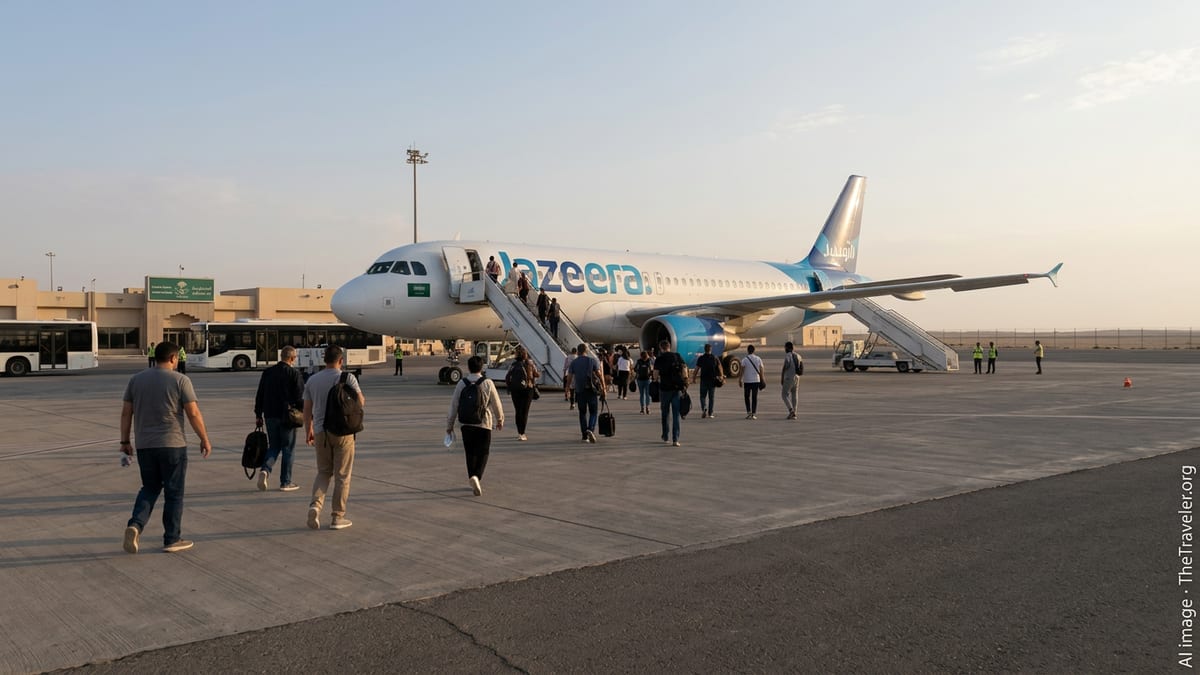
The first Jazeera Airways flight from Qaisumah Airport in Hafar Al Batin to Cairo International Airport took off on March 11, carrying 145 passengers who had traveled overland from Kuwait in a convoy of buses. The operation marked the practical start of a temporary air bridge designed to keep residents, expatriates and visitors moving between Kuwait and Egypt despite the shutdown of Kuwaiti airspace.
The route, while not a direct Kuwait–Cairo service, effectively restores that connectivity by combining an organized bus transfer from Kuwait to Qaisumah with a scheduled Jazeera Airways flight onward to Egypt. The airline has confirmed plans to operate further flights to Egyptian cities and to Amman, with the new Qaisumah hub expected to play a central role as long as restrictions on Kuwaiti airspace remain in place.
Regional airspace closures linked to the conflict involving Iran have forced carriers across the Gulf to rapidly rethink their networks. For Jazeera Airways, shifting part of its operation into neighboring Saudi Arabia is an unprecedented move that underscores both the severity of the disruption and the strong underlying demand for travel between Kuwait and key markets such as Egypt.
Industry analysts say the Qaisumah operation is likely to evolve quickly in the coming weeks, with capacity, destinations and schedules adjusted in line with demand and regulatory approvals. For now, however, the Qaisumah to Cairo link stands out as one of the most concrete efforts to keep passengers moving between Kuwait and Egypt under extraordinary conditions.
How the Kuwait–Qaisumah–Egypt Journey Works
Travelers departing from Kuwait begin their journey by road. Jazeera Airways has arranged bus convoys that leave from designated pickup points in Kuwait and drive approximately two and a half hours across the border to Qaisumah Airport in Saudi Arabia. The airline is also exploring wider cooperation with bus operators to expand ground transport options and provide more flexibility for passengers who cannot or prefer not to drive themselves.
On arrival at Qaisumah, passengers proceed through Saudi airport formalities and check in for their Jazeera Airways flight. Current operations focus on services to Cairo, with additional flights to destinations such as Assiut and other Egyptian cities expected to follow as approvals are granted and demand builds. Some passengers are using the link purely as a Kuwait–Egypt corridor, while others may connect onwards from Egypt to other countries.
For inbound travelers, the process is reversed. Passengers land in Cairo on Jazeera Airways flights from Qaisumah and then board return services back to the Saudi airport, where bus convoys transport them overland to Kuwait. The arrangement effectively replaces what was previously a straightforward two to three hour direct flight with a multi-leg journey that blends road and air travel.
Jazeera Airways is advising passengers to allow additional time for border procedures, security checks and potential traffic delays on the Kuwait–Saudi road route. While the airline is working to streamline the process, travelers should expect a longer overall travel time than under normal circumstances and plan their onward connections accordingly.
Safety, Documentation and Practical Considerations for Tourists
The new routing introduces added layers of regulation that tourists and expatriates must carefully navigate. Because the journey now involves entering Saudi Arabia by land before flying onward to Egypt, passengers need to ensure they meet Saudi entry requirements, including any applicable visas or transit permissions. Travelers should verify whether their nationality is eligible for e-visas, visa on arrival or requires prior consular approval, and should check that their passports have sufficient validity remaining.
Egyptian entry rules also still apply at the final destination. Many nationalities can obtain a visa on arrival for Egypt, while others must arrange a visa in advance. Dual nationals and residents returning home should carry both their passport and any residency permits or identification documents required by Egyptian authorities. Given the fluid regional situation, passengers are strongly encouraged to check the latest official guidance from consular services and local authorities before departure.
On the ground and in the air, Jazeera Airways says it is prioritizing safety, emphasizing coordination with Saudi and Kuwaiti aviation and interior authorities. Security checks at Qaisumah and along the overland route are expected to be robust, and travelers should anticipate possible additional screening and document verification. Tourists are advised to keep all travel papers, hotel bookings and contact details for local hosts or tour operators easily accessible.
Health and comfort are also practical considerations on the longer hybrid journey. Passengers should prepare for several hours on the road in desert conditions, carrying water, snacks and any essential medications. While the airline and bus partners aim to provide a smooth, air conditioned transfer, the combination of overland travel and cross-border formalities can be tiring, particularly for families with young children or older travelers.
What This Means for Egypt-Bound Visitors and the Wider Region
For travelers whose primary goal is to visit Egypt, the Qaisumah routing offers a much-needed, if more complex, alternative to suspended direct flights from Kuwait. Cairo remains a major hub for tourism and onward connections across Egypt, from the Nile Valley and Red Sea resorts to cultural centers such as Alexandria and Luxor. By restoring a viable path between Kuwait and Egypt, Jazeera Airways is helping tourists maintain pre-planned trips, family visits and pilgrimage-related travel that might otherwise have been canceled.
In the medium term, the airline has signaled that it may expand services from Qaisumah to additional Egyptian destinations and to neighboring Jordan, potentially turning the Saudi airport into a temporary regional spoke for disrupted routes. This could open new itineraries for travelers who are flexible and willing to accept longer transit times in exchange for maintaining their travel plans.
The move also highlights how regional carriers are adapting in real time to shifting airspace restrictions. Other airlines have adjusted routes, launched repatriation flights or rerouted services through alternative hubs in Saudi Arabia and beyond. Jazeera Airways’ decision to physically relocate part of its operation across the border stands out as one of the more radical responses to the closure of Kuwaiti airspace.
For now, the Qaisumah corridor is viewed as a contingency rather than a permanent replacement for Kuwait International Airport. As and when Kuwaiti airspace reopens and normal operations resume, direct services from Kuwait to Egypt are expected to return. Until then, tourists and residents eyeing Egyptian destinations will find that this innovative, if unconventional, route offers one of the few structured ways to keep their journeys on track.
Tips for Passengers Considering the New Route
Travelers weighing whether to book Jazeera Airways services via Qaisumah should start by building extra time and flexibility into their itineraries. The combination of bus transfer, border crossing and a regional flight leaves less margin for error than a standard point to point journey. Allowing a buffer around the travel date for any schedule changes or additional checks can reduce stress and make the experience more manageable.
Passengers are also encouraged to travel light where possible. Managing large amounts of luggage during bus transfers, border inspections and airport procedures can be cumbersome, especially in crowded conditions. Keeping essential items in a small carry-on bag and clearly labeling checked luggage can help speed up transitions between each stage of the journey.
Communication with the airline and, where relevant, travel agents will be key. Because the operation is new and closely tied to evolving security conditions, schedule adjustments and new routing options are likely. Regularly checking booking details, monitoring airline announcements and confirming meeting points for bus departures will help ensure that passengers stay aligned with any operational changes.
Ultimately, the Kuwait–Qaisumah–Egypt link is a product of extraordinary circumstances, but it also reflects the resilience of regional travel networks. For tourists determined to reach Egypt from Kuwait during this uncertain period, the route offers a carefully coordinated, if more demanding, pathway that keeps long-planned journeys possible.