

More news on this day
Kuwait’s Jazeera Airways has moved quickly to restore links for religious and regional travelers, resuming Saudi services and dedicated Umrah charters by rerouting operations through Saudi airports despite the ongoing closure of Kuwaiti airspace.
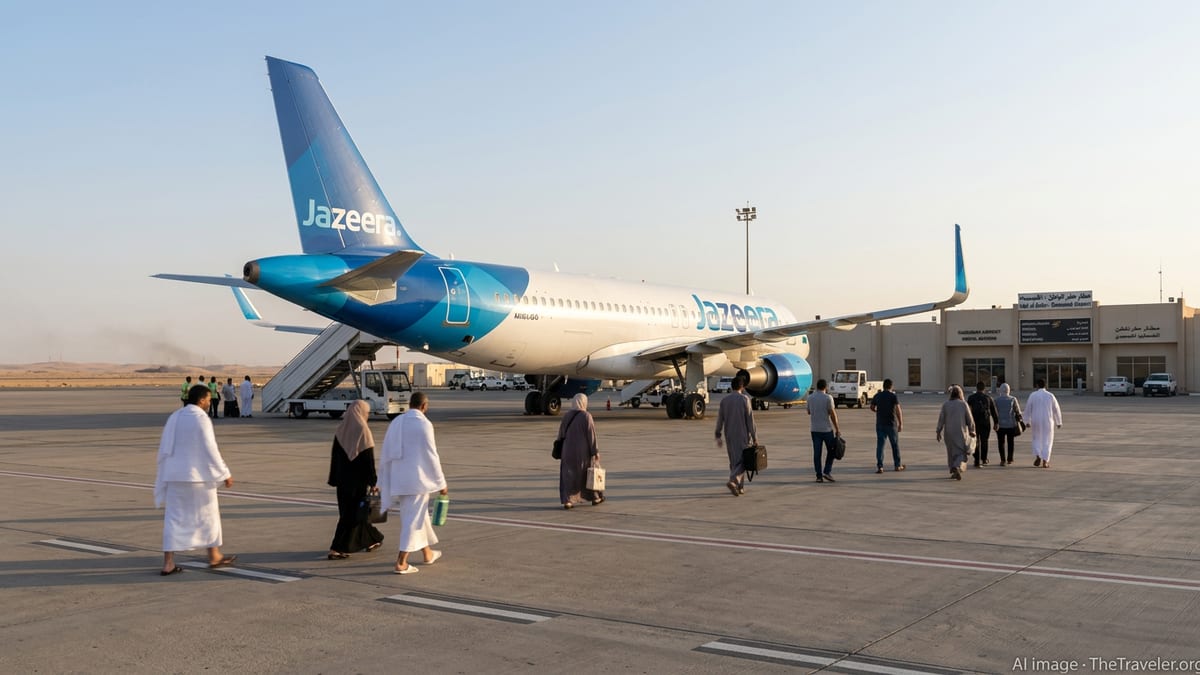
Rerouted Operations Keep Pilgrims and Passengers Moving
Jazeera Airways has restarted Umrah charter services and select Saudi-bound flights by shifting much of its operation across the border into Saudi Arabia, allowing the carrier to maintain a lifeline for pilgrims and point-to-point travelers at a time of severe regional airspace disruption. With Kuwait’s airspace temporarily shut due to the conflict involving Iran, the airline has secured approvals from Kuwaiti and Saudi authorities to operate via airports inside the kingdom instead of its traditional Kuwait City base.
The new arrangements mean that flights which would normally originate or transit in Kuwait are now planned to depart from or arrive at Saudi airports, with ground transport used to complete the final leg of the journey for many passengers. The strategy has enabled Jazeera to resume dedicated Umrah charters and restore parts of its Saudi network just days after large sections of Middle Eastern airspace were closed or restricted.
Airline officials have framed the changes as an emergency but necessary response to safeguard essential travel, especially for passengers booked on religious journeys. The carrier has emphasized that safety assessments and regulatory clearances underpin each step of the revised operation, in line with decisions by civil aviation authorities in both countries.
For travelers, the most visible change is the shift in gateway airport and the added reliance on road connections, but for many would-be pilgrims the alternative is preferable to extended delays, cancellations, or the loss of a long-planned Umrah trip.
Qaisumah Emerges as a Temporary Hub
Central to Jazeera Airways’ contingency plan is Qaisumah Airport in Hafr al Batin, in Saudi Arabia’s Eastern Province, which has rapidly become a temporary operational hub. The airport, usually a modest regional facility, is now handling arrivals and departures for passengers who would ordinarily use Kuwait International Airport, particularly those originating in or destined for Kuwait and neighboring countries.
Under the current setup, arriving passengers land in Qaisumah and then continue their journey to Kuwait by road, while outbound travelers make the reverse trip, crossing the border by land before boarding their Jazeera flight in Saudi Arabia. The airline has advised that passengers must hold valid Saudi entry documentation to use this routing, reflecting the added immigration and visa considerations created by the workaround.
The choice of Qaisumah reflects a blend of geography and feasibility. Its relative proximity to the Kuwait border, and the ability to accommodate additional flights at short notice, have made it a logical staging point as the carrier rebuilds its schedules. Airport authorities and ground-handling teams have had to adapt quickly, increasing staffing and coordinating with border officials as traffic flows rise.
While Qaisumah’s facilities and road links are being tested by the sudden increase in demand, early operations suggest that the interim solution is functioning well enough to support Jazeera’s resumed Umrah and Saudi services, even if travel times are longer and logistics more complex than in normal times.
Safeguarding Umrah Travel Amid Regional Disruption
The rapid resumption of Umrah charters underscores the importance of religious travel in the region’s aviation ecosystem. Each year, millions of Muslims travel to Saudi Arabia for Umrah outside the main Hajj season, and airlines structure schedules, capacity and pricing around this steady stream of demand. When large parts of the region’s airspace were abruptly closed, thousands of pilgrims faced uncertainty over whether they would make their journeys at all.
By restarting Umrah-specific charters, Jazeera Airways is sending a message that it intends to honor bookings and restore confidence among travel agents and group organizers, even if that means operating longer routings and coordinating cross-border ground transfers. The airline’s decision aligns with moves by other carriers that have begun restoring limited services to Jeddah and Madinah once safe corridors and alternative routings became available.
For pilgrims, especially those traveling in organized groups, the restored flights offer a measure of reassurance in a volatile environment. Travel planners, who had scrambled to rearrange itineraries or secure refunds when initial cancellations were announced, are now working through revised schedules that make use of the rerouted services. However, they continue to warn clients that conditions remain fluid and that further adjustments are possible if security conditions or regulatory restrictions change again.
Industry observers note that the episode is another reminder that religious travel, while deeply rooted in faith and tradition, is also dependent on the resilience and flexibility of modern aviation networks. The ability of airlines like Jazeera to quickly restructure operations has become critical to sustaining access to the holy cities during periods of geopolitical tension.
A Test of Airline Resilience and Passenger Patience
The Middle East’s latest airspace closures have created a complex patchwork of permissible routes and no-fly zones, forcing airlines to improvise with diversions, extended flight paths and new operational bases. For Jazeera Airways, the rapid pivot into Saudi territory is both a demonstration of resilience and a real-time stress test of its operational capabilities.
Running an airline under such conditions requires constant coordination with aviation regulators, air navigation providers and airport operators across multiple jurisdictions. Schedules that were already tightly calibrated now must accommodate longer routings to avoid restricted zones, higher fuel burn and constrained airport slots as more carriers converge on the same safe corridors.
Passengers, meanwhile, are being asked to accept more uncertainty than usual. Itineraries may change at short notice, connecting times can lengthen, and check-in procedures often require close monitoring of the latest advisories. For travelers heading to or from Kuwait on Jazeera, the added overland segment via Saudi Arabia represents an extra logistical layer, from arranging visas to factoring in potential delays at land borders.
Yet despite the inconvenience, booking patterns suggest that many passengers are prepared to tolerate added complexity in exchange for a workable route. The alternative, particularly for time-sensitive journeys such as Umrah, business trips or family visits, is often to postpone travel indefinitely or search for scarce seats on other carriers also grappling with the same constraints.
Regional Recovery and the Road Ahead
Jazeera Airways’ resumption of Saudi flights and Umrah charters highlights a broader, uneven recovery in regional aviation as some airspace segments reopen while others remain firmly closed. Airlines are advancing cautiously, restoring capacity in phases and prioritizing routes that serve pressing needs such as repatriation and religious travel.
Saudi airspace and major hubs like Jeddah, Riyadh and Dammam remain open, offering critical anchor points for rerouted services. Carriers from across Asia, the Gulf and beyond are using these gateways to stitch together viable networks that avoid conflict zones while still linking key origin and destination markets. This has made Saudi airports, particularly secondary gateways such as Qaisumah, central to interim solutions designed to keep passengers moving.
For Jazeera Airways, the coming weeks will be shaped by how quickly Kuwait’s airspace can safely reopen and whether current political tensions ease. A return to normal operations would allow the airline to draw down its reliance on cross-border workarounds and restore its hub-and-spoke model from Kuwait City. Until then, it is likely to continue refining the temporary operating pattern, adjusting frequencies and aircraft deployment in response to demand and regulatory developments.
Travelers planning trips involving Kuwait and Saudi Arabia are being urged to maintain close contact with airlines and agents, confirm documentation requirements and allow extra time for journeys that now include both air and road segments. As Jazeera Airways’ experience illustrates, airline resilience and traveler flexibility are becoming essential ingredients for keeping religious and regional travel viable amid one of the most challenging airspace disruptions the Gulf has seen in years.