

More news on this day
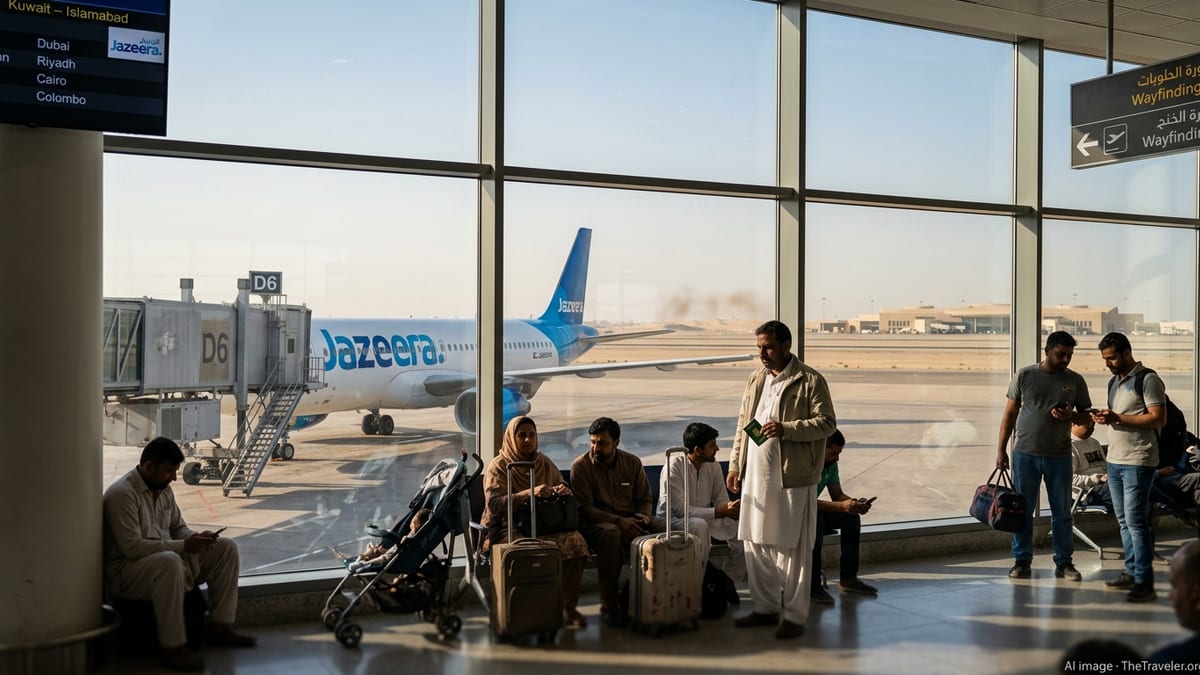
Jazeera Airways has resumed flights between Kuwait and Islamabad, adding the United Arab Emirates to a widening network of onward links that already includes Saudi Arabia, Egypt, India, Sri Lanka and other key markets, in a development expected to significantly enhance regional connectivity for business and leisure travelers.
Get the latest news straight to your inbox!
Stronger Kuwait–Pakistan Corridor After Service Resumption
Reports indicate that Kuwait based Jazeera Airways has brought back its Islamabad service after an earlier pause linked to broader regional operational disruptions. The move places Pakistan’s capital once again on the carrier’s map and restores a direct low cost link for the sizable Pakistani community living and working in Kuwait.
Publicly available schedule data shows that the resumed flights reconnect Islamabad with Kuwait’s growing role as a transfer point for travel across the Middle East and South Asia. For passengers in Pakistan, the route provides an additional alternative to hubs such as Dubai, Abu Dhabi and Doha when planning trips to the Gulf, North Africa or the Indian Ocean region.
Industry observers note that the return of the Islamabad route also reflects an improving operational environment in regional airspace after a period of temporary suspensions and reroutings. Airlines serving Pakistan have been gradually rebuilding their networks, and Jazeera Airways’ decision to reinstate flights is being viewed as part of this broader normalization.
The renewed link is expected to support not only visiting friends and relatives traffic but also business travel between Kuwait and Pakistan, particularly in construction, energy and services, where bilateral ties remain active.
UAE Joins Saudi Arabia, Egypt, India and Sri Lanka in Jazeera’s Network Options
According to published coverage, Jazeera Airways has steadily expanded and refined its network out of Kuwait, offering connections to destinations across Saudi Arabia, Egypt, India, Sri Lanka and the United Arab Emirates. Recent timetable information highlights routes to cities such as Alexandria, Assiut, Cairo and Luxor in Egypt, along with services to Amman, Istanbul and Colombo, with additional India frequencies and new points introduced progressively.
The inclusion of the UAE within Jazeera Airways’ accessible markets, through services into Al Ain and broader cooperation across the Gulf, adds another high demand gateway for travelers starting or ending their journeys in Islamabad. Al Ain’s proximity to major hubs such as Dubai and Abu Dhabi positions it as a practical entry point for passengers heading to or from Pakistan, particularly during periods of capacity constraints or fare volatility on larger carriers.
For travelers in the opposite direction, the Islamabad flights open a relatively short path into Pakistan from multiple countries now connected to the Jazeera network. Passengers originating in Saudi Arabia, Egypt, India or Sri Lanka can travel to Kuwait and continue onward to Islamabad, often using through-ticketed itineraries that keep costs lower than legacy full service alternatives.
This web of connections underscores Kuwait’s role as a mid sized but strategically placed stopover point between the Arabian Peninsula, the Indian subcontinent and parts of North Africa. The resumption of Islamabad services strengthens that positioning by ensuring that Pakistan’s political and administrative capital is directly tied into the network.
Boost for Labor, VFR and Religious Travel Segments
Analysts tracking Gulf–South Asia flows point out that routes linking Pakistan with Kuwait, the UAE, Saudi Arabia and other nearby markets are heavily used by migrant workers, families and religious travelers. Pakistan has one of the world’s largest expatriate communities in the Gulf, and many of those workers originate from areas that are more conveniently served via Islamabad than via other Pakistani cities.
The revived Kuwait–Islamabad connection is expected to appeal strongly to these segments by offering a no frills, point to point option that can be combined with onward low cost flights. For passengers traveling to Saudi Arabia for Umrah or Hajj seasons, or to the UAE for employment, connections via Kuwait and Al Ain can add much needed flexibility at peak times when direct flights often sell out early.
Visiting friends and relatives traffic, traditionally resilient even in periods of economic uncertainty, is also likely to benefit. Families based in Gulf states such as Saudi Arabia or the UAE can now more easily assemble itineraries that include a stop in Kuwait and a direct leg to Islamabad, without relying solely on Pakistan’s national carrier or on larger Gulf network airlines.
Industry data reviewed by regional media suggests that as more carriers recalibrate capacity into Pakistan, competitive pricing is returning on several Gulf–Pakistan sectors. The presence of a Kuwait based low cost operator on the Islamabad route is expected to contribute to this trend by pressuring fares and increasing seat availability.
Implications for Regional Hubs and Competitive Dynamics
The restoration of Jazeera Airways’ Islamabad flights arrives at a time when multiple Gulf and South Asian airports are vying for a larger share of connecting traffic. Dubai, Abu Dhabi and Doha have long dominated long haul flows between Europe, North America and South Asia, but second tier hubs such as Kuwait and Al Ain are emerging as niche alternatives for cost conscious travelers.
By linking Islamabad into a network that already serves Egypt, India, Sri Lanka, Saudi Arabia and the UAE, Jazeera Airways is effectively positioning Kuwait as a bridge between Pakistan and a wider ring of regional destinations. This strategy could draw a portion of short haul and medium haul travelers away from the larger Gulf hubs, particularly those whose journeys do not require extensive long haul connections.
The development also comes as Pakistan’s own aviation landscape undergoes change, with private carriers and joint ventures working to expand capacity and improve reliability on key international routes. Additional competition from foreign low cost airlines can encourage more efficient pricing and potentially stimulate new demand, especially among first time flyers who might have previously chosen long distance bus or sea travel.
For airports across the network, including Islamabad International Airport, the return of Jazeera Airways operations feeds into broader efforts to diversify airline portfolios and reduce exposure to any single carrier’s network decisions. Increased choice of airlines and routings is seen by industry observers as a key factor in building resilience for Pakistan’s outbound and inbound travel markets.
Outlook for Capacity Growth and Traveler Choice
Forward looking schedules referenced by regional aviation outlets indicate that Jazeera Airways plans to continue fine tuning frequencies across its network in response to demand, including on routes touching Pakistan, India and the wider Gulf. Additional capacity on high demand city pairs such as Kuwait–Egypt and Kuwait–India, alongside new and restored services into the UAE and other markets, could create more one stop combinations for Islamabad based passengers.
Travel trade analysts expect that if load factors remain healthy on the resumed Islamabad operation, the airline may explore seasonal adjustments, promotional fares and schedule tweaks to capture both peak holiday and off peak traffic. Tour operators and consolidators that package itineraries across the Middle East and South Asia are likely to monitor the route closely for opportunities to add lower cost options into their offerings.
For travelers, the immediate impact is a wider menu of choices at a time when some regional routes continue to experience occasional disruption or reduced capacity. The return of Jazeera Airways to Islamabad, set against its growing presence across the UAE, Saudi Arabia, Egypt, India, Sri Lanka and other markets, signals a renewed focus on Pakistan within the carrier’s broader regional strategy.
As airlines across the Gulf and South Asia continue to adapt to evolving demand patterns, the Kuwait–Islamabad link stands out as an example of how relatively short haul services can play an outsized role in knitting together labor markets, family ties and tourism flows across a densely interconnected region.