

More news on this day
Jazeera Airways has resumed flights between Qaisumah in Saudi Arabia and Sohag in Upper Egypt, reinforcing a growing web of Gulf–Egypt routes that now link Cairo, Luxor, Aswan and other key cities as regional carriers race to restore and expand connectivity after recent airspace disruptions.
Get the latest news straight to your inbox!
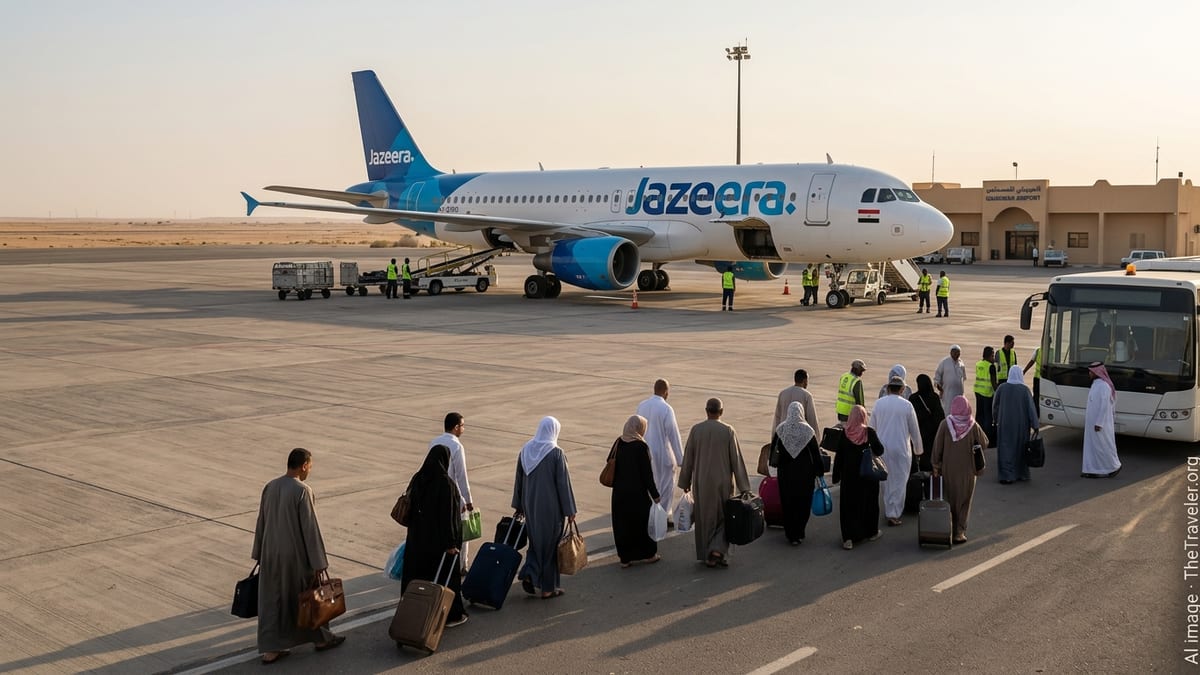
Qaisumah Emerges as a Temporary Gulf Gateway to Egypt
Publicly available scheduling data indicates that Jazeera Airways restarted services to Qaisumah Airport in Saudi Arabia from 11 March 2026, using the facility as an interim base while Kuwait’s airspace remains temporarily closed. Industry route trackers show that Qaisumah is now connected onward to Cairo and, as capacity returns, to additional Egyptian destinations including Sohag.
The move effectively turns a relatively modest regional airport in Saudi Arabia’s Eastern Province into a temporary transit point for thousands of travelers who would normally route via Kuwait City. Reports indicate that passengers are being transported by road between Kuwait and Qaisumah, then continuing by air to Egypt, creating an improvised but increasingly structured bridge between the Gulf and the Nile Valley.
Schedules published by aviation data providers show that Jazeera’s Qaisumah–Egypt flights are being layered on top of its existing Kuwait–Sohag service pattern, ensuring that Upper Egypt remains reachable despite the ongoing constraints on direct operations from Kuwait International Airport. This arrangement is designed to protect vital migrant, family visit and business traffic that depends heavily on affordable point‑to‑point links.
Analysts note that the Qaisumah solution underlines how regional carriers can rapidly reconfigure networks in response to airspace restrictions, with cross‑border cooperation between Saudi and Kuwaiti stakeholders allowing traffic flows to resume within days rather than weeks.
Network Effect: Sohag Joins Cairo, Luxor, Aswan and Other Egyptian Hubs
Sohag, a key gateway for Egypt’s populous Upper Egypt region, has become a focal point in this reshaped regional map. Flight‑tracking platforms list Jazeera Airways among several carriers offering direct or one‑stop links between Gulf cities and Sohag, alongside operators such as Air Cairo and Nesma Airlines on the Kuwait–Sohag corridor. This supplements established connectivity from Saudi Arabia to Egypt’s major airports in Cairo, Luxor and Aswan.
In Saudi Arabia, low‑cost and full‑service airlines are steadily building a dense mesh of routes into Egypt. Flyadeal, the Saudi low‑cost carrier affiliated with Saudia, has in recent seasons expanded flights from Jeddah, Riyadh, Madinah and Dammam to multiple Egyptian cities, including Sohag, Cairo and Alexandria. Industry coverage of the Saudi market highlights that Egypt is now one of the airline’s largest international markets by weekly frequency.
Full‑service operator Saudia also maintains an extensive Egypt schedule, and has commercial ties with other regional players such as Gulf Air through codeshare agreements. These arrangements facilitate same‑ticket itineraries that can connect passengers from Bahrain, Kuwait and other Gulf origin points into Egypt’s tourism and labor‑migration heartlands via Saudi hubs.
The combined effect is that travelers bound for Egypt from across the Gulf increasingly have a choice of routes: non‑stops where they exist, one‑stop itineraries through Riyadh, Jeddah or Dammam, and, during the current disruption, temporary routings via Qaisumah. For communities in Upper Egypt, this diversity of options helps stabilize access even when one airport or air corridor is constrained.
Gulf Carriers Coordinate to Maintain Regional Connectivity
Jazeera Airways’ Qaisumah deployment is part of a broader regional pattern in which Gulf carriers collectively work to preserve connectivity in the face of shifting operational conditions. Publicly available schedules show Kuwait Airways, Gulf Air, Saudia and Flyadeal all maintaining robust Egypt programs, even as they adjust timings, aircraft types and routings to reflect changing demand and airspace availability.
Bahrain‑based Gulf Air has long positioned itself as a connector between the northern Gulf and key cities in the Levant and North Africa, including Egypt. At the same time, Air Arabia Egypt’s growing Kuwait–Cairo service and other Gulf routes further widen the travel choices for Egyptian expatriates working in the Gulf states as well as leisure travelers heading in both directions.
These overlapping networks mean that when one carrier shifts capacity or adjusts a route, others can fill gaps or offer alternative itineraries. For example, the rise of Flyadeal’s low‑cost Saudi–Egypt network complements Saudia’s more traditional hub‑and‑spoke operations, while independent players such as Nesma Airlines and Air Cairo connect secondary Gulf and Egyptian cities that might otherwise lack direct links.
Sector observers point out that this layered connectivity, spread across legacy and low‑cost brands, is especially important for price‑sensitive travelers. Many passengers flying between the Gulf and Upper Egypt are visiting family or commuting for work, and rely on competitive fares and straightforward point‑to‑point services rather than long‑haul connecting itineraries.
Impact on Travelers: From Disruption to New Routing Options
The closure of Kuwait’s airspace in early March initially left many passengers uncertain about how and when they would be able to travel, particularly those holding tickets on itineraries connecting through Kuwait International Airport. Online travel forums and passenger reports describe a rapid shift toward overland transfers to Saudi Arabia and rebooked flights via Qaisumah and other regional hubs.
As Jazeera Airways and other carriers stabilize their provisional schedules, travelers bound for Egypt are beginning to see more predictable options. The resumption of Qaisumah–Sohag flights, alongside services to Cairo and planned links to destinations such as Luxor and Aswan, is giving affected passengers the ability to re‑align travel plans with relatively limited additional travel time.
However, passenger experiences still vary depending on visa requirements for Saudi Arabia, ground‑transport availability between Kuwait and Qaisumah, and the pace at which airlines can add frequencies. Travel experts recommend that passengers monitor airline schedule updates closely, verify entry rules for any transit country and allow extra time for border crossings and road transfers while the temporary arrangements remain in place.
Despite these challenges, booking data cited by aviation analysts suggests that demand for Gulf–Egypt travel remains resilient. As more flights resume and capacity builds from Saudi, Kuwait, Bahrain and other Gulf states, travelers are expected to benefit from a wider range of timings and price points than were available during the initial days of disruption.
What the Route Shift Signals for Future Gulf–Egypt Air Links
The rapid activation of Qaisumah as a substitute gateway highlights how flexible the Gulf’s aviation ecosystem has become. In previous decades, an abrupt airspace closure of a major hub could have cut off whole corridors for extended periods. Today, a combination of secondary airports, low‑cost subsidiaries and cross‑border coordination enables carriers to re‑route flows within a compressed timeframe.
Market studies on Middle East aviation note that Saudi Arabia’s long‑term strategy involves developing multiple hubs and strengthening domestic and regional feeder networks. For Egypt, the continued expansion of links into Upper Egypt cities such as Sohag, alongside established tourist centers like Luxor and Aswan, supports both labor mobility and tourism diversification beyond the traditional Cairo and Red Sea gateways.
Once Kuwait’s airspace fully reopens and operations normalize, industry observers expect Jazeera Airways to reassess the balance between direct Kuwait–Egypt services and any ongoing use of Qaisumah. Regardless of the precise configuration, the current period has shown that passengers now have access to a more redundant and resilient network across the northern Gulf and Nile Valley than in the past.
For travelers, the practical message is that new options continue to emerge, even in the wake of disruption. For the wider region, the resumption of flights to Sohag via Qaisumah, alongside sustained connectivity from Kuwait Airways, Gulf Air, Flyadeal, Saudia and other operators, underscores how central Egypt has become to the Gulf’s evolving air‑travel landscape.