

More news on this day
Kuwait’s low cost carrier Jazeera Airways has begun diverting passenger operations to Saudi Arabia after Kuwait abruptly closed its airspace, a rapid shift that highlights how regional airspace shutdowns are forcing airlines and travelers to redraw their maps in real time.
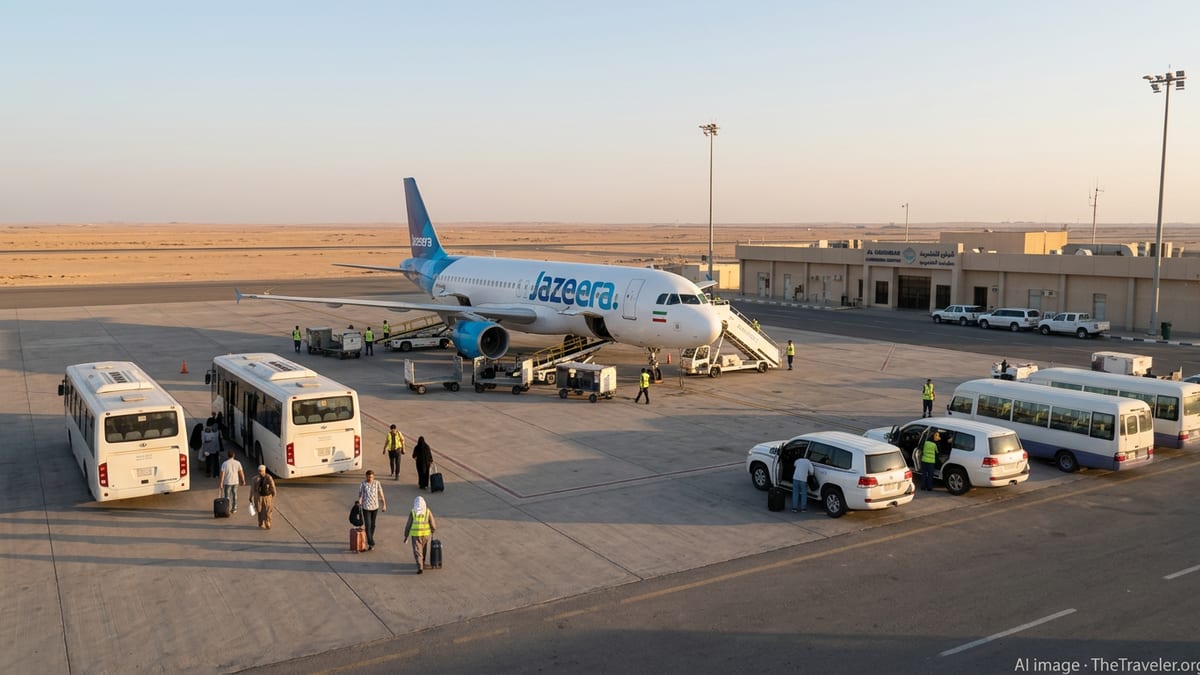
Emergency Pivot to Qaisumah as Kuwait Airspace Closes
Jazeera Airways confirmed over the weekend that it is moving a portion of its operations to Al Qaisumah Airport in Saudi Arabia’s Eastern Province, near the Kuwaiti border, after authorities shut Kuwait’s airspace to civilian traffic. The decision, cleared by regulators in both Kuwait and Saudi Arabia, allows the airline to keep at least some of its network functioning while flights to and from Kuwait City remain grounded.
The carrier is operating select services into Qaisumah, a relatively small regional airport that is now playing an outsized role in Kuwait’s connectivity. Jazeera normally links Kuwait with destinations across the Middle East, South Asia and Europe, but the sudden closure left thousands of passengers facing cancellations, long delays and scant alternatives.
For now, Jazeera is positioning the move as a temporary contingency rather than a full relocation of its hub. The airline has stressed that services remain subject to change as regional airspace conditions evolve, and it is urging customers to monitor flight status closely before setting out on their journeys.
Road Journeys Replace Short Hops for Stranded Travelers
The shift into Saudi territory has immediate and very tangible consequences for passengers. Those arriving on Jazeera flights into Qaisumah are being told they may continue their journey by road back into Kuwait, while outbound travelers must make the reverse trek, first reaching the Saudi airport overland and then boarding their international flights from there.
What used to be a straightforward hop from Kuwait International Airport has quickly turned into a hybrid itinerary combining desert road transfers with international air travel. Travel agents in the region report itineraries that once required a single boarding pass now involve a patchwork of flights and ground segments, lengthening journey times and adding logistical complexity for families, business travelers and migrant workers alike.
The road link is an especially daunting prospect for travelers with tight schedules, mobility challenges or limited documentation. Jazeera has underlined that passengers must hold a valid visa to enter Saudi Arabia in order to use the Qaisumah workaround, a requirement that leaves some customers with little choice but to wait for airspace to reopen or seek entirely different routings.
A Strategic Bet on Saudi Arabia’s Resilience
While framed as an emergency response, the move also underscores Jazeera Airways’ longer term interest in deepening its presence in Saudi Arabia, the region’s largest aviation market. The carrier has spent recent years building up charter services for Hajj and Umrah pilgrims and courting Saudi leisure and business travelers, viewing the kingdom as central to its growth strategy.
By using Qaisumah as an operational lifeline during the current disruption, Jazeera is effectively betting on Saudi infrastructure and regulatory flexibility to keep its network alive. Industry analysts note that Saudi airports have emerged as critical pressure valves in the present crisis, taking on diverted flights and offering corridors when other Gulf airspace has gone quiet.
The pivot also sends a signal to investors and competitors that Jazeera intends to stay in the game despite the latest shock. Maintaining even a skeleton schedule via Saudi territory may help the airline preserve market share, aircraft utilization and brand visibility at a time when some rivals are cancelling large portions of their schedules.
Regional Airspace Shockwaves Reshape Gulf Travel
Jazeera’s Saudi detour comes against a backdrop of sweeping disruption across the Gulf’s aviation system following the escalation of conflict involving Iran in late February. Temporary airspace closures have rippled across Kuwait, Bahrain, Qatar and parts of the United Arab Emirates, forcing airlines to suspend services, reroute around closed corridors and introduce lengthy diversions.
Major carriers including Emirates, Etihad and Qatar Airways have begun cautiously restoring portions of their networks, but schedules remain patchy and subject to last minute change. Aviation data providers show large numbers of flights to key hubs still cancelled or diverted, and airlines continue to advise passengers not to travel to the airport without confirmed, operational bookings.
For the wider region, the crunch has exposed just how dependent global travel has become on Gulf airspace and hub airports. With corridors narrowed and some hubs partially isolated, carriers from Europe, Asia and Africa have had to redraw long haul routes, adding hours to flight times and significantly increasing fuel burn, costs that are likely to filter through to fares if the disruption persists.
What Travelers Should Expect in the Days Ahead
For Jazeera Airways customers, the immediate reality is one of uncertainty, improvisation and longer journeys. Seats into and out of Qaisumah are limited, and the overland leg between Kuwait and Saudi Arabia can add several hours to total travel time, especially with potential delays at the border and on desert highways.
Travel advisers urge passengers to build generous buffers into their plans, carry printed copies of all travel documents and confirmations, and stay alert for schedule changes that might be communicated with little notice. Those without the necessary Saudi entry documents may need to work with airlines and embassies to explore alternative routings through third countries, or to postpone nonessential travel until airspace conditions stabilize.
Even as some Gulf airlines talk about ramping up flights in the coming days, the situation around Kuwait’s airspace, and by extension Jazeera’s reliance on Saudi workarounds, remains fluid. For now, the carrier’s swift pivot to Saudi Arabia underscores both the fragility of regional air corridors and the agility airlines must show to keep people moving when the sky above them suddenly closes.