

More news on this day
Regional air travel between Saudi Arabia and Egypt is rapidly recalibrating as Jazeera Airways, alongside carriers such as Kuwait Airways, Gulf Air, Flyadeal and Saudia, taps Qaisumah in Saudi Arabia as a key staging point to reconnect passengers with Sohag and other high-demand Egyptian destinations.
Get the latest news straight to your inbox!
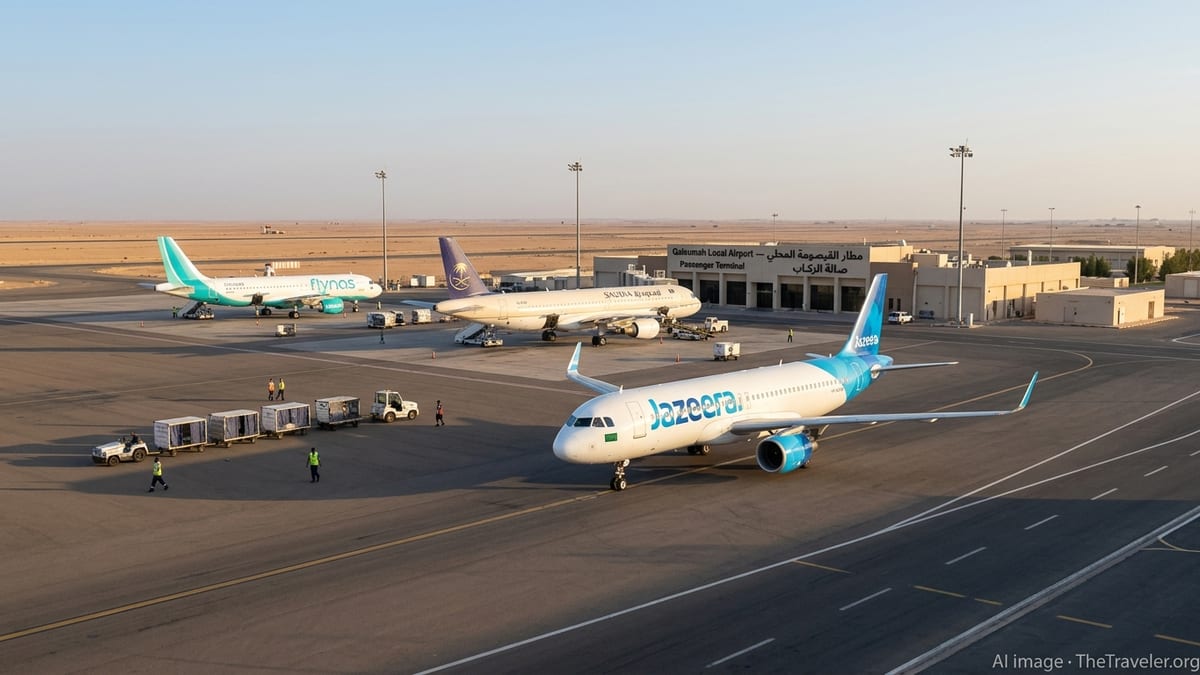
Qaisumah Emerges as a Strategic Detour Hub
Recent airspace disruptions around Kuwait have pushed airlines to reconfigure their networks, with publicly available information indicating that Jazeera Airways has temporarily shifted core operations to Qaisumah Airport in Saudi Arabia’s Eastern Province. Reports suggest the move is designed to maintain connectivity for travelers who would normally route through Kuwait, particularly on popular Saudi–Egypt flows.
Qaisumah, historically a modest regional field, is now seeing rising interest as a technical and transit stop. Fare and schedule data compiled by online booking platforms show multiple options from Qaisumah to major Egyptian gateways, including Cairo, Luxor, Aswan and Sohag, primarily through one-stop itineraries operated or marketed by Saudia and other regional partners. This evolving role positions the airport as an unexpected beneficiary of the current Gulf operational reshuffle.
For Jazeera Airways, the relocation to Qaisumah effectively creates a substitute hub, allowing the airline to keep serving Egyptian cities listed in its destination map, notably Sohag. While direct non-stop Qaisumah–Sohag links remain limited, the combination of domestic Saudi legs and onward Egypt services is restoring a measure of continuity for migrant workers, visiting families and religious travelers who rely heavily on these routes.
Industry observers note that the Qaisumah pivot may prove significant beyond the short term. If passenger demand holds, the airport could retain an expanded role in point-to-point Saudi–Egypt traffic or continue as a backup hub when regional disruptions affect primary gateways such as Kuwait City.
Saudi–Egypt Demand Underpins Network Adjustments
Saudi Arabia and Egypt are among the Middle East’s busiest country pairs, driven by large expatriate communities, religious tourism and growing leisure travel in both directions. Timetable aggregators and fare search platforms list dozens of direct and one-stop connections linking Saudi cities such as Riyadh, Jeddah, Abha and Gassim with Egyptian destinations including Cairo, Sohag, Luxor and Aswan.
Carriers such as Saudia and Flyadeal are central to this traffic flow, operating a mix of trunk routes to Cairo and secondary links to Upper Egypt. Data from flight comparison services show fares and scheduled options from Qaisumah into Egypt, often using Saudia-operated legs with connections through larger Saudi hubs. This enables itineraries from Qaisumah to Sohag and Luxor even where non-stop flights are not yet widely available.
Nesma Airlines, Nile Air and other Egyptian operators also contribute capacity between the two countries, particularly to smaller cities that serve sizable diaspora populations. Route maps published by these airlines highlight a network of links to Sohag, Luxor and Aswan, illustrating how much of the demand is oriented toward family visits and hometown travel rather than purely business traffic.
The resulting mosaic of services helps explain why airlines have been quick to re-route rather than suspend Saudi–Egypt operations during the current period of regional disruption. Maintaining continuity on these sectors is commercially important and socially sensitive, as many passengers rely on relatively affordable flights to move between work in the Gulf and families in Upper Egypt.
Jazeera Airways Joins Wider Gulf Carrier Response
Jazeera Airways’ decision to relocate operations to Qaisumah aligns with a broader pattern among Gulf-based carriers adjusting to temporary airspace closures and operational constraints. Regional aviation coverage indicates that Kuwait Airways, Gulf Air and other airlines have redeployed aircraft and adjusted schedules, in some cases shifting flights to alternative Saudi airports to preserve connectivity.
While each airline is pursuing its own strategy, the common objective is to keep hubs linked to key labor and tourism markets in Egypt. For Jazeera Airways, this means ensuring that passengers can still access destinations such as Sohag via alternative routings, even if journeys require an additional domestic leg or a change of gauge within Saudi Arabia.
Flyadeal and Saudia, already active on numerous Saudi–Egypt routes, appear well placed to absorb diverted demand and to provide onward options from interim hubs such as Qaisumah. Publicly available schedules show both carriers operating a dense mesh of flights from Saudi regional airports into Egypt’s main cities, offering potential interline or separate-ticket solutions for passengers affected by route changes around Kuwait.
The combination of these adjustments underscores the degree of coordination, both formal and informal, that characterizes Gulf aviation during periods of disruption. Even without explicit joint announcements, overlapping networks and compatible schedules allow airlines to collectively sustain flows between Saudi Arabia and Egypt.
Renewed Focus on Secondary Cities Like Sohag
The emphasis on restoring flights to Sohag highlights a continuing shift in Middle Eastern aviation toward secondary and provincial cities. Sohag International Airport has become an important gateway for Egyptians from Upper Egypt working in the Gulf, offering a closer alternative to Cairo and reducing internal travel times for returning residents.
Route data from airline and airport publications shows that Sohag, along with Luxor and Aswan, is now firmly embedded in the regional network, with multiple carriers serving these points from Saudi Arabia and other Gulf states. Although frequencies can fluctuate with seasonal demand and operational constraints, these cities remain core markets rather than occasional charter destinations.
By using Qaisumah as a launchpad, Jazeera Airways and its regional peers can reconnect Sohag-bound passengers who might otherwise face lengthy detours or overland journeys. Even when itineraries involve a connection, the availability of through-fares and coordinated schedules significantly eases the journey for travelers carrying luggage and often traveling with families.
The renewed attention on secondary airports also dovetails with broader tourism and development strategies in both countries. Egyptian authorities have promoted Upper Egypt’s cultural and archaeological sites, while Saudi Arabia continues to invest in domestic connectivity as part of its economic diversification programs. Stronger air links between Qaisumah, Sohag and nearby cities such as Luxor and Aswan support these long-term policy goals.
What Travelers Should Expect in the Near Term
For passengers, the evolving role of Qaisumah brings both new options and a degree of complexity. Travel advisories and community reports from the Gulf indicate that some itineraries now involve cross-border road segments to reach departure airports inside Saudi Arabia, including Qaisumah, before continuing by air toward Egypt.
Prospective travelers are encouraged by publicly available guidance to monitor airline notifications closely, as schedules remain subject to short-notice adjustments while airspace conditions stabilize. Fare comparison tools already reflect the updated routings, with Qaisumah appearing as an origin or transit point on journeys to Cairo and Upper Egypt destinations such as Sohag, Luxor and Aswan.
Industry analysts suggest that if the Qaisumah model proves successful, airlines could retain or even expand these connections beyond the immediate period of disruption, creating a permanent alternative corridor between Saudi Arabia and Egypt. In that scenario, Jazeera Airways would join Saudia, Flyadeal, Kuwait Airways, Gulf Air and others in anchoring a more diversified, resilient regional network.
For now, the resumption and redirection of flights via Qaisumah underline how quickly Middle Eastern carriers can reconfigure their operations. The resulting web of services is once again linking workers, families and tourists across Saudi Arabia and Egypt, with Sohag standing out as a key beneficiary of the latest round of network realignments.