

More news on this day
With Kuwait’s airspace closed amid regional tension, Jazeera Airways is rapidly reconfiguring its network via neighboring Saudi Arabia, turning improvised detours into a de facto tourist and transit lifeline for travelers trying to reach or leave Kuwait.
Get the latest news straight to your inbox!
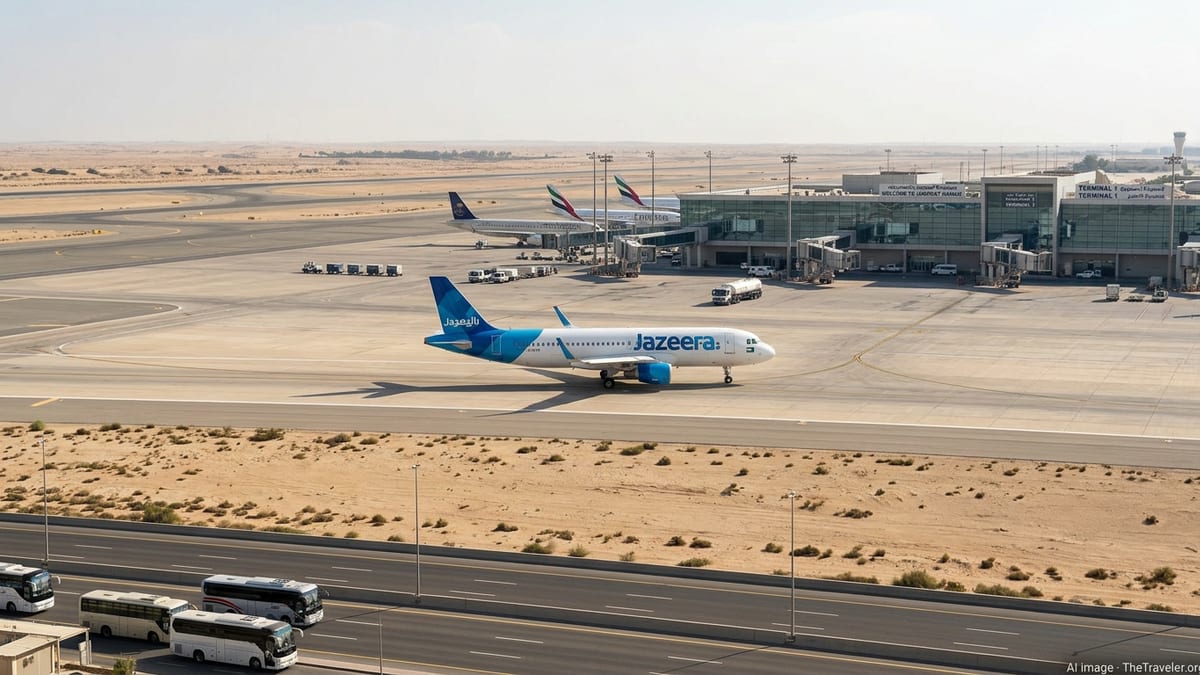
Airspace Closure Forces Rapid Rerouting
Commercial traffic through Kuwait International Airport has been heavily disrupted by the ongoing conflict in Iran, prompting carriers to suspend or reshape services that would normally funnel visitors and residents through the Gulf state. Publicly available flight and passenger reports indicate that Jazeera Airways, Kuwait’s main low-cost carrier, has been among the most affected, with schedules adjusted, charters reshaped and bookings reworked around the sudden loss of its home hub.
Instead of simply cancelling services, the airline is increasingly leaning on Saudi Arabian gateways to keep passengers on the move. Industry trackers report that Jazeera has restarted religious charter operations for Umrah directly into Saudi Arabia, avoiding Kuwaiti airspace altogether. For many travelers who once connected through Kuwait, these new routings have quickly become the only viable way to complete journeys originally planned around the country’s now-constrained airport.
The shift is particularly visible on traffic traditionally routed between Saudi Arabia and Russia, which had relied on Kuwait as a convenient midpoint. Recent operational updates show these flights now operating as direct sectors between Saudi cities and Russian destinations, preserving a flow of tourists and business passengers even as Kuwait’s skies remain largely off-limits.
Saudi Gateways Emerge as Kuwait’s Proxy Hub
While Kuwait International Airport’s role as a regional connector is on pause, Saudi airports are absorbing part of its function. Reports from aviation data providers and traveler accounts highlight Jeddah, Riyadh and other Saudi gateways as the new pivot points for journeys that once passed through Kuwait. For passengers, that often means reissued tickets, freshly booked sectors and itineraries stitched together through Saudi territory instead of Kuwait’s capital.
In parallel with formal flight rescheduling, an on-the-ground ecosystem is forming to bridge the gap between Kuwait and Saudi Arabia. Information shared by travelers indicates that cross-border road links and organized ground transfers are being used to connect passengers from Kuwait to Saudi airports where air services are still operating. In some cases, travelers describe being directed toward scheduled buses or private transport to reach Saudi departure points, effectively extending the airline network across the desert by road.
This hybrid model of buses and flights turns Saudi Arabia into an interim gateway for Kuwait-bound and Kuwait-origin passengers. It is an inversion of the usual pattern in which Kuwait acts as a feeder hub into Saudi Arabia for religious tourism and leisure travel; for now, Saudi territory is functioning as Kuwait’s surrogate air bridge to the wider world.
Umrah, Hajj and Leisure Traffic Find Alternative Paths
The disruption comes at a sensitive time for regional tourism flows, particularly for religious travel. Jazeera Airways has previously promoted its role in carrying pilgrims from Central Asia and other markets into Saudi Arabia, often via Kuwait. Recent network updates show that this role is being preserved as far as possible through renewed Umrah charter operations routed directly to Saudi cities, bypassing the restricted Kuwaiti airspace.
For pilgrims, these charters are becoming a critical workaround. Instead of transiting through Kuwait on scheduled low-cost services, many are now boarding dedicated flights that start and end entirely outside the country, even if their original plans involved a Kuwait stopover. Publicly available coverage suggests that this adjustment is enabling continued flows of religious tourism into the Kingdom at a time when many regional itineraries are being cancelled or postponed.
Leisure travelers are following a similar pattern. Tourists heading from Russia, South Asia and other markets toward the Gulf are increasingly being rebooked onto itineraries that skirt Kuwait and rely on Saudi gateways. While this limits opportunities for stopover tourism inside Kuwait itself, it keeps important visitor flows alive and preserves future demand that might otherwise be lost to competing hubs.
Ground Transport and Border Crossings Become Part of the Network
As airlines rework their schedules, travelers are turning to land borders as an essential part of their journey. Public discussions among passengers show growing interest in driving or taking buses between Kuwait and Saudi Arabia in order to connect with flights operating from Saudi airports. Some accounts describe organized coach services associated with airline operations, while others reference private transfers arranged independently to make tight connections.
This blending of air and land travel effectively extends Jazeera’s reach beyond traditional network maps. Passengers are treating the Kuwait–Saudi border as a virtual terminal change, one that requires additional paperwork and planning. Guidance circulating online points to short-stay Saudi visit and stopover visas as a key tool, allowing travelers to cross the border, reach an airport such as Jeddah or Riyadh, and then continue their journey to Europe, Asia or back toward the Indian subcontinent.
For Kuwait, the result is an improvised lifeline that keeps inbound and outbound movement possible, even if the final air sector into the country must wait for airspace restrictions to ease. For Saudi Arabia, the surge underscores its growing role in regional tourism and aviation, where its airports increasingly function as emergency backstops as well as long-term hubs.
Implications for Kuwait’s Future as a Transit Gateway
The current detours through Saudi Arabia highlight both the vulnerability and the resilience of Kuwait’s tourism ambitions. Before the latest disruption, Jazeera Airways had been steadily expanding its international reach, adding destinations across Europe and Asia and supporting inbound tourism partnerships with national and regional authorities. That growth helped position Kuwait as a compact, cost-effective jumping-off point for travelers heading deeper into the Gulf or onward to the Levant and Central Asia.
The rapid pivot via Saudi Arabia shows that, even when Kuwait’s airspace is constrained, demand for connections linked to the country remains strong. Passengers are willing to endure more complex routings and land segments to preserve jobs, family ties and long-planned trips. For Kuwait’s tourism planners, that persistence suggests that once normal operations resume, there may be a rebound in both stopover and destination traffic, especially if the country can market itself effectively to travelers who have just experienced the challenges of reaching it indirectly.
In the meantime, Jazeera’s adaptation illustrates how a mid-sized low-cost carrier can use neighboring markets to keep its customer base engaged through a crisis. By turning Saudi Arabia into a temporary extension of its network and maintaining key religious and leisure flows, the airline is keeping Kuwait connected in spirit, if not yet fully by air. The long-term test will be whether these improvised routes evolve into a more permanent dual-hub strategy, or fade back into contingency measures once Kuwait’s skies fully reopen.