

More news on this day
Athens is preparing for a rare meeting of prehistory and pop-inflected contemporary art, as the Museum of Cycladic Art unveils Jeff Koons’ monumental Balloon Venus Lespugue in a show that reimagines the city’s classical heritage for a new generation of travelers.
Get the latest news straight to your inbox!
A Landmark Moment for Athens’ Contemporary Art Scene
The Museum of Cycladic Art in central Athens is foregrounding contemporary art in a striking new way with the exhibition “Jeff Koons: Venus Lespugue.” Centered on Balloon Venus Lespugue (Orange), a polished stainless-steel sculpture standing around 2.5 meters tall, the show positions the American artist’s signature high-gloss language within a museum best known for its marble figurines and prehistoric artifacts.
According to exhibition information released by the museum and recent arts coverage, the show is scheduled to run in the museum’s Stathatos Mansion wing from March 20 to August 31, 2026. The presentation follows earlier contemporary programs at the institution featuring artists such as Cindy Sherman and Marlene Dumas, signaling a sustained effort to make Athens a key stop on the global art circuit.
For visitors, the timing aligns with the city’s broader cultural calendar, which in recent years has included large-scale events at the National Museum of Contemporary Art, the Benaki Museum and a growing roster of private foundations. Travel publications already list the Koons exhibition among the headline shows expected to draw international attention to Athens in 2026.
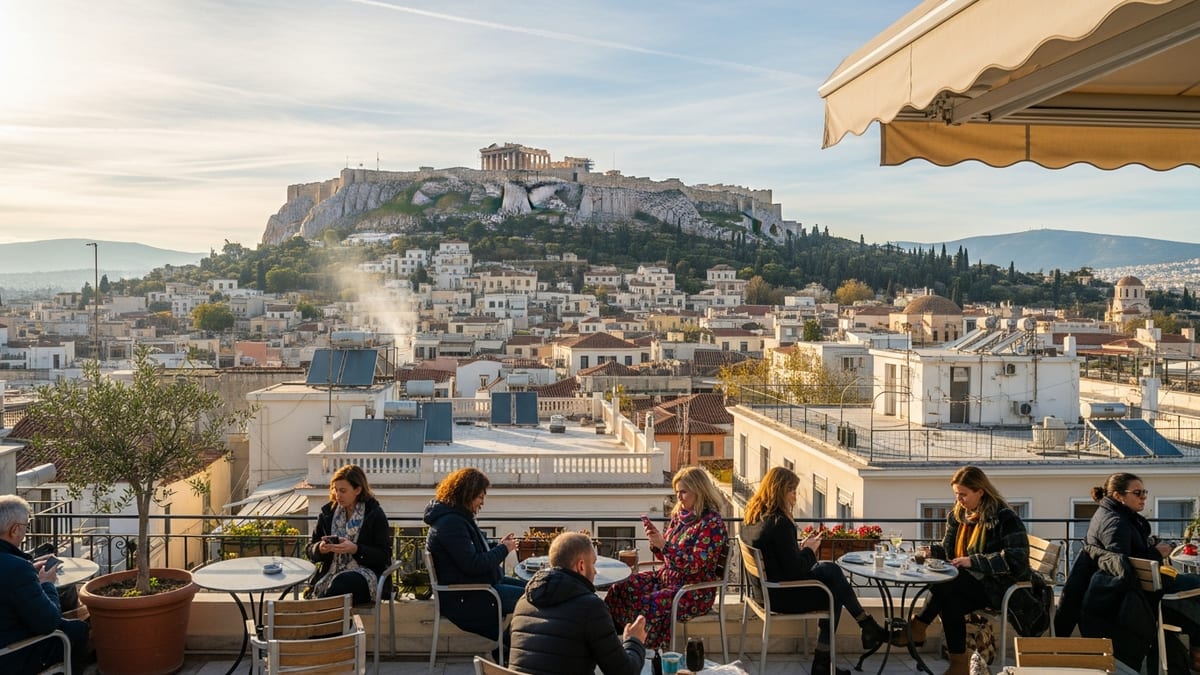
Situated in the upscale Kolonaki district, close to Syntagma Square and the National Garden, the Museum of Cycladic Art offers travelers an accessible pivot from ancient ruins to climate-controlled galleries, adding a contemporary highlight to classic city itineraries focused on the Acropolis and nearby archaeological sites.
Prehistoric Venus Reimagined in Stainless Steel
Balloon Venus Lespugue (Orange) is part of Koons’ long-running engagement with historical sculpture, particularly prehistoric fertility figures. The work takes its cue from the Venus of Lespugue, a small mammoth-ivory figurine discovered in France and dated to roughly 28,000 years ago. Koons enlarges this compact object into a gleaming, reflective presence that towers above museum visitors while retaining the exaggerated curves associated with Paleolithic depictions of the female body.
Exhibition materials indicate that the Cycladic presentation is the first time this specific version of the Balloon Venus series has been shown in Greece. The sculpture’s mirror-like surface, engineered through industrial fabrication methods, reflects both viewers and surrounding architecture, effectively inserting the present-day city into the visual field of a figure inspired by deep prehistory.
The museum places the Koons work in conversation with replicas of Upper Paleolithic Venus figurines, including examples based on finds from across Europe. These small-scale reproductions, some only a few centimeters tall, emphasize how fertility figures once fit into the palm of a hand or a pocket, in stark contrast to the monumental scale and engineered perfection of Koons’ 21st-century version.
The dialogue invites visitors to consider how ideals of beauty, fertility and desire have shifted over tens of thousands of years, as well as how contemporary artists mine archaeological imagery to address present-day questions of identity, consumer culture and the commodification of the body.
A New Lens on the Museum of Cycladic Art
For many travelers, the Museum of Cycladic Art is primarily associated with its renowned collection of Early Bronze Age Cycladic figurines, characterized by minimal, folded-arm silhouettes carved in marble. The Koons exhibition builds on this reputation by extending the institution’s interest in the human form across a far wider timescale, linking Cycladic simplification of the body to both Paleolithic archetypes and Koons’ industrially produced abstractions.
Publicly available information shows that the Koons show occupies the Stathatos Mansion, a 19th-century neoclassical building connected to the museum’s main complex. Visitors will encounter the Balloon Venus there alongside contextual material, before or after exploring permanent displays of Cycladic, ancient Greek and Cypriot art in the main galleries.
The institution has framed the exhibition as part of a broader research initiative into prehistoric art and its resonances today, supported by a new publication with essays by Koons and specialist scholars. This academic underpinning positions the show as more than a high-profile art-world event, aligning it with the museum’s ongoing work on Cycladic and Aegean prehistory.
For tourism, the pairing of an internationally recognizable artist with a museum rooted in archaeological collections offers a bridge between audiences who might typically gravitate either to blockbuster contemporary shows or to classical antiquities, but not both.
Planning a Culture-Focused Visit to Athens
The exhibition’s March to August run aligns with Athens’ spring and summer visitor seasons, when many travelers combine island trips with a few days in the capital. The Museum of Cycladic Art’s central location makes it straightforward to integrate a visit into walking routes that take in the Byzantine and Christian Museum, the Benaki Museum on Vasilissis Sofias Avenue, and, a short metro ride away, the Acropolis Museum.
Reports in local travel media describe the Koons show as one of the city’s headline cultural draws for 2026, suggesting that advance planning around peak periods may be prudent for those seeking quieter viewing hours. While the Museum of Cycladic Art is generally less crowded than the Acropolis Museum or the Parthenon itself, the presence of a major international artist is expected to lift visitor numbers.
Athens’ growing reputation as a regional art hub, supported by commercial galleries, artist-run spaces and public institutions, means that a trip built around the Koons exhibition can easily expand into a broader survey of the city’s creative scene. Travelers interested in contemporary work can pair the Cycladic visit with stops at emerging galleries in neighborhoods such as Metaxourgio and Koukaki, or with larger-scale shows at the National Museum of Contemporary Art.
By foregrounding a dialogue between a prehistoric Venus and a polished stainless-steel sculpture, the Cycladic Museum offers visitors a compact yet resonant way to think about time, tradition and transformation, all within a single afternoon in the Greek capital.
From Prehistoric Figurines to Global Art Icon
Jeff Koons’ appearance at the Museum of Cycladic Art follows decades of high-profile exhibitions in New York, Paris, London and Bilbao. Coverage in international art media frequently notes his ability to turn everyday objects and familiar archetypes into monumental works that blur the boundaries between luxury commodity, popular culture and fine art.
In Athens, this approach encounters a city already saturated with archetypal imagery, from the Caryatids of the Acropolis Museum to the kouroi and korai in the National Archaeological Museum. By inserting Balloon Venus Lespugue into this environment, the Cycladic Museum highlights how contemporary artists continue to reinterpret ancient forms for a global audience.
At the same time, the exhibition asks viewers to look closely at the prehistoric replicas framing the Koons sculpture. Their worn surfaces, compact proportions and ritual associations offer a counterpoint to the pristine, reflective finish of Balloon Venus, underscoring how ideas about the sacred, the sensual and the monumental have evolved over millennia.
For travelers, the result is an experience that extends beyond a single artwork, inviting reflection on what it means to move through a city where traces of the distant past coexist with some of the most recognizable contemporary art of the present.