

More news on this day
Jeju Island, a volcanic outcrop off South Korea’s southern coast, is reshaping its tourism appeal as a tranquil escape where dramatic lava-sculpted landscapes meet traditional island culture and increasingly eco-conscious travel experiences.
Get the latest news straight to your inbox!
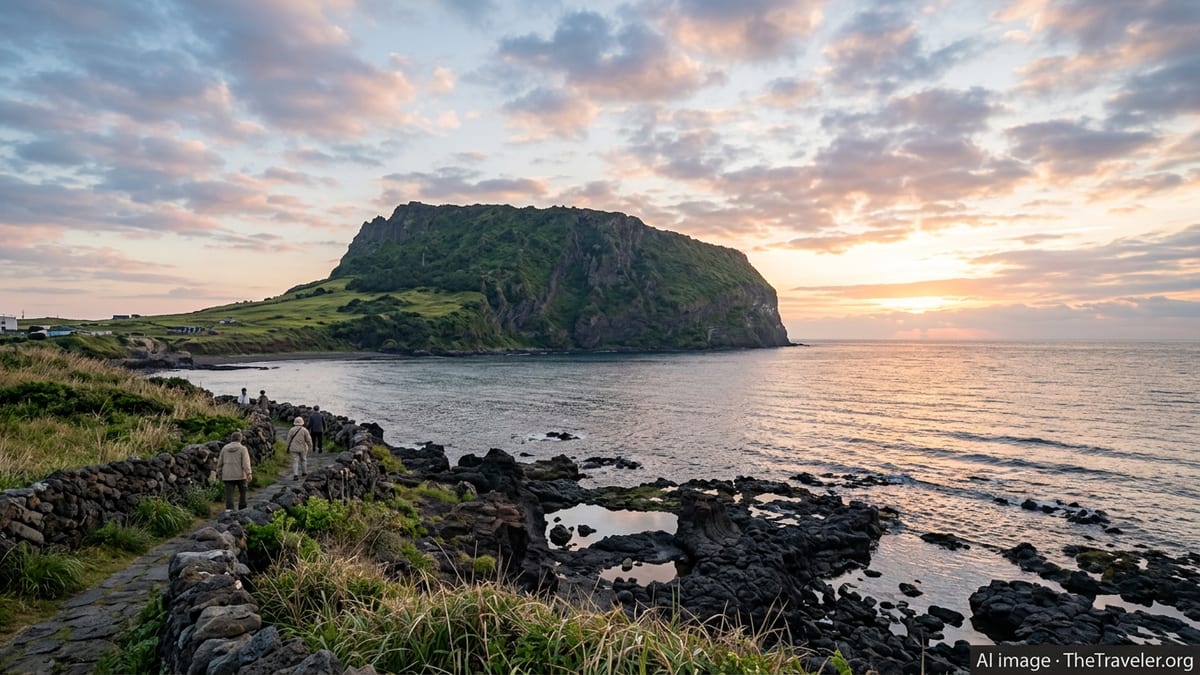
Volcanic Landscapes Shape a Natural Sanctuary
Jeju’s identity is rooted in its geology, with the island recognized globally for its volcanic terrain and extensive lava tube systems. The Jeju Volcanic Island and Lava Tubes complex, inscribed as a UNESCO World Heritage Site, includes Mount Hallasan at the island’s center, the fortress-like Seongsan Ilchulbong tuff cone on the east coast, and underground passages such as Manjanggul and Gimnyeonggul. These formations have made Jeju a showcase for how volcanic activity can create both wild scenery and surprisingly gentle walking environments.
Mount Hallasan, South Korea’s highest peak at 1,950 meters, is ringed by crater lakes, seasonal wildflowers, and forests that shift from subtropical at lower elevations to alpine vegetation near the summit. Well-maintained trails give visitors access to this variety of habitats, while park regulations limit daily hiker numbers on popular routes to help protect fragile ecosystems and preserve the calm that walkers seek on the mountain.
Along the coast, Seongsan Ilchulbong, known as Sunrise Peak, rises abruptly from the sea, offering sweeping views over the surrounding ocean and nearby islets. The crater’s steep green slopes and coastal cliffs have become emblematic of Jeju’s image as a place where elemental volcanic forces and soft morning light coexist, drawing early-morning hikers looking for a quiet vantage point above the water.
Below ground, accessible sections of lava tubes such as Manjanggul and Gimnyeonggul allow visitors to see cooled lava formations, soaring cave ceilings, and naturally sculpted stone pillars. Controlled lighting, marked paths, and restricted zones are used to balance visitor access with conservation, reinforcing Jeju’s positioning as a destination where geological spectacle is experienced with a degree of restraint.
Tourism Rebounds With a Focus on Calm and Space
Recent tourism figures indicate that Jeju is firmly back on the international travel map. Data from local tourism bodies and Korean media coverage show that more than 13 million visitors traveled to the island in 2024, with foreign arrivals surpassing 2 million and continuing to climb into 2025. Growth has been particularly strong among travelers from mainland China, who now account for a significant share of foreign visitors following changes to visa policies and expanded air capacity.
At the same time, reports from Korean outlets highlight that domestic visitor numbers, which boomed during the pandemic when international travel was restricted, have eased from their peak. Industry observers suggest that this shift is encouraging a recalibration of Jeju’s visitor mix, with more emphasis on international travelers seeking longer, slower-paced stays that combine hiking, coastal drives, and food-focused itineraries rather than short, high-intensity package tours.
Expanded airline routes and cruise calls have played a key role in the rebound. More direct flights now link Jeju with Chinese cities and regional hubs such as Macau and parts of Southeast Asia, while domestic carriers continue to operate frequent services from Seoul and Busan. This connectivity has made it easier for visitors to reach the island for long weekends or short nature-focused breaks without transiting through major hubs on the mainland.
Despite the rising numbers, Jeju remains marketed as an alternative to big-city breaks, with tourism campaigns emphasizing open horizons, stone-walled fields, and relatively uncrowded walking paths outside peak holiday periods. Travel planners point to shoulder-season visits in spring and late autumn as particularly attractive for travelers prioritizing tranquility over nightlife or shopping.
Cultural Traditions Add Depth Beyond the Scenery
Jeju’s volcanic setting is complemented by a distinct island culture that differentiates it from the Korean mainland. Publicly available information on Jeju’s cultural heritage highlights traditions such as the haenyeo, or female free divers, who harvest seafood without breathing apparatus and are recognized by UNESCO as part of the world’s intangible cultural heritage. Demonstration sites and small coastal communities give visitors a chance to observe this practice from designated viewing areas, in line with local rules that aim to prevent disruption to divers’ work.
Historical villages and folk museums across the island showcase low-slung stone houses built to withstand strong sea winds, along with basalt guardian statues, known as dol hareubang, that once stood at village entrances. These features, along with tangerine orchards and small family-run farms, reinforce Jeju’s image as a place where everyday life still follows the rhythm of the seasons rather than the cadence of a major metropolis.
Modern cultural offerings are also expanding. Arts centers, small galleries, and design-focused cafes clustered around Jeju City and Seogwipo host exhibitions, performances, and local craft markets that appeal to younger visitors. Travel industry analyses suggest that a growing number of domestic and regional tourists are building itineraries that combine hiking or coastal walks during the day with contemporary cultural experiences and seafood dining in the evening.
Food remains a major draw, with the island’s reputation built on black pork raised on volcanic soil, fresh sashimi, abalone dishes, and seasonal citrus. Restaurants range from traditional marketplaces to minimalist dining rooms overlooking the ocean, giving travelers multiple ways to experience local flavors after a day on the trails or along the shore.
Balancing Visitor Growth With Conservation and Courtesy
As Jeju’s popularity grows, local authorities and tourism bodies are working to manage potential pressures on the environment and communities. The island has triple UNESCO recognition as a Biosphere Reserve, a World Natural Heritage Site, and a Global Geopark, and recent conference papers and planning documents emphasize the need to protect lava tubes, wetlands, and coastal habitats from overuse.
One visible initiative involves the roll-out of multilingual etiquette notices in key visitor areas, including popular viewpoints, beaches, and town centers. According to coverage in regional travel media, these notices, printed in Korean, English, and Chinese, outline expectations around littering, noise, and respectful behavior at cultural sites. The goal is to maintain Jeju’s calm atmosphere even as more visitors arrive, by setting clear norms in a way that is accessible to diverse travelers.
Conservation measures extend to hiking routes and coastal zones. On Hallasan, limits on daily hiker numbers and seasonal trail closures are used to prevent erosion and allow vegetation to recover, while along the coast some sensitive areas are fenced off or accessible only via raised walkways. Environmental groups and academic studies have urged continued monitoring of visitor impacts on lava tube microclimates and endemic plant species, underscoring that Jeju’s appeal depends heavily on the health of its volcanic ecosystems.
Waste management and traffic are also under scrutiny. Tourism research discussing Jeju’s eco-friendly branding notes ongoing efforts to expand public transport options, encourage shuttle use between major sites, and promote longer stays that reduce the number of short, high-emission trips. Moves to highlight lesser-known trails and villages are intended to spread visitor traffic more evenly across the island, easing congestion at a handful of marquee sights while bringing tourism income to quieter communities.
Nature-Oriented Experiences Anchor Jeju’s Appeal
Beyond headline sites, Jeju is positioning itself as a walking island, centered on the Jeju Olle Trail network. The system of coastal and inland footpaths, divided into numbered sections that circumnavigate the island, allows visitors to follow old village roads, through tangerine groves, and along sea cliffs at a relaxed pace. Hikers collect stamps at waypoints, turning multi-day walks into a personal record of their journey.
For many visitors, the attraction lies in Jeju’s slower rhythm: modest-speed coastal roads, fishing harbors where small boats move with the tide, and stretches of black lava rock shoreline punctuated by pale sand beaches. Even in busier seasons, early morning and late afternoon often bring quieter moments when hikers share trails mainly with local residents and migratory birds.
Industry observers expect that as regional travel continues to recover, Jeju will face ongoing questions about how many visitors its landscapes and communities can comfortably host. For now, the island is leaning into an image that blends volcanic drama with accessible hiking, distinctive island culture, and a growing framework for responsible tourism, positioning Jeju as a volcanic paradise aimed at travelers seeking nature, culture, and tranquility in equal measure.