

More news on this day
Jet AirWerks is expanding its presence in the engine services market through a newly announced collaboration with Stratton Aviation, adding dedicated teardown capacity designed to feed the global demand for serviceable engine material and support airlines seeking more flexible maintenance options.
Get the latest news straight to your inbox!
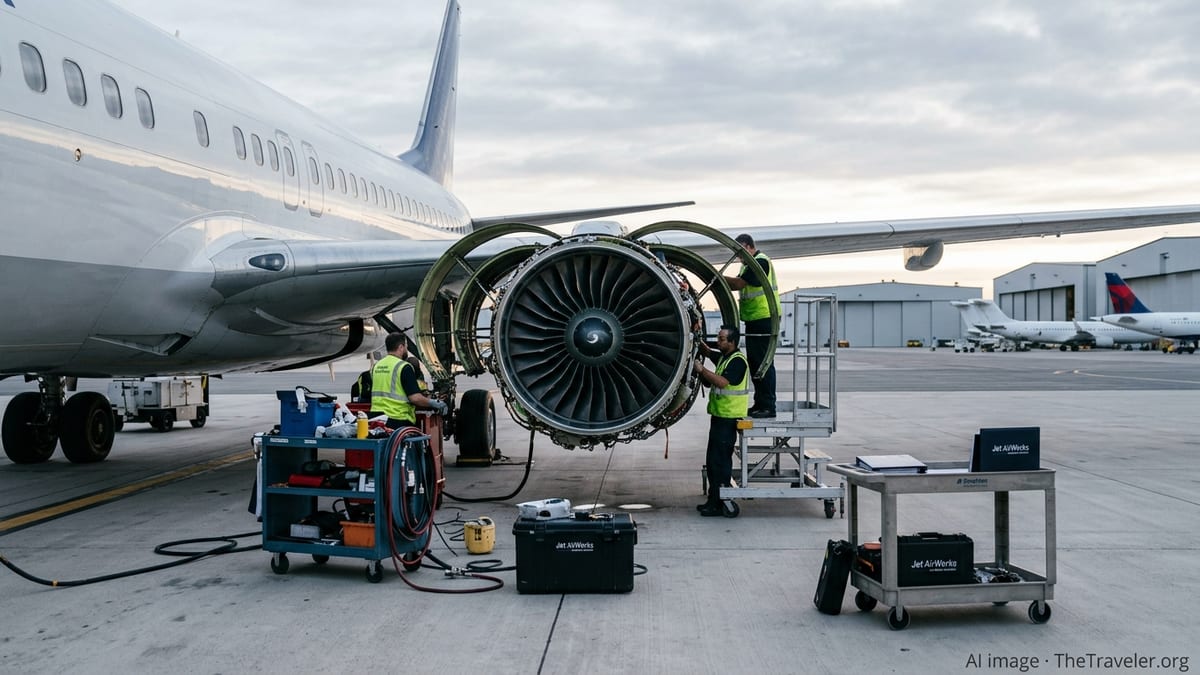
Partnership Targets Growing Demand for Engine Material
The collaboration between Kansas-based Jet AirWerks and Stratton Aviation focuses on expanding engine teardown services that supply serviceable material to maintenance, repair and overhaul providers, leasing companies and operators. Publicly available company information indicates that Jet AirWerks has traditionally concentrated on component repair and life-limited parts for CFM56, CF34 and CF6 families, while Stratton Aviation has built its business around acquiring, trading and managing aircraft and engine assets.
By combining Jet AirWerks’ established repair capabilities with Stratton Aviation’s asset management and trading network, the two companies aim to accelerate the flow of engines through teardown and into the material supply chain. Industry observers note that air travel demand and fleet utilization have remained strong, which in turn has increased the need for competitively priced used serviceable material as airlines work to keep legacy and mid-life engines in operation for longer cycles.
The expanded teardown activity is expected to focus on high-volume commercial engine types widely used in single-aisle and regional fleets. For airlines and lessors, additional teardown capacity can offer an alternative to new parts procurement, which remains constrained in some segments, and may help reduce turnaround times for shop visits where critical components are in short supply.
The agreement underlines a broader trend across the engine aftermarket, where specialist repair houses are forming closer ties with asset-focused companies to secure a more predictable pipeline of engines for disassembly. This approach is intended to smooth volatility in used-material availability and give operators greater confidence when planning heavy maintenance events.
How Expanded Teardowns Fit Into Jet AirWerks’ Strategy
Jet AirWerks has progressively positioned itself as a niche engine component repair and overhaul specialist, with directory listings in annual engine yearbooks pointing to capabilities across life-limited parts, tubes, ducts, manifolds and structural hardware on several widely used engine platforms. The addition of more systematic teardown activity through Stratton Aviation offers the company a way to deepen its role across the engine lifecycle, from repair of individual parts to management of material streams coming from complete engines.
Rather than operating only as a repair station receiving parts from multiple sources, Jet AirWerks can now participate closer to the front end of the supply chain, where engines are evaluated, disassembled and routed either to resale, consignment or repair. This vertical extension is intended to provide better visibility on upcoming material, allowing the company to match its repair capacity to market demand and to support customers with a broader portfolio of solutions.
For Stratton Aviation, teaming with a repair-focused partner offers a technical pathway to enhance the value of assets acquired for teardown. Engines that move through the program can yield components that are eligible for repair under original equipment manufacturer manuals, extending their service lives and creating additional revenue streams once they are recertified and made available to the secondary market.
Market analysts describe these kinds of partnerships as a way for mid-sized aftermarket businesses to compete with larger integrated players. By leveraging complementary strengths rather than building all capabilities in-house, companies can react more quickly to shifts in engine residual values, retirement patterns and changes in operator fleet strategies.
Implications for Airlines, Lessors and MRO Providers
For airlines and engine lessors, the Jet AirWerks and Stratton Aviation collaboration may contribute to a more diverse pool of used serviceable material at a time when global supply chains are still normalizing. Many carriers have extended the in-service life of older narrowbody aircraft and delayed fleet renewal decisions, which has placed additional pressure on engine overhaul shops and parts suppliers.
In this environment, teardown programs are viewed as an important tool for balancing cost and availability. Engines removed from aircraft due to age, performance or lease-return timelines can be disassembled and converted into material that supports the rest of the fleet. Additional capacity brought on by collaborations such as this one can help reduce dependency on new-production parts and mitigate some of the lead-time uncertainty that has challenged maintenance planning.
Maintenance and repair organizations may also benefit from having more structured access to material flows that originate at the teardown stage. With a specialist repair house involved directly in the program, MRO providers can work with a partner that understands repair schemes, scrap rates and documentation requirements, which are critical for ensuring that harvested parts meet regulatory and airworthiness standards.
Leasing companies, meanwhile, are expected to continue evaluating assets for part-out when they no longer fit long-term portfolio strategies. Partnerships between teardown and repair-focused firms provide additional exit options for engines coming off lease, potentially improving residual value outcomes and offering more predictable channels for placing serviceable material back into the market.
Engine Aftermarket Trends Drive Consolidation and Collaboration
The decision by Jet AirWerks and Stratton Aviation to expand engine teardown services aligns with a broader shift in the engine aftermarket, where collaboration and specialization have become defining features. Published industry surveys show that many operators are seeking flexible maintenance arrangements, mixing in-house capabilities, independent repair shops and material traders to control costs.
As new-generation engines gradually take a larger share of global fleets, mid-life and mature engine types continue to generate substantial maintenance activity. Teardown programs targeting these platforms remain an important source of cost-effective material, particularly for carriers operating in price-sensitive markets or on secondary routes where capital-intensive fleet renewal is less immediately feasible.
At the same time, environmental considerations are playing a larger role in asset strategies. Structured teardown and recycling allow more components and materials to remain in productive use, supporting circular-economy objectives within aviation. By formalizing how engines are disassembled, inspected and routed, partnerships like the one between Jet AirWerks and Stratton Aviation contribute to more transparent and traceable end-of-life processes for complex assets.
Industry commentary suggests that similar collaborations may continue to emerge as businesses look for scale without necessarily pursuing full mergers or acquisitions. Combining teardown, repair, trading and logistics expertise under coordinated programs can provide many of the advantages of integration while retaining the agility of smaller, specialized firms.