

More news on this day
Global air travel is bracing for a turbulent 2026 as jet fuel prices soar to multi-year highs, pushing airlines to raise fares, trim routes and warn passengers to expect more volatile flight schedules in the months ahead.
Oil Shock and War Drive Jet Fuel to Multi‑Year Highs
Jet fuel benchmarks, which track the cost of refining crude oil into aviation fuel, have jumped sharply since January as conflict in Iran and wider Middle East tensions disrupted energy markets. Analysts say the spike has pushed jet fuel to its highest levels since the pandemic-era commodity shock, reversing the relative stability airlines had counted on for 2025.
The International Air Transport Association’s latest fuel price data show a steep climb in global jet fuel indices through February, reflecting both higher crude prices and wider refining margins. IATA’s December 2025 outlook for 2026 had assumed a more moderate fuel environment, but the sudden escalation in regional conflict has upended those forecasts and left carriers scrambling to adjust.
Government and industry figures underscore how quickly conditions have shifted. In the United States, official statistics for January 2026 show airlines paying nearly 2 percent more per gallon than in December, even as they burned substantially less fuel. That combination of rising unit costs and constrained supply is being mirrored in key aviation hubs across Europe, the Gulf and Asia.
Market strategists warn that if crude remains elevated and refining capacity in key export regions remains constrained, airlines could be locked into significantly higher fuel bills through the peak northern summer travel season. For an industry where fuel already accounts for roughly a quarter of operating costs, the latest spike leaves little room to absorb shocks without passing them on to travelers.
Airlines Signal Higher Fares as Cost Pressures Mount
Major carriers have begun preparing customers for a new round of airfare increases. United Airlines’ chief executive told investors last week that the surge in jet fuel prices would have a “meaningful” impact on first-quarter results and could quickly translate into higher ticket prices if elevated costs persist into the second quarter. Similar messages have emerged from European and Asian airlines in recent days as they revise internal fuel and revenue assumptions.
Financial analysts say many carriers initially sought to absorb part of the increase by trimming discretionary spending and using fuel hedging contracts, which can partially shield airlines from short-term volatility. However, with prices now at multi-year highs and futures markets reflecting sustained tension in the Middle East, the scope for quietly absorbing costs is narrowing. Several network airlines are already testing targeted “fuel surcharges” on long-haul routes and premium cabins where demand is less price-sensitive.
Early signs of the shift are visible in key leisure and business markets. Frequent flyers in North America and Europe report paying significantly more for spring and early summer itineraries than a year ago, even when booking months in advance. In many cases, base fares have risen while the lowest promotional buckets have quietly disappeared, limiting the availability of headline discounts that previously kept average prices in check.
Industry groups caution that higher fares risk dampening the robust demand rebound seen in 2025, when global passenger traffic finally surpassed pre-pandemic levels. IATA’s January traffic data showed record-high load factors on many international routes, but economists warn that persistent price inflation could curb discretionary travel, particularly for price-sensitive leisure passengers in emerging markets.
Capacity Cuts and Fragile Schedules Add to Traveler Uncertainty
The fuel shock is hitting airlines at a time when global schedules are already under strain from aircraft delivery delays, staffing challenges and lingering air traffic control restrictions. To protect margins, carriers are beginning to prune their 2026 capacity plans, particularly on thinner or marginally profitable routes where higher fuel costs quickly erase earnings.
Network planners in the United States and Europe are reviewing frequency reductions on short-haul business routes and trimming seasonal flying to secondary leisure destinations. Some low-cost carriers in Asia and the Middle East, which rely heavily on high aircraft utilization and aggressive pricing, are reworking timetables and deferring planned route launches into late 2026 or 2027. In several cases, airlines are consolidating flights, turning two off-peak departures into a single, fuller service.
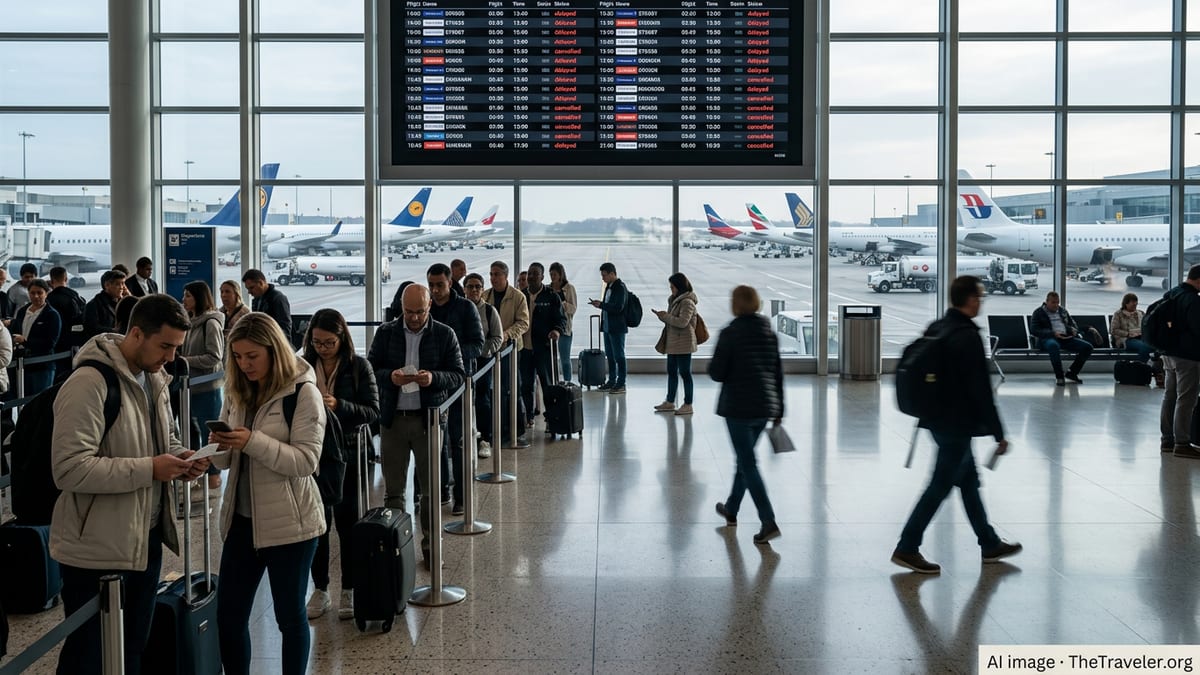
The result for passengers is an increasingly unpredictable schedule environment. Travelers are seeing more timetable changes in the weeks and months after booking, with flight times shifted, routings altered and departure days adjusted as airlines chase efficiency and cut underperforming sectors. Operational buffers, such as spare aircraft and crew, remain thin, meaning that any disruption can cascade quickly through a carrier’s network.
Recent data from the United States already show a decline in aviation fuel consumption as airlines operate fewer flights and streamline operations. European air traffic managers report similar patterns, with capacity growth slowing in early 2026 compared with last year’s rapid rebound. Throughout the Middle East, emergency airspace restrictions and constrained airport throughput tied to the regional conflict are further limiting airlines’ ability to restore pre-crisis schedules.
Middle East Disruptions Ripple Across Global Networks
The geopolitical shock in and around Iran is amplifying the fuel price surge by simultaneously disrupting key air corridors. Several Gulf carriers are operating reduced schedules or rerouting flights to avoid conflict zones, lengthening journey times and raising fuel burn on some of the world’s busiest long-haul connections between Europe, Asia and Africa.
Aviation analysts note that while only a portion of global flights pass directly through the affected region, the airlines based there play an outsized role in connecting traffic between continents. When major hubs operate under capacity caps or emergency procedures, connections that once relied on tightly timed banks of arrivals and departures become harder to sustain. That can prompt airlines elsewhere to retime or even suspend routes that depend on smooth onward connections through Gulf or Levant hubs.
War-related disruptions are also feeding back into fuel markets. Concerns about the security of shipping lanes and export terminals in the Gulf have already pushed crude and refined product prices higher, while some refineries that specialize in aviation fuel have had to adjust output in response to logistical bottlenecks. The closure or restriction of specific pipelines and terminals can have an outsized impact on regional jet fuel availability, forcing airlines to tanker additional fuel on certain legs and further complicating flight planning.
For travelers, that translates into a patchwork of schedule changes that extends far beyond the Middle East. Flights between Europe and South Asia, Australia and Western Europe, and even certain transatlantic services that rely on aircraft and crew rotations via Gulf hubs are all experiencing irregular operations. Travel agents report longer minimum connection times, more forced overnights and greater reliance on secondary hubs as airlines attempt to rebuild resilient routings.
Sustainable Aviation Fuel Costs Add Another Layer of Pressure
Even before the latest oil shock, airlines were grappling with the rising cost of meeting climate targets through sustainable aviation fuel. IATA estimates that sustainable aviation fuel, or SAF, will account for less than 1 percent of global jet fuel consumption in 2026, yet it already adds billions of dollars to industry fuel bills because it trades at several times the price of conventional kerosene in many regulated markets.
Policy mandates in the European Union, United Kingdom and parts of North America are gradually increasing minimum SAF blending requirements, forcing airlines to buy small but costly volumes. At the same time, industry forecasts suggest that global SAF supply growth could slow in 2026 due to high feedstock costs and project delays, keeping prices elevated and limiting the ability of airlines to substitute away from traditional jet fuel as fossil prices spike.
Carriers warn that without stronger government support to scale up SAF production and reduce costs, the combination of expensive green fuel and volatile fossil prices could create a prolonged period of elevated airfares. Environmental groups counter that high prices may accelerate efficiency improvements and curb unnecessary flying, but acknowledge that sudden spikes risk undermining public support for long-term decarbonization measures.
For now, most airlines are focusing on incremental steps: deploying more fuel-efficient aircraft where possible, fine-tuning flight paths and speeds to save fuel, and using dynamic pricing to balance higher costs with still-strong demand. Yet as 2026 unfolds, both industry executives and passengers are confronting a new reality in which cheap fuel and predictable schedules can no longer be taken for granted.