

More news on this day
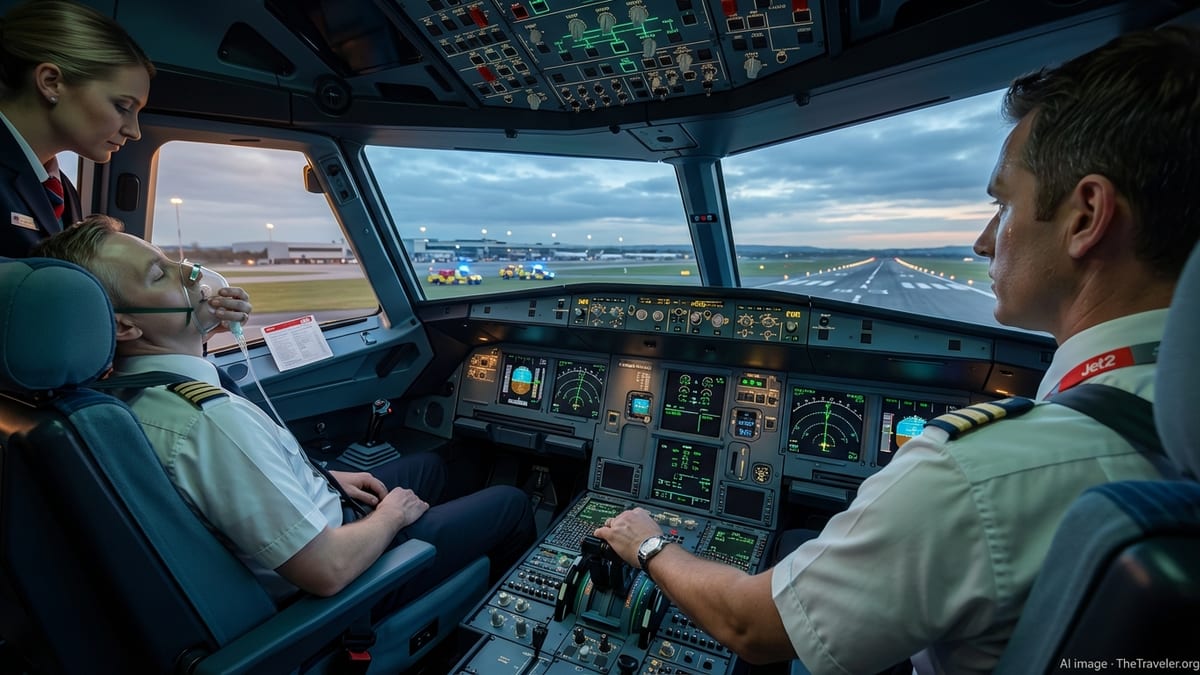
A Jet2 Airbus A321 operating between Spain’s Canary Islands and the United Kingdom made an emergency landing at Manchester Airport after one of the pilots became incapacitated on approach, thrusting aviation safety procedures in both countries into the spotlight.
The incident on February 3, 2026, involving flight LS980 from Lanzarote to Manchester, ended safely, but it has sparked renewed attention on how airlines and regulators prepare for rare yet serious cockpit medical emergencies.
More News
- TSA Rolls Out $45 ConfirmID Fee for Travelers Without REAL ID at Security
- Flying Blue Launches February 25% Promo Rewards on Transatlantic and Regional Routes
- United Fast-Tracks Starlink Wi‑Fi Across Fleet, Free for MileagePlus Members
Emergency Over Northwest England as Pilot Falls Ill
Jet2 flight LS980 departed Lanzarote in the late afternoon, bound for Manchester with holidaymakers returning from Spain’s Canary Islands. For most of the journey, the service operated routinely, cruising over the Bay of Biscay and into United Kingdom airspace under standard air traffic control procedures. Weather conditions in the northwest of England were reported to be stable, and the aircraft, a relatively new Airbus A321neo, was following its assigned arrival route toward Manchester.
According to specialist aviation outlets and tracking data, the emergency unfolded in the final stages of the flight, roughly 25 minutes before the expected landing time. During the descent, one of the pilots in the cockpit suffered a sudden medical problem and became incapacitated. With the aircraft already committed to its arrival profile, the remaining pilot had to rapidly shift from a routine approach to managing a critical, time-sensitive situation.
In line with established international procedures, the crew declared a general emergency by setting the transponder to Squawk 7700, a widely recognized code that alerts air traffic controllers and nearby aircraft that the flight requires immediate priority handling. Audio from air traffic communications, reported by aviation news sites, indicates that the situation escalated from an urgent advisory call to a full distress declaration as the affected pilot’s condition worsened.
Despite the seriousness of the incident, the Airbus A321 landed safely at Manchester on a priority approach, with emergency services standing by alongside the runway. Passengers disembarked without injury, and the incapacitated pilot received medical attention on arrival. Subsequent reports indicate that the pilot regained consciousness after landing and was transferred to hospital for further assessment.
Spotlight on UK and Spanish Safety Oversight
The emergency has placed a joint spotlight on aviation safety oversight in the United Kingdom and Spain, two countries connected by some of Europe’s busiest leisure air corridors. The flight originated in Lanzarote, part of Spain’s Canary Islands, and arrived in Manchester, a major UK base for low-cost and holiday carriers serving Mediterranean and Atlantic resorts. Regulators in both countries share responsibility for ensuring that airlines operating these routes meet stringent safety and crew training standards.
Under European and UK aviation rules, pilot health, fitness to fly, and medical certification are subject to strict regulation. Spanish and British authorities require commercial pilots to undergo regular medical examinations, with criteria covering cardiovascular, neurological, and psychological health, among other factors. However, regulators and safety experts acknowledge that sudden, in-flight medical issues cannot be entirely eliminated, which is why cockpit redundancy and procedural training play such a central role in risk mitigation.
Industry observers note that the incident also comes at a time of sustained high travel demand between the United Kingdom and Spain, with Jet2 among the leading carriers on these routes. The airline’s operation of a relatively young A321neo fleet and adherence to European design and maintenance standards underline that this was not an equipment failure but a human medical emergency, the kind of scenario that regulatory frameworks anticipate through requirements for multi‑pilot operations and formalised emergency protocols.
Authorities in both countries typically coordinate post-incident reviews, examining air traffic data, crew reports and medical information to determine whether any additional safety recommendations are necessary. At the time of writing, there is no indication of systemic failure, but the event is likely to feature in ongoing discussions about pilot workload, health screening, and support mechanisms for flight crews flying long seasonal rosters between the UK and southern Europe.
How Flight LS980’s Emergency Unfolded
Data compiled by aviation tracking services shows that Jet2 flight LS980 departed Lanzarote in the mid-afternoon and initially followed its usual northerly route over the Atlantic and western Europe. The aircraft, registered G‑SUNU, is part of Jet2’s growing Airbus A321neo fleet, delivered in 2025 and configured for high‑capacity leisure operations. For most of its roughly four‑and‑a‑half‑hour journey, the flight’s profile appeared typical for the route, with no signs of technical irregularities.
The situation changed as the aircraft began its descent toward Manchester. Approximately 25 minutes before the scheduled arrival, while the jet was passing through lower flight levels on approach, one of the pilots reportedly experienced a sudden medical event. Accounts from aviation news platforms describe an initial call to air traffic control indicating that the pilot was unwell, followed by an escalation as the crew recognized that full incapacitation was imminent or had already occurred.
In response, the remaining pilot took exclusive control of the aircraft, while the cabin crew were informed and began preparing for a potential high‑priority landing. The transponder was set to the emergency code, alerting air traffic control units across the region. Radar tracking records show the aircraft being given a direct approach into Manchester, avoiding delays and minimizing additional workload on the sole functioning pilot in the cockpit.
Emergency services at the airport were immediately placed on standby. After landing on one of Manchester’s main runways, the aircraft paused to allow paramedics and fire crews to access the cockpit quickly. Passengers on board later reported that, although they were aware of an issue near landing, the approach felt controlled and professional, underscoring the effectiveness of the crew’s handling of a stressful and unusual situation.
Jet2’s Safety Record and Operational Response
Leeds‑based Jet2 has built a strong reputation as a leisure carrier connecting UK regional airports with holiday destinations in Spain, Portugal, Greece and beyond. Industry databases list the airline as operating a mixed fleet of Boeing 737s and Airbus A321 variants, with an increasingly modern profile due to recent deliveries. The Airbus A321neo model involved in the Manchester incident is widely used by carriers around the world and is certified under rigorous European and UK safety standards.
Following the emergency landing, the aircraft remained on the ground in Manchester for an extended period, reportedly around half a day, while technical checks and administrative procedures were carried out. This is standard practice after an in‑flight emergency, even when there is no suggestion of mechanical malfunction. Engineers and safety teams typically inspect systems, review cockpit data, and ensure the aircraft is fully cleared before returning it to commercial service.
Jet2 has not reported any injuries among passengers or crew other than the affected pilot, whose condition has been described in media reports as stable after hospital evaluation. The airline has reiterated that safety remains its top priority and that its flight and cabin crews are trained to handle medical events, whether involving passengers or staff, including within the cockpit itself.
Travel industry analysts point out that Jet2 has experienced very few serious incidents relative to the scale of its operations. The combination of two‑pilot operations, recurrent simulator training, and regular technical maintenance provides multiple layers of protection. The outcome of flight LS980, where a complex emergency was managed without loss of life or damage, is being cited in some quarters as an example of safety systems working as intended rather than a sign of deteriorating standards.
What Pilot Incapacitation Procedures Look Like
Pilot incapacitation is a scenario that airlines hope never to encounter in regular service, but it is one for which crews across the industry are thoroughly drilled. During simulator sessions and recurrent training, pilots practice scenarios in which one crew member becomes unable to perform their duties, whether due to a sudden medical event, extreme fatigue, or other unexpected causes. These sessions emphasize both technical aircraft handling and coordination with cabin crew and air traffic control.
In a typical procedure, if one pilot shows signs of incapacitation, the other pilot is trained to assume full control of the flight, secure the incapacitated crew member’s seat to prevent unintentional inputs, and inform the cabin crew so that medical assistance can be sought. Simultaneously, the operating pilot declares an emergency to air traffic control, requests priority routing and, when possible, diverts to the nearest suitable airport equipped with appropriate medical facilities.
Modern commercial aircraft like the Airbus A321 are designed to be flown safely by a single pilot in such circumstances, although regulations require two qualified pilots to be present under normal operations. Auto‑flight systems, including autopilot and auto‑thrust, can significantly reduce the workload on the remaining pilot, allowing them to focus on communication and decision‑making. On the LS980 emergency, these systems are understood to have played a role in enabling a controlled descent and landing while the captain or first officer managed the evolving medical crisis.
Cabin crew also receive training on cockpit access during emergencies, basic medical response and cooperation with ground services. Their role includes coordinating passengers, maintaining calm on board, and assisting medical teams once the aircraft has landed. In Manchester, witnesses noted the rapid arrival of emergency responders and the orderly disembarkation of passengers, elements that align closely with standard operating procedures for such an event.
Reassuring Holidaymakers Between Spain and the UK
The incident has naturally prompted questions from travellers planning or currently undertaking holidays between Spain and the United Kingdom, particularly those flying to and from the Canary Islands during the busy winter sun season. Travel agents and airlines report that, so far, there has been no measurable impact on booking patterns, though customer enquiries about safety procedures and contingency planning have increased in the wake of widespread media coverage.
Safety experts emphasize that events involving pilot incapacitation remain extremely rare when compared with the millions of flights operated each year between the UK and Spain. The robust outcome in Manchester serves as a reminder that modern commercial aviation is built on multiple layers of redundancy: two‑pilot operation, advanced automation, strict medical certification and emergency planning with air traffic control and airport response teams.
Regulators in both countries also stress that any serious in‑flight emergency triggers a thorough review process. Investigators assess whether existing guidance, training syllabuses or medical oversight could be improved. Even when the root cause is a non-preventable medical event, authorities may still use the opportunity to refine communication protocols or enhance scenario‑based training to further reduce risk.
For passengers, the most visible outcomes of such reviews are often subtle: slightly different briefing styles, additional guidance provided to crew, or incremental adjustments to scheduling rules designed to manage fatigue. Travel industry bodies say that the overall safety picture on the UK–Spain corridor remains strong, with incident rates continuing to be low compared with historical levels and with the broader global industry.
Broader Context: Recent UK and Spain Aviation Incidents
While the Jet2 emergency at Manchester has drawn significant attention, it comes against a backdrop of other aviation incidents in and around the United Kingdom and Spain that highlight the diversity of situations airline crews face. In recent days, UK media have reported on technical issues leading to unscheduled landings and separate police‑led investigations involving aircraft at Scottish airports, though none of these have resulted in serious injuries.
Aviation analysts caution against drawing direct links between unrelated events, pointing out that heightened public awareness often coincides with periods of intense media coverage rather than an underlying deterioration in safety. In reality, modern commercial aviation in Europe operates under some of the world’s most stringent regulatory frameworks, with mandatory occurrence reporting, independent investigation bodies, and cross‑border data sharing designed to identify and address risk patterns early.
The incident involving flight LS980 is likely to be fed into this broader safety data ecosystem. Even where the cause is unique to an individual’s health, investigators look for learning opportunities, such as optimizing cockpit procedures when one pilot is suddenly unavailable, refining communication with passengers, or streamlining the coordination between airport medical services and airline operations control centers.
Industry voices underscore that the public’s high expectations of safety are well founded. The fact that cases like the Jet2 emergency in Manchester lead news bulletins reflects how unusual serious in‑flight issues have become, particularly on short and medium‑haul leisure routes between the United Kingdom and southern Europe.
FAQ
Q1. What exactly happened on the Jet2 flight from Lanzarote to Manchester?
The Jet2 Airbus A321 operating flight LS980 from Lanzarote to Manchester declared an emergency during descent on February 3, 2026, after one of the pilots became medically incapacitated. The remaining pilot took full control, declared a general emergency with air traffic control, and landed safely at Manchester where medical teams were waiting.
Q2. Were any passengers injured during the emergency landing?
No passenger injuries have been reported. The aircraft landed safely and passengers disembarked normally. The only reported medical issue involved the incapacitated pilot, who received treatment from paramedics on arrival at Manchester Airport.
Q3. What is Squawk 7700 and why is it important?
Squawk 7700 is a four‑digit transponder code used by pilots to signal a general emergency to air traffic control. When set, it alerts controllers that the aircraft is facing a serious issue and requires immediate priority, enabling faster routing, cleared airspace and rapid coordination with emergency services on the ground.
Q4. How common are pilot incapacitation incidents in commercial aviation?
Pilot incapacitation events are very rare compared with the total number of flights operated each year. Airlines and regulators treat them as critical scenarios in training, but statistically they occur only a tiny fraction of the time, which is why two‑pilot operations and extensive simulator practice are key elements of safety design.
Q5. Is it safe to fly between the United Kingdom and Spain after this incident?
Yes. Flights between the United Kingdom and Spain continue to operate safely under strict regulatory oversight. The Jet2 incident in Manchester is being viewed by many experts as evidence that established safety systems and training worked as intended, allowing a serious but contained emergency to be managed without injuries to passengers.
Q6. What medical checks do commercial pilots have to pass?
Commercial pilots in the UK and Spain must hold valid medical certificates issued under national and European regulations. These involve regular examinations of cardiovascular health, vision, hearing and other key systems, with more frequent checks as pilots age. Any concerns can result in temporary or permanent grounding until specialists clear them to fly.
Q7. Can a single pilot safely land a large passenger aircraft like an A321?
Modern airliners such as the Airbus A321 are designed so that one qualified pilot can safely land the aircraft in an emergency if the other becomes incapacitated. Automation, standard procedures and air traffic control support reduce workload, although regulations still require two pilots to be on the flight deck in normal operations.
Q8. Did this incident indicate any mechanical problem with the aircraft?
Current reports suggest the emergency was related to a medical issue affecting one pilot and not to a technical failure of the aircraft. The A321 remained fully controllable, and standard descent and landing profiles were followed with priority handling from air traffic control.
Q9. How do UK and Spanish authorities respond to such incidents?
When an in‑flight emergency occurs, authorities in both countries collect data from the airline, crew and air traffic control to understand what happened. If necessary, they may open a safety investigation, issue recommendations, or refine guidance and training. Even when no systemic faults are found, the information contributes to wider safety analysis.
Q10. Should travellers expect any changes to their flights because of this event?
Most travellers will not notice any direct changes. The aircraft involved underwent checks before returning to service, and airlines continually review training and procedures. If regulators or operators decide on adjustments, they are usually implemented behind the scenes to further enhance safety without disrupting passenger travel plans.