

More news on this day
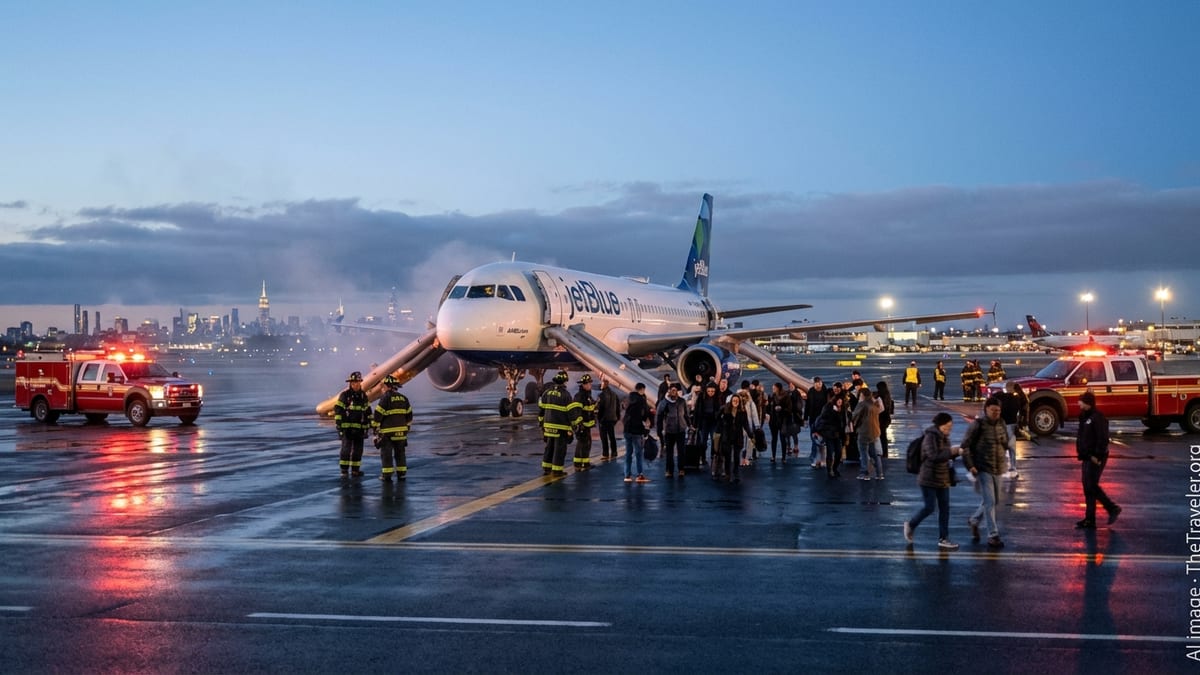
A JetBlue Airbus A320 bound for West Palm Beach made an emergency return to Newark Liberty International Airport on Wednesday evening after an apparent engine failure and smoke in the cabin, triggering a dramatic slide evacuation on the taxiway and briefly disrupting air traffic across the New York metropolitan area.
Engine Trouble Minutes After Takeoff
JetBlue flight 543 departed Newark Liberty International Airport for West Palm Beach, Florida, early Wednesday evening, carrying 128 passengers and crew on board the Airbus A320. According to officials, the aircraft lifted off from runway 04L at approximately 5:43 p.m. local time, beginning what was scheduled to be a routine three-hour flight to Palm Beach International Airport.
Within minutes of departure, however, the flight crew reported a problem with the aircraft’s left engine, a V2527 model. Air traffic control recordings and aviation incident reports indicate that the crew declared an emergency and leveled off at around 10,000 feet, advising controllers that they had experienced an engine issue, described by some on board as a loud bang, consistent with an engine stall event.
As the crew worked through emergency checklists, the situation escalated when smoke was reported inside the aircraft. Officials later said smoke was first noted in the rear of the cabin before crew members reported smoke in the cockpit. The combination of an engine anomaly and smoke in the aircraft prompted an immediate decision to return to Newark.
The A320 turned back toward the airport and lined up for landing on runway 04R. Approximately 15 to 20 minutes after takeoff, the jet touched down safely, with fire and rescue units already positioned alongside the runway and taxiways in anticipation of a possible evacuation.
Dramatic Taxiway Evacuation and Ground Stop
After landing, flight 543 exited the runway and stopped on a nearby taxiway while rescue vehicles moved into place. Initially, the crew told controllers they would allow fire and rescue personnel to inspect the affected engine while passengers remained seated on board. That plan changed quickly as smoke levels inside the cabin increased.
In radio transmissions captured by public flight audio services, the captain can be heard informing controllers that there was smoke in the back of the aircraft and that an evacuation was imminent. Moments later, emergency responders on the ground notified the tower that the slides were about to be deployed, and controllers broadcast that Newark Airport was closed to traffic while the situation unfolded.
Passengers were ordered to remove their seatbelts and move rapidly to the nearest exits as the aircraft’s emergency slides deployed. Video and eyewitness accounts describe a chaotic but ultimately effective evacuation as travelers slid onto the tarmac and were guided away from the aircraft by first responders. Despite the alarm on board, authorities reported no injuries to passengers or crew.
With the disabled A320 sitting on the taxiway surrounded by emergency vehicles, the Federal Aviation Administration instituted a temporary ground stop, pausing inbound flights to Newark and suspending many departures. Airport officials said normal operations began to resume shortly before 7 p.m., about an hour after the first reports of the incident, though delays rippled through the schedule for the remainder of the evening.
Ripples Across New York Airspace and Passenger Plans
The emergency diversion and subsequent ground stop at Newark sent shockwaves through one of the country’s busiest aviation corridors. Alongside John F. Kennedy International and LaGuardia, Newark forms part of the tri-airport system that handles a large share of the nation’s domestic and transatlantic traffic. Even a short disruption at one of these hubs can cascade into delays across the region and beyond.
Flight-tracking data showed waves of inbound aircraft being placed into holding patterns or diverted while Newark’s runways and taxiways were partly shut down during the JetBlue evacuation. Airlines worked with controllers to reroute traffic and manage congestion, but dozens of flights experienced delays as operations gradually restarted. At one point, more than 30 percent of arriving and departing services at Newark were reported delayed.
Passengers inside the terminal and on board other aircraft faced extended wait times as the Port Authority and the FAA coordinated the clearance of the disabled A320 from the taxiway. Airport announcements urged travelers to check with individual carriers for updated departure and arrival information, while airline agents scrambled to rebook missed connections and inform customers of revised schedules.
For those who had been en route to West Palm Beach on flight 543, the disruption was even more personal. The flight was ultimately canceled, and JetBlue began arranging alternative travel options, including rebooking on later services to Florida and providing assistance to those needing hotel accommodations overnight in the New York area.
What We Know About the Aircraft and Investigation
The aircraft involved in the incident was identified by aviation databases as an Airbus A320-200, registration N640JB, a narrow-body jet widely used across short and medium-haul routes in the United States. The A320 family has a long safety record and is a backbone of many airline fleets, including JetBlue’s, which operates dozens of the type on routes along the East Coast and across the country.
Preliminary reports indicate that the problem originated with the aircraft’s left engine, leading to what was described by the crew as an engine stall and followed by smoke in the cabin and cockpit. The exact origin of the smoke remains under investigation. Possible sources in such cases can include engine components, bleed air systems tied to cabin pressurization, or other mechanical or electrical systems in the vicinity of the affected powerplant.
The Federal Aviation Administration confirmed that it had opened a formal investigation into the event, as it does with all incidents involving emergency evacuations and reported mechanical failures. Investigators are expected to review cockpit voice and flight data recorders, maintenance logs, and interviews with the flight crew and maintenance personnel, as well as conduct a detailed technical inspection of the engine and surrounding systems.
JetBlue said it would cooperate fully with federal authorities and conduct its own internal review. The aircraft remained on the ground at Newark while technical teams began inspections, with the jet temporarily withdrawn from service until a root cause is identified and any necessary repairs or component replacements are completed.
JetBlue and Authorities Emphasize Safety
In statements following the incident, JetBlue stressed that safety remains its highest priority. The airline highlighted that the flight landed safely, that all passengers and crew were evacuated using emergency slides, and that no injuries had been reported. The carrier also noted that its teams were focused on supporting affected customers and crewmembers in the hours after the evacuation.
The Port Authority of New York and New Jersey, which operates Newark Liberty International Airport, similarly underscored that the emergency response functioned as designed. Fire and rescue units remained on standby as the flight returned, responded within moments of the aircraft stopping on the taxiway, and assisted in the rapid evacuation and post-incident assessment.
The FAA said it briefly paused some arrivals during the height of the emergency response, then lifted the ground stop once it was safe to resume operations. Officials pointed to the lack of injuries as a positive outcome and a testament to standardized crew training, aircraft design requirements, and airport emergency procedures that together aim to protect passengers even when mechanical problems arise.
Aviation experts interviewed by national and local outlets observed that while episodes involving smoke and engine anomalies are unsettling for passengers, they remain rare events when measured against the millions of flights that operate safely each year. Nonetheless, incidents like JetBlue flight 543 receive intense scrutiny in order to identify any potential safety improvements and ensure ongoing public confidence in commercial air travel.
Passenger Accounts from Inside the Cabin
For travelers on board the disrupted flight, the routine departure quickly turned into a tense ordeal. Several passengers described hearing a loud bang shortly after takeoff, followed by an announcement from the cockpit that the aircraft would be returning to Newark. In the minutes that followed, the cabin remained relatively calm, with crew members moving through the aisle to check on passengers as the plane descended.
When smoke became visible, the mood shifted. Some passengers reported the smell of something burning, while others said visibility inside the aircraft began to diminish toward the rear of the cabin. Flight attendants instructed travelers to remain seated with seatbelts fastened as the jet made its approach back to Newark, reiterating safety procedures and preparing customers for a possible rapid deplaning.
Once on the ground, however, events accelerated. Passengers recounted that emergency vehicles surrounded the aircraft and that an announcement instructed everyone to leave their seats and move quickly toward the exits. Many were surprised to find themselves exiting onto the inflatable slides, a maneuver most had only seen demonstrated during preflight briefings.
Despite the suddenness of the evacuation, eyewitness accounts suggest that crew members remained composed and assertive, guiding travelers down the slides and directing them away from the aircraft to designated safe areas on the tarmac. Passengers were then transported by bus back to the terminal for processing, rebooking, and medical checks for anyone who reported discomfort from the smoke.
Impact on West Palm Beach Travel and Winter Getaways
The Newark to West Palm Beach route is a busy corridor for leisure and business travelers alike, particularly during the winter months when many passengers head to South Florida for warmer weather. The abrupt cancellation of flight 543 disrupted holiday plans and family visits for dozens of travelers who had expected to arrive in Palm Beach County later that evening.
As word of the incident spread, airlines serving South Florida from the New York region saw increased pressure on remaining flights, with some later departures and next-day services operating close to full capacity. Travelers unable to secure same-day rebooking were forced to delay their trips, while others opted for alternative routings through different airports in the tri-state area.
Tourism officials in Palm Beach County noted that while one canceled flight represents a small fraction of overall traffic, such incidents underscore the interconnected nature of the U.S. aviation system. A single disruption at a major Northeast hub can ripple through schedules and customer itineraries hundreds or even thousands of miles away, especially during peak travel periods when spare capacity is limited.
Travel advisors urged passengers headed to or from South Florida in the coming days to monitor flight status closely, allow extra time at the airport, and keep contact information updated with airlines so they can receive real-time notifications about any changes to departure or arrival times linked to residual delays in the New York area.
Broader Questions on Aging Fleets and Engine Reliability
While investigators have not yet identified the precise cause of the incident on JetBlue flight 543, the event has renewed discussion around engine reliability, maintenance practices, and the age of aircraft operating in high-frequency domestic networks. Many U.S. carriers, including JetBlue, rely on older but carefully maintained narrow-body fleets that have logged thousands of flight hours over decades of service.
Aviation analysts emphasize that commercial aircraft are designed with rigorous redundancy and safety margins, and that engines undergo extensive inspection regimes governed by both manufacturers and regulators. Still, every episode involving engine problems attracts attention from regulators and the traveling public, especially when it results in a visible emergency response and an airport shutdown.
Experts say that even in a highly regulated environment, continuous improvement remains essential. Outcomes of investigations like the one now underway at Newark can lead to revised maintenance intervals, targeted inspections of specific engine components, or updated training for flight crews on how to handle certain types of failures and cabin smoke events.
For now, authorities maintain that flying remains one of the safest ways to travel. Yet the sight of passengers evacuating an aircraft by slide and the temporary closure of a major airport serve as stark reminders of the complexity of modern aviation and the importance of robust safety systems that can respond effectively when the unexpected occurs.