

More news on this day
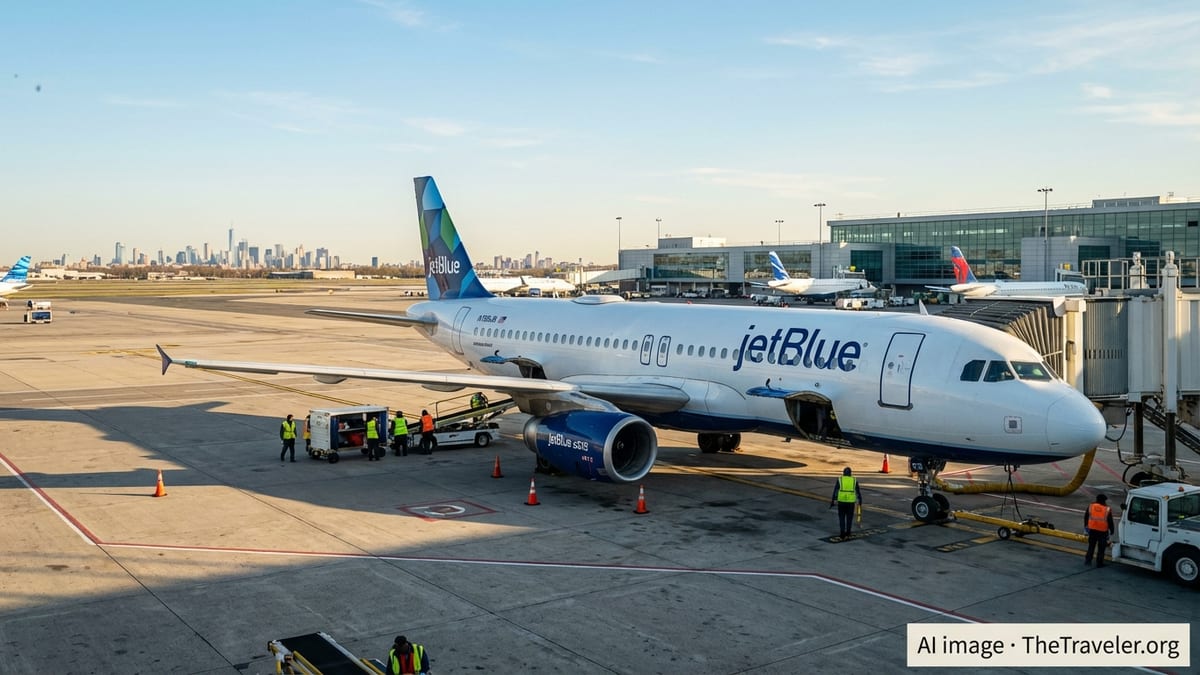
JetBlue is returning to the New York–Houston corridor with a fresh competitive edge, launching twice-daily nonstop flights between John F. Kennedy International Airport and George Bush Intercontinental Airport from May 21, 2026, with seats now on sale and early demand already building ahead of a packed travel year.
A Strategic Return to a High-Demand Corridor
The new service restores a nonstop JetBlue link between New York and Houston, two of the country’s most influential business and cultural hubs. Beginning May 21, 2026, the airline will operate two daily roundtrips between JFK and IAH, reestablishing a direct connection it has previously served and positioning itself as a challenger to entrenched legacy carriers on the route.
JetBlue is marketing the move as a win for both business travelers and leisure customers, emphasizing schedule flexibility and access to its wider network. The twice-daily pattern is designed to support same-day corporate trips while still catering to longer stays and connecting journeys onward from New York. For Houston, it adds capacity and competition on a route that links directly into one of the world’s busiest international gateways.
The timing reflects broader growth in JetBlue’s New York flying, alongside recent and upcoming route launches from JFK to other mid-sized and major U.S. cities. For the airline, reinforcing its position as “New York’s hometown carrier” hinges on offering more nonstop options from the city’s primary long-haul hub, particularly to economic centers like Houston.
Flight Schedule: Morning and Afternoon Options Both Ways
According to the schedule filed by JetBlue, the new route will feature two daily flights in each direction, using Airbus A320 aircraft. From New York JFK, departures are planned for 7:54 a.m., arriving in Houston at 10:59 a.m., and 1:41 p.m., arriving at 4:48 p.m. The pattern is mirrored from Houston, with departures at 11:50 a.m. and 5:44 p.m., arriving back in New York at 4:27 p.m. and 10:23 p.m. respectively.
For New York-based business travelers, the early morning departure to Houston offers enough time to arrive before lunchtime meetings in the Energy Capital of the World, while the afternoon option provides flexibility for those who prefer a later start or are connecting from other East Coast points. On the return, the late-afternoon and evening departures from Houston are timed to allow a full working day before flying back to New York.
Houston travelers benefit from similar flexibility. The late morning departure to JFK gives leisure passengers a comfortable start and easy transfers onto domestic and international itineraries. The evening flight, landing in New York just after 10 p.m., is suited to those wrapping up business commitments before heading north or catching overnight onward flights from JFK.
By offering two distinct time bands in each direction, JetBlue is signaling that it is not simply testing the market with a single daily service but committing capacity designed to compete for a broad mix of corporate and leisure traffic.
Booking Opens as JetBlue Chases Business and Leisure Travelers
Seats on the new route have already gone on sale through JetBlue’s direct channels, with the airline promoting the flights as part of a broader push to encourage customers to book via its own website and app. Travelers booking direct can access the full range of fares, promotional sales, and loyalty benefits, including accelerated TrueBlue points earning and pooling options.
The airline is explicitly targeting corporate travelers who regularly move between the New York financial and media hub and Houston’s energy and healthcare sectors. The twice-daily structure is pitched as enabling same-day turns, with early arrivals and evening returns, a pattern that has long proven popular among business road warriors.
At the same time, JetBlue is emphasizing leisure appeal, highlighting access from Houston to a wide range of East Coast and transatlantic destinations reachable via JFK. With New York serving as a gateway to Europe, the Caribbean, and Latin America, Houston-origin passengers can now build itineraries that combine a nonstop to JFK with onward flights on JetBlue’s growing long-haul and leisure network.
Industry analysts note that the carrier’s entry is likely to put downward pressure on fares on the route, at least in the near term, as JetBlue brings its typically competitive pricing strategy to a market where legacy carriers have historically been dominant.
Onboard Experience: Fly-Fi, Seatback Screens, and A320 Comfort
The route will be served by JetBlue’s Airbus A320 fleet, which the airline promotes as offering some of the most generous legroom in standard economy among U.S. carriers. Every seat on the aircraft is equipped with an individual seatback screen, a hallmark of JetBlue’s product that continues to differentiate it from some competitors on domestic routes.
Passengers on the New York–Houston flights will have access to free high-speed Wi-Fi, branded as Fly-Fi, allowing them to work, stream, or stay connected throughout the roughly three-hour journey. Live television and an array of on-demand entertainment options will also be available through the seatback systems, supporting both productivity and relaxation in flight.
Complementary snacks and nonalcoholic beverages remain a core part of JetBlue’s onboard proposition, with the airline leaning on its reputation for a more generous and passenger-friendly service model compared with many domestic rivals. For travelers facing repeated trips between Houston and New York, this consistency and comfort can be an important factor in carrier choice.
By pairing its familiar onboard experience with a schedule tailored to business and leisure needs, JetBlue is seeking to carve out a loyal customer base on a route where service differentiation and reliability can be decisive.
Houston’s Role Grows as a JetBlue Gateway
JetBlue already operates daily service between Houston and Boston Logan International Airport, and the addition of two daily flights to New York JFK significantly strengthens the airline’s footprint in the Texas market. From Houston’s George Bush Intercontinental Airport, travelers will now be able to choose between two of JetBlue’s key Northeastern hubs, both offering onward access to an extensive domestic and international network.
The move reflects a long-term shift in JetBlue’s Houston strategy. Years ago, the airline relocated its operations from William P. Hobby Airport to George Bush Intercontinental to align more closely with key partners and to increase its relevance in the broader New York and Boston markets. That decision laid the groundwork for today’s expansion, positioning IAH as the logical platform for a renewed push into Texas.
Local authorities in Houston have also been investing in ground connectivity and airport infrastructure, further enhancing the appeal of flying into Bush Intercontinental. Improved links between the region’s two major airports and downtown, along with broader mobility upgrades, are making it easier for both residents and visitors to navigate Houston’s sprawling metropolitan area.
For JetBlue, a stronger Houston presence supports its ambition to connect more secondary and primary markets into its East Coast hubs, tapping into both point-to-point demand and flows that use New York and Boston as transfer points.
New York Connectivity: From Domestic Hubs to Global Gateways
At the New York end of the route, JFK offers Houston travelers a direct link into one of the most globally connected airport hubs in the United States. JetBlue’s expanding presence at JFK means passengers can connect onward to key business destinations along the Eastern Seaboard as well as to popular leisure spots in Florida, the Caribbean, and Latin America.
In recent years, JetBlue has also been building out its transatlantic operation, including services to major European capitals from JFK. For Houston-based travelers, the new nonstop flight effectively opens a one-stop path to cities in Europe with JetBlue handling the entire itinerary under a single ticket, simplifying connections and baggage handling.
For New Yorkers, the route deepens access to Houston’s status as a center of the energy industry, medical research, and space-related activity, given the city’s ties to NASA facilities. It also makes it easier for New York-area residents to explore Houston’s cultural offerings, from its theatre district and museums to its well-regarded dining scene.
The interplay between these two major metros, each serving as a gateway in its own right, underscores why airlines have long seen the New York–Houston corridor as strategically important. JetBlue’s reentry, now with a twice-daily schedule, signals its determination to participate meaningfully in that high-value traffic flow.
World Cup Momentum and a Busy 2026 Travel Calendar
The launch of the new flights comes as both New York and Houston prepare for a surge in international visitation tied to the 2026 FIFA World Cup, which will see matches played across multiple North American cities. The tournament is expected to generate heavy demand for travel between major hubs, with fans, media, and corporate delegations moving rapidly between venues.
By bringing back nonstop service ahead of the event, JetBlue is positioning itself to capture some of this incremental demand. The twice-daily schedule could appeal to football supporters and tour operators seeking predictable, direct links between two key host cities, particularly during phases of the competition when travel windows are tight.
Beyond the World Cup, 2026 is shaping up as a strong year for U.S. domestic and international travel, with airlines and airports preparing for robust passenger numbers as capacity continues to grow. For Houston and New York, which both serve as gateways for corporate and leisure traffic, incremental nonstop capacity is likely to be welcomed by local tourism authorities and business stakeholders.
JetBlue’s decision to formalize and announce the schedule well ahead of the May start date gives travelers time to plan and secure seats, particularly during peak travel weeks when demand is expected to be intense.
Competitive Dynamics and What Travelers Should Watch
JetBlue’s expansion into the New York–Houston sector adds fresh competition to a route where large network carriers have traditionally held significant market share. With its twice-daily flights, the airline is not only targeting point-to-point travelers but also those booking connecting itineraries that might previously have defaulted to legacy hubs.
Travelers can expect introductory promotions and competitive pricing as JetBlue and incumbent carriers respond to the new capacity. Historically, the arrival of a value-focused entrant on a business-heavy route has led to more fare options and, in some cases, lower average prices, particularly in economy cabins.
Corporate travel managers and frequent flyers will be watching closely to see how schedule reliability, on-time performance, and service standards compare across carriers once the flights begin operating. For many business travelers, the combination of a convenient schedule, dependable operations, and a comfortable onboard environment can matter as much as headline fares.
With bookings now open, early adopters will have the first opportunity to secure preferred dates and departure times. For those eyeing travel during the World Cup or other peak periods in 2026, industry observers suggest moving quickly, as the best-priced seats on desirable flights are likely to be snapped up well before the May launch.