

More news on this day
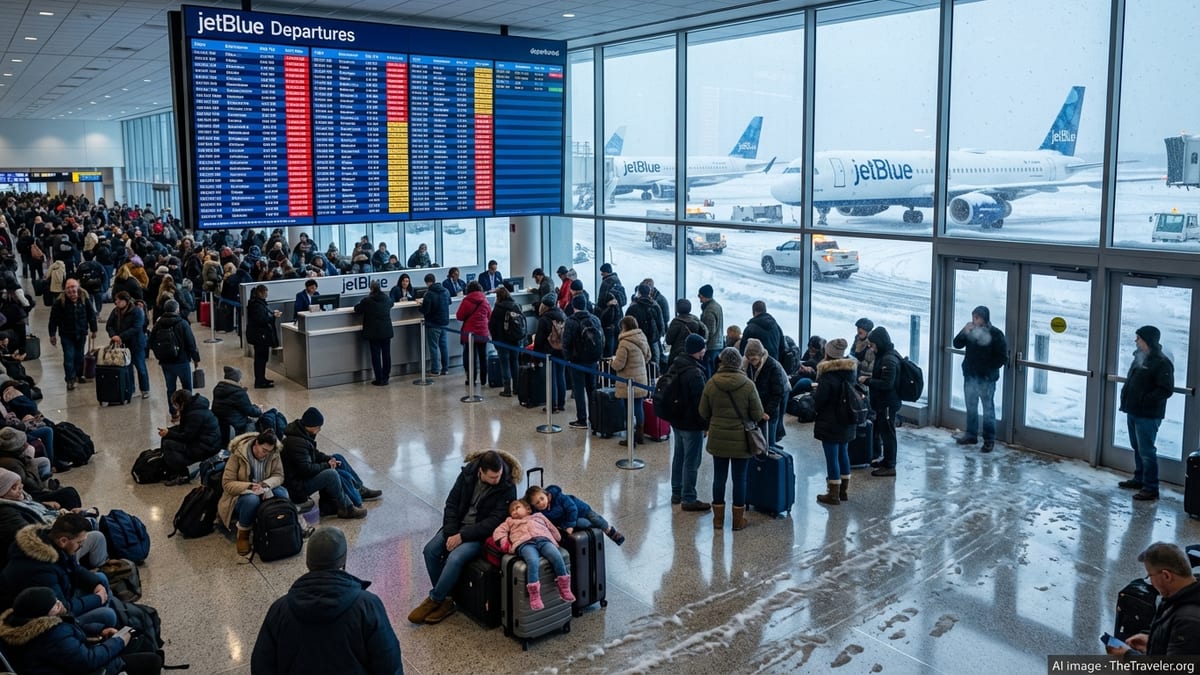
Hundreds of JetBlue passengers were stranded on Monday across the United States, Puerto Rico, the Dominican Republic and other destinations after a powerful winter storm sweeping through the Northeast forced 447 flight cancellations and 212 delays at major hubs including New York, Boston, Fort Lauderdale, San Juan and Orlando.
JetBlue Hit Hard as Nor’easter Freezes Key East Coast Corridors
The latest nor’easter barreling up the Eastern Seaboard has turned JetBlue’s normally busy route network into a patchwork of ground stops, rolling delays and stranded aircraft. With operations centered at weather-vulnerable airports such as New York’s JFK and LaGuardia, Boston Logan and Orlando International, the low cost carrier has emerged as one of the hardest hit airlines in a disruption that has rippled from New England deep into the Caribbean.
By mid day Monday, JetBlue had scrubbed 447 flights and logged 212 delays across its system, according to aviation tracking data, as blizzard conditions and high winds made safe takeoffs and landings impossible at several airports. The numbers shifted through the afternoon as crews and aircraft fell out of position, turning an already bad day into a logistical knot that will likely take days to fully untangle.
While other U.S. carriers also slashed schedules, JetBlue’s concentration in the storm zone has magnified the impact for its predominantly leisure and visiting friends and relatives customer base. Routes connecting the Northeast to Florida, the Caribbean and Latin America, traditionally busy during the winter high season, have been particularly affected, leaving vacationers and returning families suddenly grounded far from home.
Airports reported long lines, crowded gate areas and improvised sleeping arrangements as the storm transformed terminals into holding zones. At JFK and Boston Logan, departure boards were dominated by red “cancelled” notices beside JetBlue flight numbers, while in San Juan and Santo Domingo, passengers clustered around customer service counters seeking scarce rebooking options back to New York and Boston.
Stranded in Sun and Snow: Passengers Caught Between Hubs and Holiday Destinations
In contrast to the whiteout conditions at Northeastern airports, many of JetBlue’s stranded customers found themselves under clear skies in places like San Juan, Punta Cana and Orlando, unable to leave despite calm local weather. With aircraft and crews stuck where the snow was falling, flights out of these sunny destinations were cut as the airline attempted to reset its network.
At San Juan’s Luis Muñoz Marín International Airport, which serves as a key focus city for JetBlue, multiple daily departures to New York, Boston and Orlando were grounded, leaving passengers to queue for hours for rebooking. Families returning from school vacation breaks, elderly travelers connecting to medical appointments on the mainland and tourists nearing the end of beach holidays all faced last minute changes and unexpected overnight stays.
In the Dominican Republic, where JetBlue operates a heavy schedule from Punta Cana, Santo Domingo and Santiago to Northeastern gateways, stranded passengers reported limited hotel availability as resorts remained busy with peak season visitors. Some travelers opted to extend their vacations if they could afford the additional cost, while others scrambled to find budget accommodations far from the beach as they waited for updated departure times.
In Florida, Orlando and Fort Lauderdale became choke points for northbound traffic. With many flights into snowbound New York and Boston grounded, JetBlue’s Florida departures filled or were canceled outright, trapping cruise passengers, theme park visitors and snowbirds seeking to return home. Lines stretched through concourses as agents worked to move customers onto the few flights still operating to Mid Atlantic and Midwest cities less affected by the storm.
New York, Boston and Orlando Bear the Brunt of Cancellations
The greatest operational pain was concentrated at JetBlue’s largest hubs. New York’s JFK and LaGuardia airports, along with Boston Logan, sat directly in the path of the nor’easter, experiencing intense snowfall, fierce crosswinds and low visibility that forced air traffic controllers to sharply reduce arrivals and departures. Proactive cuts to the schedule, meant to prevent passengers from being stranded on aircraft, nonetheless translated into mass cancellations.
At JFK, where JetBlue is a dominant carrier on domestic and transborder routes, gates that would normally turn multiple flights per day instead hosted parked aircraft waiting out the worst of the weather. Crews timed out as delays mounted, compounding the operational shock and leaving the airline short staffed just as conditions began to marginally improve.
Boston Logan, another crucial JetBlue stronghold, saw similar scenes. Blizzard conditions left runways slick and ground crews battling blowing snow, prompting extended deicing times when flights could operate at all. Airlines cut schedules heavily in advance, but as snow totals mounted, additional cancellations were added in real time, leaving many passengers who had made it to the airport only to find their flights suddenly scrapped.
Farther south, Orlando International experienced cascading disruptions as its role as a major leisure departure point collided with the Northeast’s faltering capacity. Though the Central Florida airport avoided the worst weather, its tightly timed departure banks to Boston, New York and other northern cities were quickly overwhelmed by cancellations, leading to overcrowded terminals and long waits at ticket counters.
Puerto Rico and Dominican Republic Routes Expose Network Vulnerabilities
The scale of the disruption on routes to Puerto Rico and the Dominican Republic highlighted how dependent these markets are on a small group of carriers with heavy Northeast exposure. JetBlue, which has built a strong brand among Puerto Rican and Dominican diaspora communities thanks to frequent flights and competitive fares, suddenly found its core connecting corridors severed.
In Puerto Rico, the storm’s effects went beyond tourism. Many residents rely on JetBlue’s flights to the New York and Boston areas for family visits, medical care and business travel. With dozens of flights canceled or delayed, passengers reported difficulty finding any same week availability, particularly on nonstop routes. Some turned to multi stop itineraries through Florida or the Mid Atlantic on rival carriers, while others resigned themselves to longer island stays.
The Dominican Republic faced a similar squeeze. Popular routes to Santo Domingo and Santiago, which serve large diaspora communities in New York and New England, saw widespread cancellations, leaving passengers searching for alternatives through Miami, Atlanta or Charlotte. However, those hubs were also absorbing displaced travelers from across the storm battered Northeast, driving up fares and filling available seats.
The episode underscored the risk inherent in route networks that heavily depend on a handful of weather sensitive hubs. With so much of JetBlue’s traffic funneled through New York and Boston, a single major nor’easter can send shockwaves through its entire operation, from the Caribbean to Central Florida and beyond.
Rebooking Challenges, Voucher Offers and Customer Frustration
For passengers, the initial disappointment of a canceled or severely delayed flight quickly gave way to the practical challenge of finding an alternative way home. With the storm affecting thousands of flights system wide, rebooking channels were flooded. JetBlue encouraged customers to use its app and website rather than lining up at airport counters, but many reported error messages and long hold times as demand overwhelmed digital and call center capacity.
The airline issued flexible travel waivers for a broad set of airports in the path of the storm, allowing customers to change dates without incurring standard change fees and fare differences within specified windows. For some, this provided an opportunity to delay trips until midweek, when weather conditions and airport operations are expected to stabilize. Others, who faced pressing commitments, scrambled to piece together complex reroutes or turned to competing airlines even at higher last minute prices.
At airports, frustration sometimes boiled over as travelers compared experiences and swapped information about available seats. Families with young children and elderly passengers were particularly vulnerable, relying on gate agents to find hotel vouchers, meal credits or cot space in makeshift rest areas. While many praised frontline staff for their efforts under pressure, others complained of inconsistent communication and limited transparency about when flights might realistically depart.
Consumer advocates reminded travelers that while airlines are not generally required under U.S. law to compensate for weather related cancellations, they are expected to provide clear information about options and to honor publicly posted customer service commitments. Passengers were advised to document expenses, such as unexpected hotel stays and meals, in case JetBlue or travel insurers later offer reimbursements.
Operations Teams Race to Recover as Storm Slowly Moves On
Even as snowfall rates begin to ease across parts of the Northeast, aviation analysts warn that the worst of the disruption for travelers may still lie ahead. Getting aircraft and crews back into the right places is a complex puzzle that can take days to solve, especially for a carrier like JetBlue whose fleet utilization is typically high and whose schedule leans heavily on tight turns.
Once runways and taxiways are fully cleared and visibility improves, JetBlue is expected to begin restoring capacity first on its highest demand trunk routes, such as New York to Florida and Boston to key business markets, before layering back in more peripheral services. That strategy may leave some Caribbean and secondary U.S. destinations with fewer options for several days, prolonging the ordeal for stranded passengers.
Maintenance requirements present another hurdle. Aircraft that have spent extended periods on the ground in snow and ice frequently require additional inspections and deicing, adding time to already packed operations. Crew duty limits, which cap the number of hours pilots and flight attendants can work in a day, will also influence how quickly full schedules can be reestablished.
Industry observers say that the disruption is likely to show up in JetBlue’s financial results for the quarter, both through lost revenue from canceled flights and higher operating costs tied to irregular operations, including crew repositioning, overtime and customer care expenses. The storm arrives at a time when airlines are already grappling with higher labor and fuel costs, making weather related shocks particularly painful.
Wider U.S. Flight Chaos Puts JetBlue’s Woes in Context
While JetBlue’s 447 cancellations and 212 delays have drawn intense attention from travelers and social media users alike, the carrier is far from alone in grappling with the nor’easter’s fallout. Across the United States, thousands of flights were canceled or delayed as the storm swept from the Mid Atlantic into New England, turning one of the country’s busiest air corridors into a temporary no fly zone.
Major airlines including American, Delta, United and Southwest all preemptively trimmed schedules in and out of New York, Boston, Philadelphia and other affected cities, hoping to avoid scenarios in which aircraft and passengers were stranded on snowbound taxiways. Regional carriers that feed larger networks into these hubs reported some of the highest cancellation rates, dislodging travelers even in cities where conditions remained relatively calm.
Transportation officials stressed that safety considerations overrunway conditions, visibility and crosswinds take precedence over schedule reliability during severe winter weather. Air traffic managers at the Federal Aviation Administration coordinated closely with airlines and airport operators to meter traffic volumes, sometimes instituting ground stops or reduced arrival rates that forced last minute cancellations.
Rail and road networks across the Northeast also experienced significant disruption, limiting alternatives for travelers caught mid journey. Amtrak scaled back service on key routes along the Northeast Corridor, while state and local authorities imposed temporary travel restrictions on highways as plows worked to keep up with rapidly falling snow and blowing drifts.