

More news on this day
A Florida-bound JetBlue flight carrying 122 people was forced to make a dramatic emergency landing at Newark Liberty International Airport on Wednesday evening after an apparent engine failure sent smoke into the cabin, prompting a rapid evacuation on the taxiway and a brief shutdown of one of the nation’s busiest airports.
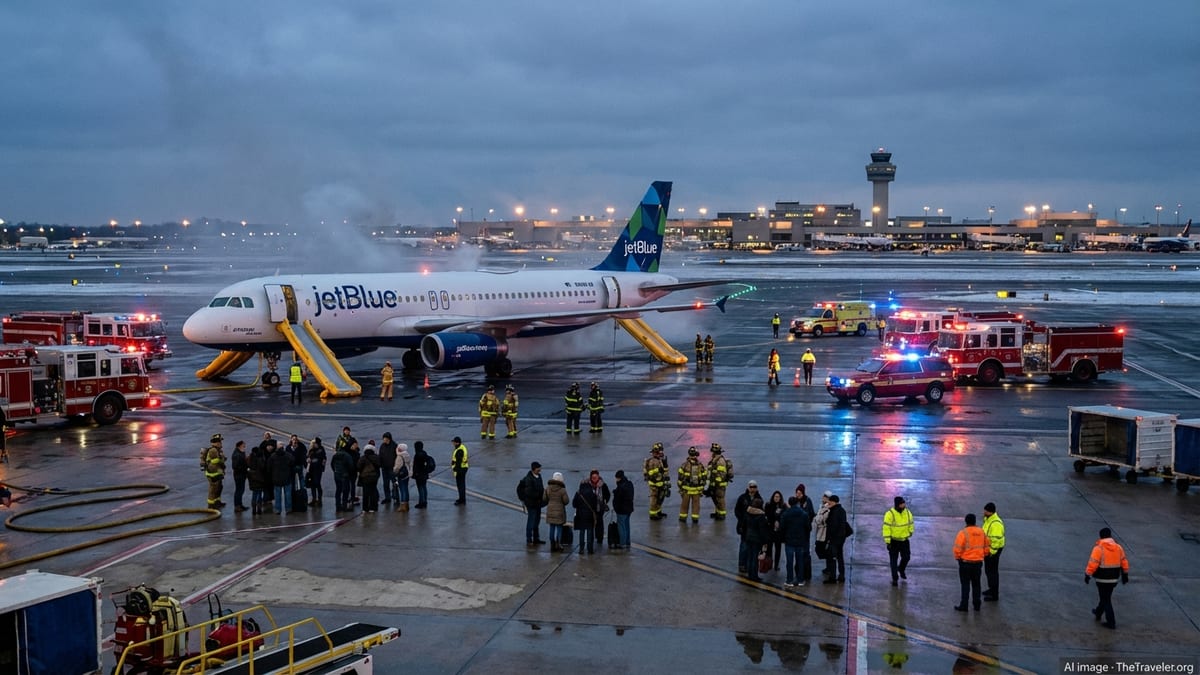
Flight to Florida Turns Back Minutes After Takeoff
The incident unfolded on the evening of Wednesday, February 18, when JetBlue Flight 543, an Airbus A320 operating from Newark Liberty International Airport to West Palm Beach, Florida, departed a little after 5:30 p.m. local time. According to aviation officials, the aircraft had been airborne for only about 15 to 20 minutes when the crew reported an engine issue and smoke on board, prompting an immediate decision to return to Newark.
Initial accounts from the Federal Aviation Administration and the Port Authority of New York and New Jersey indicate that the crew reported smoke in the cockpit and later in the rear of the cabin. Flight-tracking data showed the aircraft making a tight loop above the New Jersey airspace before lining up for an emergency landing back at Newark. Passengers on board described hearing a loud bang from one side of the aircraft, followed by the smell of smoke and a noticeable drop in cabin calm as information filtered through the cabin.
Flight 543 was operating with 122 passengers and several crew members on board, typical for an evening departure on the route linking the New York metropolitan area with South Florida. JetBlue, widely known as a low cost carrier with a large East Coast network, is a prominent operator on the Newark to Florida corridor, and the flight was reportedly nearly full with leisure travelers and snowbirds heading south.
Despite the alarming circumstances, air traffic control recordings suggest the cockpit crew maintained a controlled, professional tone as they coordinated with controllers to prioritize an immediate return and lined up for landing within minutes of declaring the problem.
Terrifying Moments Inside the Cabin as Smoke Appears
Passengers have described a tense and confusing series of moments as smoke began to drift through parts of the cabin after the aircraft had already turned back toward Newark. Some travelers reported first noticing an unusual smell that quickly turned into visible haze, leading to coughing and rising anxiety among those on board.
As the aircraft descended, some passengers looked out to see emergency vehicles already positioned along the runway and taxiway, a clear indication that the situation was being treated as a serious emergency. Others said they tried to remain seated and follow instructions, but the sight of smoke inside an enclosed cabin amplified fears of a potential fire or worsening mechanical failure.
Despite the growing concern, the cabin crew continued to issue calm but firm instructions, reminding passengers to keep their seatbelts fastened and to listen carefully for further directions. One traveler recounted crew members moving quickly through the aisle to assess conditions and reassure passengers, even as they themselves were strapped in for the landing.
The tension peaked shortly after touchdown. Once the plane rolled clear of the active runway, smoke reportedly intensified in one section of the cabin, and the decision was made to initiate a full-scale emergency evacuation using the aircraft’s inflatable slides.
Emergency Landing and Taxiway Evacuation via Slides
After landing safely back at Newark, the JetBlue aircraft exited the runway and came to a stop on a taxiway surrounded by fire trucks and airport emergency crews. Within moments, the pilots and cabin crew began the evacuation sequence, deploying multiple emergency slides along the sides of the Airbus A320.
Passengers described a chaotic but determined rush toward the exits as instructions were shouted to leave belongings behind and move quickly down the slides. Some video and photos shared by travelers show plumes of smoke inside the cabin and lines of people making their way down the bright yellow chutes to the tarmac below, aided by firefighters and ground personnel.
While most of the 122 passengers were able to exit the aircraft quickly and without assistance, at least one traveler was reportedly evaluated for chest pains and taken to a nearby hospital as a precaution. Officials said there were no serious injuries, a fact many passengers later described as remarkable given the level of panic and urgency that accompanied the evacuation.
Once on the ground, evacuees were directed away from the aircraft and gathered in secure areas of the airfield, some wrapped in blankets or carrying shoes and small items they had managed to grab. Airport staff and emergency crews distributed water and tried to answer questions as stunned passengers watched firefighters continue to inspect the grounded aircraft.
Newark Airport Temporarily Shut as Operations Disrupted
The emergency return and evacuation of JetBlue Flight 543 had immediate ripple effects throughout Newark Liberty International Airport, one of the main air travel hubs for the New York metropolitan region. As the incident unfolded, air traffic controllers ordered an immediate halt to arrivals and departures, effectively closing the airport while the emergency response played out on the taxiway.
For roughly an hour, flights bound for Newark were held at their origin airports or placed into holding patterns, while departures from Newark were suspended. The Federal Aviation Administration instituted a formal ground stop, and the Port Authority confirmed that operations were paused while the disabled JetBlue aircraft remained on the taxiway surrounded by emergency vehicles.
Travelers inside the terminals were met with sudden gate changes, departure delays, and cancellations as airlines scrambled to adjust schedules. Information boards lit up with alerts, and announcements urged passengers to stay in close contact with their carriers for updated flight statuses. Some travelers already on planes awaiting takeoff reported being told that an aircraft emergency had shut the airfield and that they would not be moving until further notice.
By around 7 p.m. local time, officials said, the aircraft had been removed from the taxiway and the ground stop was lifted. Even after traffic resumed, delays rippled through the system for hours, affecting not just Newark but connecting flights across the United States and beyond.
Authorities Launch Investigation into Engine Failure and Smoke
In the aftermath of the incident, federal and airline investigators moved quickly to begin piecing together what went wrong. The Federal Aviation Administration confirmed that it had opened an investigation into the reported engine failure and subsequent smoke in the cockpit and cabin of the Airbus A320.
Engine failures on commercial jets are rare, and modern aircraft are designed to be able to fly safely on a single engine if one fails. The added factor of smoke in the cockpit and cabin significantly raises the stakes, however, given the risk of fire and the limited time crews have to diagnose and respond to such a scenario in flight.
Investigators are expected to examine the aircraft’s maintenance records, engine condition, onboard systems, and cockpit voice and flight data recorders. Specialists will also interview the flight crew and cabin staff, review air traffic control communications, and analyze passenger accounts and video that may provide clues about the sequence of events.
While it is too early for officials to determine the exact cause, aviation experts note that such investigations typically look at whether there were signs of mechanical wear, component failure, bird strike, fluid leaks, or other anomalies that could generate smoke without an obvious external fire. The focus will be on understanding why the engine failed, how smoke entered occupied areas of the aircraft, and whether all safety procedures functioned as intended.
JetBlue Emphasizes Safety and Support for Passengers
JetBlue issued a public statement following the incident, saying the aircraft experienced an engine issue shortly after departure from Newark and that smoke was reported in the cabin. The airline emphasized that the plane landed safely, and that customers and crew members evacuated using the aircraft’s emergency slides in coordination with airport emergency services.
The carrier stressed that safety remains its top priority and pledged full cooperation with federal authorities, including the Federal Aviation Administration, as they investigate what happened. The airline also said it was focused on supporting the passengers affected by the ordeal, including providing rebooking assistance for those headed to West Palm Beach and offering additional customer support for those shaken by the experience.
In the hours that followed, JetBlue arranged for alternative flights and accommodations where necessary, though some passengers reported long waits to receive updated itineraries and baggage that had been left behind during the swift evacuation. Others praised the professionalism of crew members, saying that flight attendants remained composed and directive during the most critical minutes.
For JetBlue, which has built a brand around customer-friendly service and competitive fares, the incident poses a test of passenger confidence at a time when airlines are already under scrutiny for reliability, punctuality, and safety practices. How the carrier communicates with affected travelers and the public in the coming days will be closely watched by industry observers.
Passenger Experiences Capture Fear and Relief
Accounts from those on board Flight 543 paint a vivid picture of the emotional journey from routine departure to emergency evacuation. Several passengers described a sudden loud noise shortly after takeoff, followed by turbulence and the announcement that the plane would be returning to Newark as a precaution.
At first, some travelers believed the situation might simply be a minor technical issue or a sensor warning, but the appearance of smoke quickly shifted the mood. One passenger described children on board beginning to cry, while adults tried to reassure one another and interpret fragments of information coming over the intercom.
Once the aircraft was on the ground and the crew ordered an evacuation, the mood swung from anxious waiting to panicked urgency. People scrambled to unbuckle seatbelts, leave bags in the overhead bins and under seats, and move toward the nearest exits. The steep slides proved intimidating for some, yet passengers behind urged those in front to keep moving, acutely aware of the smoke still present inside the cabin.
After reaching the tarmac, many travelers said the overwhelming feeling was relief. Buses transported them from the airfield back to the terminal, where they were met by airline staff, medical personnel, and security officers. Some called family and friends immediately, while others sat quietly processing what had happened, grateful that a frightening situation had ended without serious injuries.
Broader Questions on Aviation Safety and Resilience
The emergency landing of JetBlue Flight 543 adds to a growing list of recent incidents in which smoke, suspected fire risks, or engine problems have forced commercial jets to turn back shortly after departure. While aviation remains one of the safest modes of transportation, such episodes draw intense public attention and raise questions about maintenance standards, fleet age, and the robustness of safety systems.
Experts point out that the very fact an incident like this can occur without fatalities or major injuries is evidence of how modern safety protocols are designed to work. Aircraft systems, crew training, and airport emergency planning are all built around the assumption that rapid, decisive action is critical when smoke or engine failures are involved.
However, the disruptions caused by Thursday’s ground stop at Newark also highlight the vulnerability of major hubs to even a single serious aircraft emergency. With hundreds of flights relying on tightly scheduled runway and taxiway access, the closure of one airport for around an hour can cascade through airline networks nationwide, stranding or delaying thousands of travelers.
For passengers planning trips through Newark and other busy hubs, the incident serves as a reminder of both the resilience and fragility of the air travel system. While serious emergencies remain rare, airlines, regulators, and airports are likely to review the response to Flight 543 closely in the coming weeks as they look for lessons that can further strengthen safety and reliability across the system.