

More news on this day
JetBlue flights across the United States are resuming after the Federal Aviation Administration lifted a brief nationwide ground stop early Tuesday, following an internal system outage that prompted the carrier to halt departures.
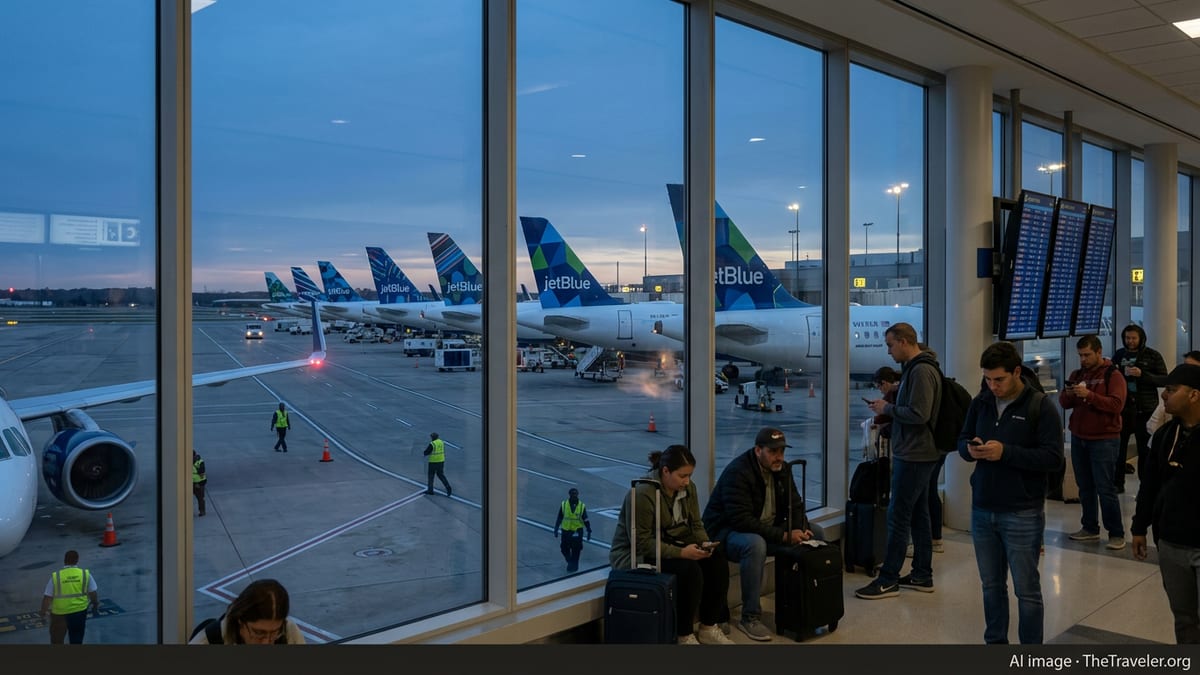
Brief Nationwide Halt Disrupts Early-Morning Departures
The Federal Aviation Administration issued the ground stop for all JetBlue Airways flights shortly before dawn on March 10, after the airline requested a temporary halt while it worked through a technology failure. The pause applied to JetBlue departures nationwide, though aircraft already in the air were allowed to continue to their destinations.
FAA advisories show the halt taking effect around 5:30 a.m. Eastern and being lifted roughly 40 minutes later, with an updated notice confirming that the airline’s operations could resume. In a statement, JetBlue described the incident as a “brief system outage” and said that normal operations were restarting.
Because of the short duration of the stop, JetBlue’s published schedule remained largely intact, though some early-morning flights were delayed while aircraft and crews were repositioned. Data from flight-tracking services indicated that the majority of the carrier’s departures were operating close to schedule within an hour of the pause being lifted.
At the time the order was issued, only a limited number of JetBlue flights were airborne, mitigating the risk of widespread mid-route disruptions. The larger effect was felt at departure gates, where boarding was held and some pushbacks were paused pending the all-clear from air traffic authorities.
System Outage Raises Questions About Airline IT Resilience
JetBlue has not yet detailed the precise cause of the outage, beyond characterizing it as an internal system problem significant enough to warrant a full ground stop. Industry sources and aviation analysts say such requests are typically linked to failures in core operational tools, including flight-planning software, crew-scheduling platforms or communications systems used to coordinate with air traffic control.
While full, nationwide ground stops initiated at the request of a single airline are relatively uncommon, they are not unprecedented. Carriers sometimes seek this option when they are unable to safely dispatch or monitor flights using their standard procedures, preferring a controlled halt to a piecemeal slowdown that can create additional complexity.
The episode underscores the dependence of modern air travel on robust technology infrastructure. A single connectivity or software issue can quickly ripple across a network that serves dozens of cities, especially for an airline such as JetBlue, whose operations are tightly concentrated at hubs including New York’s John F. Kennedy International Airport and Boston Logan International Airport.
In recent years, other major U.S. airlines have also grappled with IT disruptions that led to temporary ground stops or large-scale delays, highlighting an ongoing challenge for carriers investing in new digital tools while maintaining system reliability.
Impact on Travelers at Key JetBlue Hubs
The timing of Tuesday’s disruption coincided with the early-morning outbound rush at airports along the East Coast, where JetBlue carries a significant share of domestic and transborder traffic. At JFK and Boston Logan, some travelers reported delayed boarding calls and extended waits on the tarmac as crews awaited clearance to depart.
However, the brevity of the ground stop meant that queues at security checkpoints and customer service counters did not reach the levels seen during longer disruptions. Many passengers experienced delays measured in minutes rather than hours, though knock-on effects could still be felt throughout the morning at busy connection banks.
JetBlue did not issue a formal travel waiver, a sign that the airline expected to work through the backlog within the day. Still, passengers on tightly timed connections and those traveling from smaller focus cities were advised to monitor their flight status closely and allow extra time at the airport.
For travelers already in the air when the outage occurred, the experience was largely seamless. Aircraft continued on course while JetBlue operations teams coordinated with the FAA to ensure that any necessary rerouting or gate changes were handled once planes reached their destination airports.
What the Ground Stop Means for the Broader U.S. Air Network
Because the halt was confined to a single airline and lasted less than an hour, the broader U.S. aviation system remained stable. Neighboring carriers operating at shared airports reported normal operations, and air traffic control facilities did not need to implement widespread flow restrictions related to the JetBlue outage.
Aviation experts note that the FAA’s ability to quickly implement and then lift a targeted ground stop can help contain the impact of airline-specific issues, preventing them from cascading into larger nationwide disruptions. The centralized approach also provides clarity to pilots and controllers, who receive unified instructions rather than a patchwork of company-level directives.
The incident comes against the backdrop of growing scrutiny of aviation technology after a series of high-profile outages affecting both government and airline systems in recent years. Travelers and regulators alike are paying close attention to how quickly operations can be restored and whether carriers are investing adequately in redundancy and backup capabilities.
For JetBlue, which is navigating a competitive domestic market and ongoing adjustments to its route network, maintaining customer confidence in operational reliability will be central to its recovery from Tuesday’s glitch. How the airline communicates about the root cause and any steps taken to prevent a repeat may influence traveler sentiment in the weeks ahead.
What JetBlue Passengers Should Do Now
With flights back in the air, most JetBlue customers booked to travel later on March 10 are expected to operate near schedule, though lingering delays and a small number of cancellations remain possible as aircraft and crews are realigned. Travelers are being urged to keep a close eye on their flight status through the airline’s digital channels and airport information screens.
Passengers whose flights were significantly delayed or canceled during the ground stop window are encouraged to retain documentation of their disruption, such as boarding passes and receipts, in case they seek accommodations, meal vouchers or future travel credits under JetBlue’s customer service policies. Eligibility can vary based on the length and cause of the delay.
Travel advisers recommend that affected customers build extra time into any onward connections not booked on the same ticket, including trains, ferries or separate airline itineraries. Even modest schedule changes early in the day can compress connection windows later on, particularly at busy hubs where security queues and taxi times can be unpredictable.
For upcoming trips in the days ahead, there is no indication that the system outage will have a lasting operational impact. Nonetheless, the episode serves as a reminder that even well-planned journeys can face sudden disruptions, and that flexible arrangements and travel insurance can help soften the blow when unexpected issues arise.