

More news on this day
JetBlue is restoring a key link between Texas and the Northeast, announcing new twice-daily nonstop flights between Houston’s George Bush Intercontinental Airport and New York’s John F. Kennedy International Airport, a move that boosts competition and travel options for one of the country’s most important business and leisure corridors.
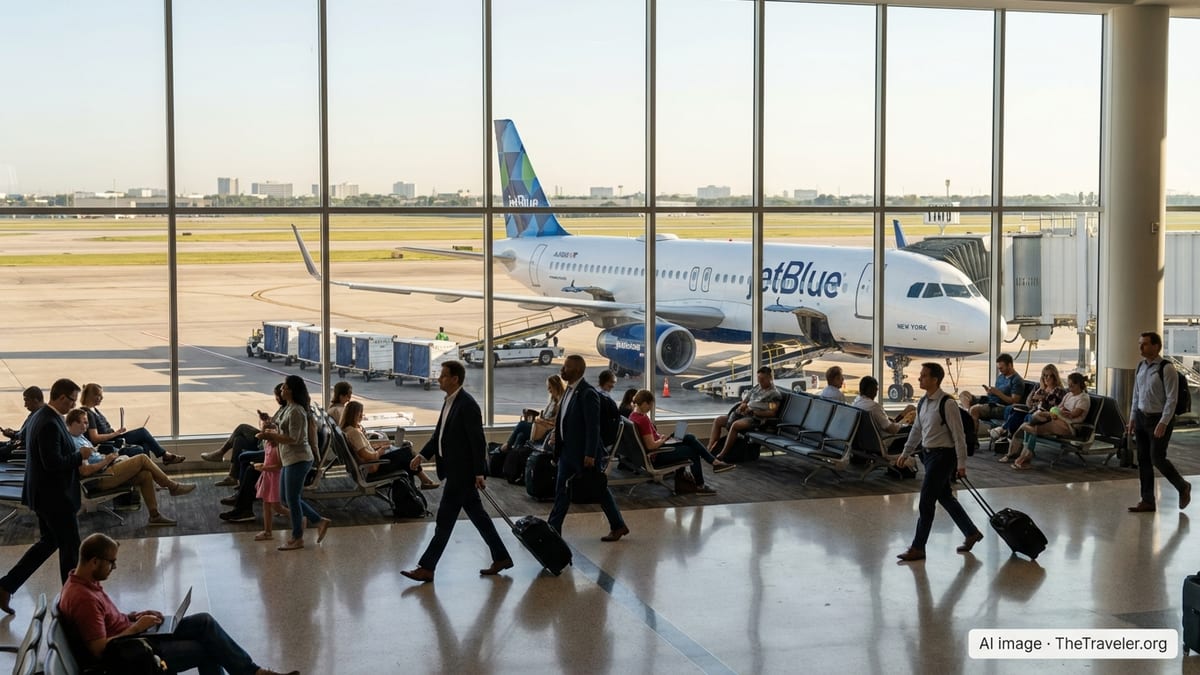
Key Details of JetBlue’s Reintroduced Houston–New York Route
The carrier will resume nonstop service between Houston and New York-JFK on May 21, 2026, operating two flights in each direction every day. The schedule is designed to appeal to both business and leisure travelers, with a morning departure from New York that arrives in Houston late morning, and a second early afternoon departure that reaches Texas in the late afternoon. Return flights from Houston are set around midday and early evening, giving travelers flexibility for same-day meetings or longer stays on either end of the route.
According to JetBlue’s published schedule, flight 1381 will depart JFK at 7:54 a.m. and arrive at IAH at 10:59 a.m., while flight 281 will leave JFK at 1:41 p.m. and land in Houston at 4:48 p.m. From Houston, flight 1382 will depart at 11:50 a.m., touching down at JFK at 4:27 p.m., and flight 282 will push back from IAH at 5:44 p.m., returning to New York at 10:23 p.m. The timetable offers a spread of options across the day, aimed at capturing a mix of corporate travelers, visiting friends and relatives, and connecting passengers.
The new Houston–New York flights will be operated with Airbus A320 aircraft, which form the backbone of JetBlue’s domestic mainline fleet. The A320s allow the airline to offer a consistent onboard experience that loyal customers will recognize from other transcontinental and East Coast routes. Tickets for the resumed service are already on sale through JetBlue’s direct channels, giving travelers ample time to plan for late-spring and summer trips in 2026.
Strategic Importance of the Houston–New York Corridor
The nonstop link between Houston and New York is one of the most heavily trafficked domestic business corridors in the United States, connecting two major hubs for energy, finance, health care, technology and international trade. Houston’s role as a global center for the energy industry and medical research, paired with New York’s position as a financial and corporate capital, ensures steady year-round demand from executives, project teams and industry specialists. The route also taps into robust leisure traffic, with travelers from the Northeast heading to Texas for cultural events, sports, conferences and cruise departures from nearby Gulf Coast ports.
JetBlue’s decision to re-enter this market follows a pause in service that ended in early 2025, during which the airline continued to serve Houston via Boston. By returning to JFK, JetBlue is positioning itself more directly against legacy competitors that have historically dominated the Houston–New York space. The carrier’s leadership has framed the move as a way to give customers in both cities a fresh choice, anchored in the airline’s reputation for competitive fares and a more comfortable in-cabin product than many standard domestic offerings.
For Houston, the renewed service links the city to JetBlue’s largest focus city and primary transatlantic gateway. For New York, the flights restore a direct connection to one of the country’s fastest-growing metropolitan areas, with a substantial population of business travelers and frequent flyers. The corridor’s significance is reflected in the twice-daily schedule from the outset, a level of frequency that signals confidence in demand and the ability to capture both point-to-point and connecting traffic.
Enhanced Comfort and Onboard Experience for Travelers
JetBlue is betting that its onboard experience will be a key differentiator as it returns to the Houston–New York market. The A320 aircraft assigned to the route will feature the carrier’s well-known cabin layout, with wider-than-average economy seats, in-seat power options and free seatback entertainment at every seat. Passengers can expect access to a full slate of live television channels, movies and streaming content, helping to make the roughly three-and-a-half-hour flight more productive or relaxing.
The airline’s fast, free unlimited Fly-Fi service will be available gate-to-gate, allowing travelers to stay connected to email, messaging apps and web browsing throughout the journey. This connectivity is particularly important for corporate travelers who need to work in transit or coordinate meetings on arrival. Coupled with complimentary snacks and nonalcoholic beverages, the service aims to create a cabin experience that resembles a pared-back version of long-haul international service rather than a no-frills domestic hop.
JetBlue’s Even More seating, which offers additional legroom and early boarding, will also be available for purchase on the Houston–New York flights. This upgrade option could appeal to frequent travelers who are cost-conscious but still looking for added personal space and priority treatment. The combination of legroom, connectivity and entertainment is a central pillar of JetBlue’s branding and will likely feature prominently in the airline’s marketing of the route across both Texas and the Northeast.
Greater Connectivity Through New York-JFK and Beyond
By operating the Houston flights into JFK, JetBlue places Houston travelers at the heart of its broader network. JFK serves as the airline’s principal hub on the East Coast, offering a wide range of domestic and international destinations. Customers arriving from Houston will be able to connect to popular leisure markets such as Florida and the Caribbean, as well as to Latin American destinations where JetBlue maintains a strong presence. The schedule is structured so that mid-morning and late afternoon arrivals from Houston feed into banked departure waves across the network.
For international travelers, the resumed route strengthens access to transatlantic services that depart from JFK. JetBlue has invested in building out a portfolio of flights to European gateways, and Houston-origin passengers can now connect in New York to reach those long-haul routes on a single ticket. That connectivity also works in reverse, opening up Houston as an additional U.S. destination for inbound travelers from Europe and Latin America who are flying JetBlue or its partner airlines.
On the New York side, residents and businesses gain direct access to Houston beyond the city’s central business district. George Bush Intercontinental Airport is a major connecting hub in its own right, offering onward links across Texas, the Gulf Coast and Mexico. While JetBlue is not a hub carrier at IAH, its presence there, combined with interline and codeshare arrangements elsewhere in its network, gives travelers more flexibility in building complex itineraries that pass through both Houston and New York.
Impact on Competition and Fares in a Key Market
JetBlue’s return to the Houston–New York route adds a new competitor to a market traditionally served by large network airlines. With another carrier offering nonstop service, travelers can expect a more competitive environment for fares and booking options, particularly during peak travel periods. Historically, the introduction or resumption of service by a value-oriented carrier like JetBlue has tended to put downward pressure on average ticket prices, or at least increase the availability of lower fare buckets, even when demand remains strong.
The airline’s leadership has emphasized not only price competitiveness but also what it describes as a higher level of service compared with typical domestic offerings. By combining free Wi-Fi, complimentary entertainment and relatively spacious seating as standard, JetBlue aims to reposition the route as one where travelers can expect more for their money. That strategy could resonate with both cost-conscious corporate travel managers and individual passengers who are increasingly focused on value and comfort in the wake of recent industry-wide disruptions.
The twice-daily frequency also enhances competitive dynamics by offering alternatives at different times of day. Travelers who previously had limited nonstop choices for early morning or evening departures between the two cities will now have more flexibility in tailoring their itineraries to meeting schedules, connections or personal preferences. Over time, the added capacity and timing may influence how corporate contracts are awarded and how travel policies are written for companies with significant footprints in both regions.
Benefits for Business Travelers and Corporate Markets
Few domestic routes serve as many high-value corporate travelers as the Houston–New York corridor, and JetBlue has clearly calibrated its schedule to appeal to this segment. The early morning departure from JFK supports day-of-arrival meetings in Houston, giving New York-based executives and project teams the ability to land before lunch and conduct business throughout the afternoon. The later return options from IAH allow travelers to fly back to New York the same evening or stay overnight and depart the following day, depending on their needs.
For Houston-based professionals, the midday and early evening departures to New York offer similar flexibility. These flights support a range of use cases, from same-day financial or legal consultations in Manhattan to extended trips that include multiple client visits along the East Coast. The ability to work productively in flight, thanks to free Wi-Fi and seatback power, can be particularly attractive to corporate travelers who need to make the most of their time between meetings.
Corporate travel buyers may also take note of the added competition when negotiating contracts and preferred-carrier agreements. JetBlue’s presence on the route introduces more leverage for large companies based in either city, potentially leading to more favorable terms or expanded options when it comes to class of service, change policies and last-minute availability. In an environment where many businesses are re-evaluating their travel budgets, the reintroduction of this route gives them another lever to pull in search of both savings and service quality.
Leisure Travel, Visiting Friends and Relatives, and Tourism Links
While the Houston–New York route clearly serves a substantial business market, the new flights are also poised to support strong leisure and visiting-friends-and-relatives demand. New Yorkers have long viewed Houston as a gateway to Texas culture, from its renowned food scene to its arts institutions and professional sports franchises. The city’s proximity to the Gulf Coast and to major cruise terminals adds another layer of appeal, making Houston a natural starting point for broader regional trips.
Texans, in turn, gain easier access to the attractions of New York City and the wider metropolitan area. The restored nonstop connection means shorter total travel times and less uncertainty around missed connections, a significant benefit for families, students and casual travelers planning short stays. With flights arriving into JFK, visitors can connect to ground transportation and regional rail, or link onward to other destinations in the Northeast, turning a single nonstop leg into the first step of a wider vacation.
The schedule, which includes afternoon and evening flights, also works well for weekend getaways and holiday travel. Travelers can depart after work or school and arrive with enough time to settle in before starting their plans the next day. Combined with JetBlue’s cabin amenities, the timing helps the airline market the route as both convenient and comfortable for nonbusiness travelers, including those who might be less accustomed to frequent flying.
How the Route Fits Into JetBlue’s Broader Network Strategy
The decision to reinstate Houston–New York service comes as JetBlue continues to fine-tune its network following several years of industry volatility and shifting travel patterns. In recent months and years, the airline has added and adjusted routes in markets such as Florida, New England and the Midwest, seeking to balance leisure-focused flying with high-yield business traffic. The move into Houston aligns with that strategy by pairing a large, internationally connected city with JetBlue’s largest focus city at JFK.
In Texas, the new flights complement the carrier’s existing daily service between Houston and Boston Logan International Airport, effectively linking Houston with two of JetBlue’s most important East Coast focus cities. This dual connectivity allows the airline to appeal both to New England-based travelers heading to Texas and to Houston residents seeking a choice of gateways for connections into JetBlue’s broader network. It also gives the airline more options for how it deploys aircraft and manages capacity across different business and leisure peaks.
From a brand perspective, re-entering the Houston–New York market underscores JetBlue’s commitment to being seen as a national carrier with reach across major economic centers, not just a coastal or leisure-focused airline. As the carrier navigates financial headwinds and ongoing changes in traveler behavior, high-profile routes like Houston–JFK serve as both revenue generators and visible signals of JetBlue’s long-term network ambitions.