

More news on this day
JetBlue is set to reignite the air corridor between Houston and New York City, announcing twice-daily nonstop flights between George Bush Intercontinental Airport and John F. Kennedy International Airport starting May 21, 2026.
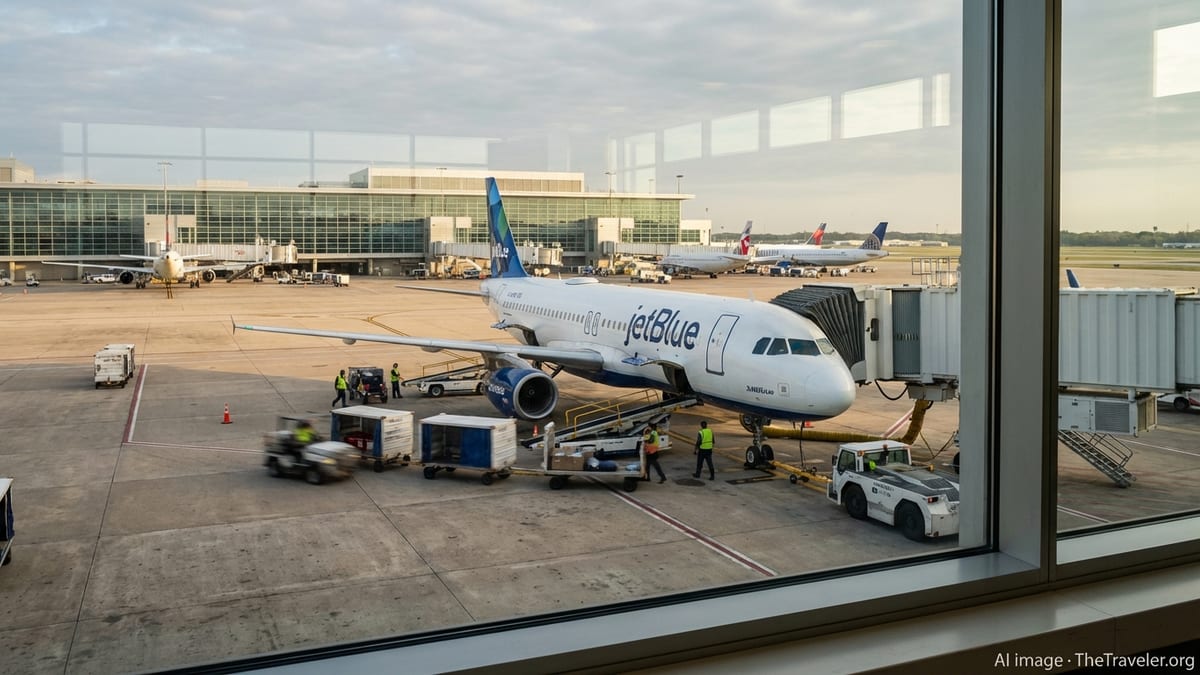
Twice-Daily Nonstops Reconnect Two Powerhouse Cities
The new Houston–New York service will operate twice daily in each direction, restoring a nonstop option on a route that links one of the country’s leading energy hubs with its largest financial and media center. JetBlue previously served the IAH–JFK market but exited in mid-2025; the May relaunch marks a renewed bet on strong demand between the two metropolitan areas.
From May 21, 2026, the schedule is designed to capture both same-day business trips and convenient connections. Morning departures from New York will arrive in Houston late morning, with return flights timed for late afternoon and evening, allowing travelers a full workday on either end. A second afternoon departure from JFK, paired with an evening return from Houston, targets both business and leisure travelers looking for flexible options.
The route will join JetBlue’s existing daily Houston–Boston service, cementing the carrier’s strategy of linking major business and tech centers across its network. For Houston-based travelers, it adds a new nonstop to New York that competes directly with legacy carriers already entrenched on the corridor.
Capacity on the route is expected to ramp up quickly if demand holds, positioning Houston as a more prominent spoke within JetBlue’s growing East Coast and transatlantic network. Aviation analysts note that the move slots neatly into the airline’s broader push to reinforce New York as a high-frequency gateway.
Expanded Access to JetBlue’s East Coast and Transatlantic Network
By reinstating Houston–JFK flights, JetBlue is offering Texas travelers one-stop access to a large portfolio of domestic and long-haul destinations that feed through its New York focus city. From JFK, passengers can connect to popular leisure markets in Florida and the Caribbean as well as long-haul routes to London and other European gateways served by JetBlue and its partners.
For Houston, which already enjoys extensive international service to Europe and Latin America on other airlines, the new link adds competitive pressure and greater choice, particularly for travelers who value JetBlue’s cabin product and customer service. The carrier is positioning JFK not only as a destination in its own right but also as a connection point to secondary vacation spots and smaller Caribbean islands that are less accessible via Houston’s existing network.
On the New York side, the additional feed from Texas is expected to strengthen JetBlue’s position on high-demand leisure routes. Traffic from Houston will help backfill seats on transatlantic departures and popular East Coast sun routes during peak periods, especially in summer and over major holiday travel windows.
Industry observers note that the timing of the launch coincides with broader airport upgrades at JFK’s Terminal 5, JetBlue’s home base, where a refresh of concessions and public spaces is underway through 2026. The upgraded terminal environment is expected to improve connection flows for customers using the new Houston services.
Onboard Experience Aims to Differentiate on a Competitive Route
JetBlue plans to operate the Houston–New York flights with aircraft offering its well-known mix of complimentary amenities, including free high-speed Wi-Fi, live television and on-demand entertainment via individual seatback screens. Complimentary snacks and soft drinks will be available, with additional food and beverage options for purchase.
While the carrier has not highlighted premium Mint service on this specific route, its standard economy cabin still aims to stand out with comparatively generous legroom, in-seat power on most aircraft and a more relaxed in-flight atmosphere than some full-service rivals. That formula has been central to JetBlue’s appeal in key business markets where it competes head-to-head with larger network airlines.
The airline will be entering a corridor that already sees heavy traffic from other major carriers linking Houston and the New York area. By focusing on the JFK gateway, JetBlue is targeting travelers who prioritize connections to its East Coast and transatlantic network, along with those who simply prefer the amenities and customer experience the airline is known for.
Analysts expect fare competition to intensify once tickets go on sale, potentially delivering sharp introductory prices as JetBlue and incumbent airlines vie for market share. Corporate travel managers and frequent flyers along the corridor will be watching closely to see how schedules and pricing evolve ahead of the May 2026 start date.
Economic and Tourism Boost for Houston and New York
The reinstated nonstop service is poised to deliver a modest but meaningful boost to both local economies. For Houston, direct links to New York’s finance, media and technology sectors are critical for the city’s energy firms, healthcare institutions and growing innovation ecosystem. More nonstop capacity to JFK can shorten travel times for executives, investors and professionals who crisscross between the two metros.
Tourism officials in both cities are also likely to welcome the increased airlift. For New Yorkers, Houston offers a gateway to Gulf Coast culture, top-tier museums, professional sports and the region’s culinary scene. For Houstonians, nonstop access to JFK puts Broadway, major cultural institutions and New York’s neighborhoods within easier reach, while also opening up smooth onward travel to Europe for city breaks and summer holidays.
The route’s twice-daily cadence should also support small and medium-sized enterprises that rely on quick, reliable connections for client meetings, conferences and trade shows. Enhanced connectivity can play a role in corporate location decisions, particularly for firms weighing expansion in either the Houston or New York markets.
Local airport authorities at George Bush Intercontinental are expected to highlight the service as part of Houston’s broader efforts to expand its roster of airlines and destinations. For JetBlue, the move fits into a pattern of re-engaging with markets where it sees improved revenue potential and strong corporate travel demand.
What Travelers Can Expect as May 2026 Approaches
With the launch date now set for May 21, 2026, travelers on both ends of the route can expect schedule details and introductory fares to become more visible in booking channels in the months ahead. As the start of service nears, the focus will shift to how reliably JetBlue can maintain on-time performance across the busy Northeast corridor, where congestion and weather often test airline operations.
Customers connecting through JFK on the new flights will benefit from continuing upgrades to JetBlue’s Terminal 5, including expanded retail and dining options scheduled to phase in through late 2026. The improvements are aimed at making connections smoother and dwell time more comfortable, an important consideration for Houston-origin travelers heading onward to transatlantic or Caribbean destinations.
For now, the announcement signals that JetBlue sees long-term value in reasserting its presence between Houston and New York City. If demand proves robust and operational performance holds steady, industry watchers say the twice-daily schedule could later evolve with upgauged aircraft, seasonal frequency adjustments or enhanced connectivity with partner airlines.
As airlines recalibrate their networks for the second half of the decade, the revived IAH–JFK link underscores how crucial Houston and New York remain in the broader map of U.S. business and leisure travel. For passengers, it translates into another competitive option on one of the country’s most important city pairs.