

More news on this day
JetBlue is restoring nonstop service between Houston and New York just months before the 2026 FIFA World Cup, adding crucial capacity on a key corridor as Houston prepares for an influx of global soccer fans and a surge in business travel tied to the tournament.
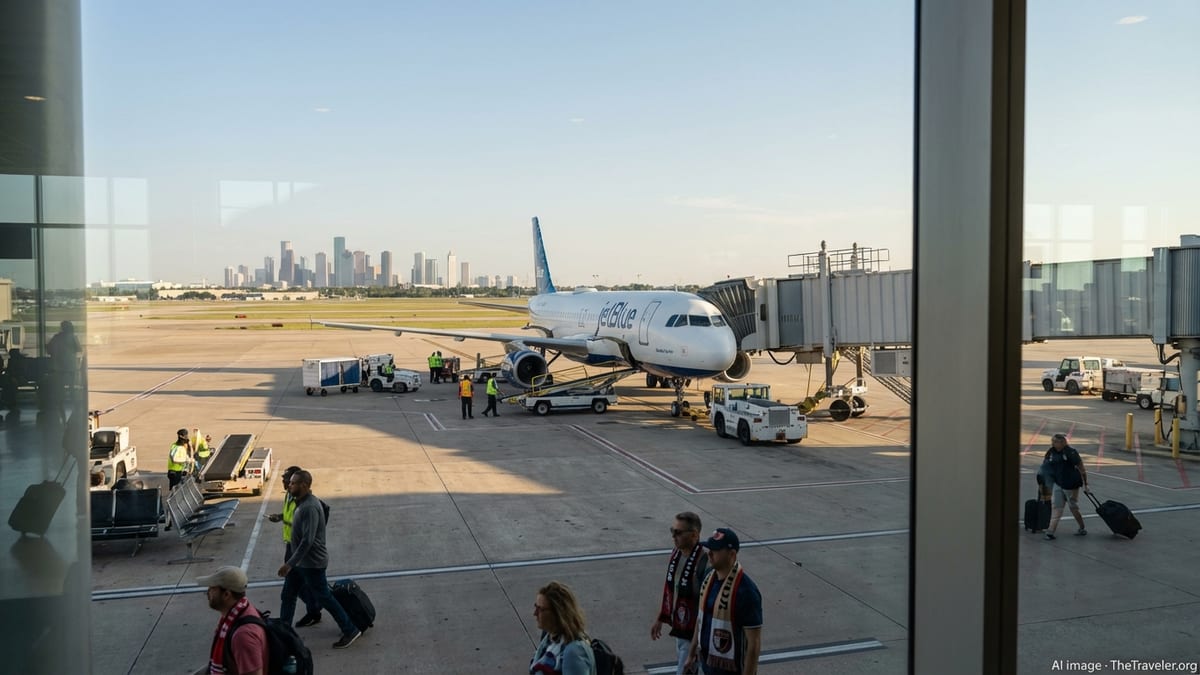
Twice-Daily Nonstops Return on the Houston–New York Corridor
JetBlue has confirmed that it will relaunch nonstop flights between Houston’s George Bush Intercontinental Airport and New York’s John F. Kennedy International Airport, beginning May 21, 2026. The move restores a high-profile link in the carrier’s network, reconnecting two of the country’s largest metro areas with JetBlue’s low fares and full-service onboard experience just weeks before the World Cup kicks off in the United States, Canada and Mexico.
The new schedule features two daily roundtrips. Morning Flight 1381 is slated to depart JFK at 7:54 a.m., arriving in Houston at 10:59 a.m., with the return Flight 1382 leaving Bush Intercontinental at 11:50 a.m. and touching down in New York at 4:27 p.m. An afternoon pairing, Flights 281 and 282, will depart JFK at 1:41 p.m. and IAH at 5:44 p.m., respectively, giving travelers both daytime and evening options tailored to business and leisure needs.
The service will be operated with Airbus A320 aircraft, bringing JetBlue’s signature touches to the route, including seatback screens, complimentary Wi-Fi, and free snacks and soft drinks. For Houston, the additional capacity arrives at a pivotal moment as the region gears up for seven World Cup matches and an expected half-million visitors.
JetBlue previously linked Houston and New York before restructuring its network in recent years. The return of the route underscores how competition is heating up again on one of the country’s most important business and tourism corridors, even as other major carriers expand their own Houston–Northeast offerings ahead of 2026.
Why May 2026 Matters for World Cup Travelers
The timing of JetBlue’s relaunch is strategic. The World Cup window for Houston’s matches runs from mid-June through early July 2026, and airlines typically open peak-summer schedules months in advance. By starting service on May 21, JetBlue positions itself to capture early tournament arrivals as well as last-minute fans and corporate travelers who will be shuttling between New York, a World Cup final host, and Houston, one of the key group and knockout-stage venues.
Travel demand tied to the tournament is already showing up in data. Booking platforms and airline partners report triple-digit increases in searches for flights to Houston since the match schedule was released, with especially strong interest from European markets whose national teams will play in Texas. The city’s tourism and airport officials estimate that as many as 500,000 visitors could pass through Houston during the tournament period, generating up to 1.5 billion dollars in economic impact.
Against that backdrop, nonstop connectivity to New York is more than a convenience. It offers a direct link to one of the world’s most important international gateways, where fans can connect from Europe, South America, Africa and Asia before continuing on to Houston. It also gives supporters who plan to follow their teams across multiple U.S. host cities an efficient way to move between the East Coast and Texas without detouring through other hubs.
The mid-May launch also allows JetBlue to ramp up operations and iron out any schedule or performance issues before the first whistle is blown. With airport congestion, security lines and air traffic volumes all expected to spike in June and July 2026, airlines and local officials have been keen to ensure new routes are tested and established well ahead of the tournament.
Schedules, Aircraft and What Passengers Can Expect
For travelers plotting their World Cup journeys or frequent business trips, the exact flight times will matter. JetBlue’s morning departure from JFK at 7:54 a.m. reaches Houston just before 11 a.m. local time, making same-day meetings feasible for New York-based executives and allowing international passengers arriving into New York early in the morning to make a same-day connection to Texas. On the return, the 11:50 a.m. Houston departure lands in New York in the late afternoon, leaving enough time to connect onwards to evening flights to Europe and beyond.
The later pair of flights, leaving JFK at 1:41 p.m. and Houston at 5:44 p.m., caters to travelers who prefer a more relaxed start, as well as fans flying in for evening events, fan festivals or training sessions. The 5:44 p.m. departure from Houston arrives at 10:23 p.m. in New York, matching up with late-night transatlantic departures and giving domestic passengers the option to reach other East Coast cities before midnight.
Onboard, passengers can expect JetBlue’s established A320 cabin, known for its relatively generous legroom compared with many competitors in the domestic market. Features include free high-speed Wi-Fi throughout the cabin, seatback entertainment with live television and on-demand content, and a complimentary selection of snacks and nonalcoholic beverages. While the route will not feature the airline’s Mint premium cabin, upgrades to extra-legroom seating are available for an additional fee, a likely draw for business travelers and long-haul connectors.
JetBlue is also emphasizing the benefits of booking directly through its channels, such as the ability to earn additional loyalty points and access promotional fares that may not appear on third-party sites. For fans watching fares closely in the run-up to 2026, this could make the difference when securing last-minute seats on peak match days.
Houston’s Airports Brace for a World Cup Wave
The restoration of nonstop service from New York comes as Houston’s airport system accelerates preparations for the World Cup. George Bush Intercontinental is in the midst of a multiyear expansion, including a new international terminal complex that airport leaders say will be fully operational ahead of the tournament. A 17-lane security checkpoint, upgraded customs facilities and expanded concessions are intended to ease bottlenecks as passenger volumes climb.
Houston Airports has also rolled out a digital tools push in anticipation of 2026. An interactive “Fútbol” filter on its destination map highlights nonstop routes from Houston to every World Cup host city across North America, encouraging fans to use the city as a jumping-off point for multi-city itineraries. The relaunch of direct flights to New York, itself a host of marquee late-stage matches including the final, adds an important piece to that connectivity puzzle.
Beyond fixed infrastructure, airport managers have been investing in customer service and accessibility. Staff have been trained under the Hidden Disabilities Sunflower program to assist travelers with non-visible needs, while additional multilingual agents, upgraded Wi-Fi and new information kiosks aim to keep wayfinding simple even for first-time visitors to the United States. With rental car agencies increasing their electric vehicle fleets and new public transit links from Bush Intercontinental to downtown, Houston is positioning itself as a central, easy-to-navigate hub for the tournament.
City leaders say the combination of increased air service, including JetBlue’s return, and facility upgrades will be vital in handling the spike in arrivals without overwhelming terminals. As security plans ramp up and local agencies seek federal funding for police overtime and crowd management, reliable air connections are seen as a foundational part of the city’s World Cup readiness strategy.
New York’s Role as a Global Gateway for Fans
On the other end of the route, New York is preparing for a World Cup of its own. The New York and New Jersey region is set to host some of the tournament’s most consequential matches, culminating in the final. That makes the city both a destination and a key transit hub, with tens of thousands of fans expected to flow through JFK on peak days as they head to and from other host cities.
JetBlue, long branded as New York’s “hometown airline,” is leaning into that positioning. The Houston nonstop will plug directly into its sprawling JFK schedule, offering same-day connections to destinations throughout the eastern United States, the Caribbean, Latin America and Europe. For international fans, particularly from markets where JetBlue has built a strong presence such as the Dominican Republic and parts of South America, the ability to connect through JFK and onto a dedicated Houston service could simplify planning considerably.
New York’s three major airports are all anticipated to see increased traffic in 2026, with JFK shouldering a significant share of international arrivals. Infrastructure upgrades, including improved terminal facilities and expanded security lanes, aim to smooth the flow. Airlines, in turn, are adjusting their networks, and JetBlue’s move to restore Houston service is one of the clearest signals yet that carriers see the corridor as central to their World Cup strategies.
For fans splitting their itineraries between the two cities, the twice-daily Houston–New York flights will also open up opportunities to attend matches, fan zones and cultural events in both markets, turning what might have been a single-city trip into a broader tour of two of America’s most diverse urban centers.
What This Means for Competition and Fares
Houston is already one of the most connected cities in the United States, with major carriers offering dozens of daily departures to New York–area airports. The addition of JetBlue’s twice-daily service into JFK injects fresh competition into a market that is expected to see sustained demand spikes before, during and even after the World Cup, as tourism marketing campaigns keep the spotlight on host cities.
Industry analysts note that while airlines often raise fares during peak events, increased competition on a specific route can moderate price pressure and expand inventory at entry-level fare buckets. With JetBlue joining incumbents on the Houston–New York corridor, travelers may find more choice in both price and schedule, especially for midweek flights and off-peak times surrounding key match days.
The route also strengthens JetBlue’s positioning as a leisure-focused East Coast carrier that is nonetheless able to tap into major global events. In recent years, the airline has repeatedly adjusted its network, trimming some markets while restoring others where it sees strong demand and competitive advantage. The decision to return to Houston in the lead-up to the World Cup suggests confidence that the city’s visitor boom will outlast the final whistle, sustained by business ties, medical tourism and conventions.
For Houston’s tourism sector, additional nonstop links to New York are a welcome development. Hotels, restaurants and local attractions are counting on repeat visits after 2026 as first-time visitors return for business or leisure. Direct flights make it easier to convert a one-time World Cup trip into an enduring travel corridor between two powerhouse metros.
Planning Tips for Fans Considering JetBlue’s New Route
With schedules now published and tickets on sale, fans who plan to use JetBlue’s nonstop service between Houston and New York are being urged by travel advisors to book early, especially for dates around major matches and knockout rounds. Historical patterns from previous World Cups show that fares can climb sharply as fixtures approach and seat availability dwindles, particularly in the days immediately before and after high-profile games.
Travel planners recommend building flexibility into itineraries where possible. Flying into New York a day early and connecting to Houston on JetBlue’s morning or afternoon flights can provide a buffer against weather delays or congestion. Likewise, fans may want to consider midweek travel on the Houston–New York leg, when business demand can be more predictable and leisure travelers have more opportunity to find lower fares.
Given the expected surge in demand across all host cities, passengers are also being reminded to pay close attention to airport logistics. Bush Intercontinental and JFK both advise arriving earlier than usual during the tournament period, allowing additional time for security, border checks and terminal transfers. With JetBlue offering Fly-Fi onboard and modernized digital tools on the ground, the airline is betting that a blend of connectivity and convenience will help ease some of the stress.
For those who see the World Cup as a once-in-a-lifetime chance to explore multiple destinations, JetBlue’s Houston–New York flights can serve as the backbone of a broader itinerary, linking Texas’ World Cup hub with the cultural and sporting spectacle awaiting in the Northeast.