

More news on this day
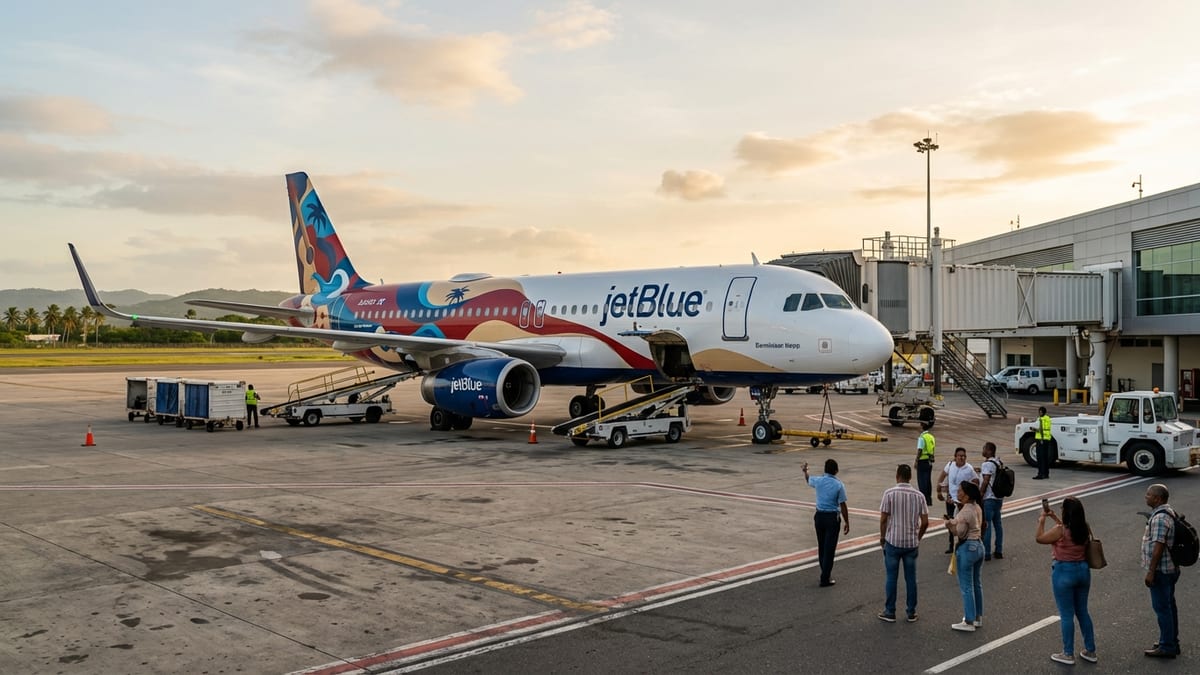
JetBlue is putting the Dominican Republic front and center in the skies, unveiling a community-chosen special livery that turns one of its Airbus A320s into a flying homage to the Caribbean nation’s culture, creativity, and diaspora.
The new design, created by Dominican artist Willy Gómez and selected through a public vote, is the crowning moment of the airline’s RD Orgullo que Eleva campaign, which invited Dominicans and JetBlue customers to help choose the look of the first JetBlue aircraft ever dedicated to the Dominican Republic.
More News
- Caribbean Travel to U.S. Upended by New Visa Freezes and Expanded Bans
- Mexico Restores E-Visas for Brazilians, Paving the Way for Borderless Tourism
- Philippine Airlines Joins Regional Carriers Powering Southeast Asia’s Tourism Boom
A New Chapter in JetBlue’s Dominican Story
The unveiling of the community-chosen livery marks a symbolic milestone in a relationship that began more than two decades ago, when JetBlue launched its first international route from New York to Santiago in the Dominican Republic. Since then, the airline has steadily grown into the largest carrier serving the country, offering more seats between the United States and the Dominican Republic than any competitor and connecting major Dominican cities with key U.S. gateways.
That growth has been powered not only by tourism, but by the deep, year-round ties of a diasporic community that moves frequently between the island and cities like New York, Boston, Orlando, and Fort Lauderdale. For many of those travelers, JetBlue has long been the preferred bridge between family, work, and home. The new livery is JetBlue’s way of turning that bridge into a canvas, transforming a familiar blue-and-white fuselage into a moving celebration of identity and pride.
Announced in New York on February 4, 2026, the design will debut on a JetBlue Airbus A320 later this spring. The aircraft will then rotate across the carrier’s Caribbean and U.S. network, giving travelers on a variety of routes the chance to spot, photograph, and fly on what is set to become one of JetBlue’s most recognizable special liveries.
From Public Vote to Painted Aircraft
The new Dominican Republic tribute livery is the result of a rare level of public participation in an airline design process. Rather than commissioning a one-off concept behind closed doors, JetBlue invited customers and fans to vote on three original designs by Dominican artists, turning the selection into a social and cultural event as much as a branding exercise.
The campaign, launched in January as RD Orgullo que Eleva, opened voting to the public for several days, with participants encouraged to choose the design that best captured the colors, rhythms, and stories of Dominican life. The initiative followed a model JetBlue recently used in Puerto Rico, where a separate public vote determined a Boricua-inspired livery, and underscores the airline’s strategy of allowing the people most closely tied to an island to help decide how it is represented on the fuselage.
While JetBlue has previously introduced special liveries celebrating destinations, teams, and causes, this is its first aircraft dedicated specifically to the Dominican Republic and its people. By putting the final decision in the hands of the community, the airline signaled that the aircraft is as much a tribute to the voters as it is to the island itself.
The Artist Behind the Design: Willy Gómez
The winning concept belongs to Dominican artist, art director, illustrator, and muralist Willy Gómez, whose work blends Neo-traditional aesthetics with Art Nouveau influences and a strong focus on Latin culture. With more than 20 years of creative experience, Gómez has built a portfolio that often centers on themes of identity, heritage, and the everyday poetry of Caribbean life.
For JetBlue, Gómez translated that vision into a large-scale, aircraft-ready artwork filled with flowing lines, bold contrasts, and imagery drawn from Dominican music, dance, nature, and coastal landscapes. The design, rendered to wrap around the A320’s fuselage and tail, is intended to evoke movement and rhythm even when the aircraft is parked at the gate, with forms and colors that recall a blend of carnival, shoreline, and neighborhood street scenes.
In remarks shared with the airline, Gómez described seeing his art take to the air as a personal and collective milestone. The aircraft, he said, is a tribute to his roots and to the energy of the Dominican Republic itself, a place whose spirit has shaped his work from the beginning. For Dominican travelers and aviation enthusiasts alike, the livery positions Gómez alongside a small but growing group of Caribbean artists whose work now circulates across international air routes instead of traditional gallery walls.
Three Visions of Dominican Culture, One Chosen by the People
Before Gómez’s design secured the public vote, it competed with two other bold interpretations of Dominican identity from the creative collective Los Plebeyos and illustrator Lena Tolkens. Each artist was commissioned by JetBlue to produce an original concept inspired by Dominican life, with the airline compensating all three for their work regardless of the outcome of the vote.
Los Plebeyos, known for sharp, graphic storytelling and a contemporary social lens, produced a design grounded in everyday Dominican scenes and folklore. Their concept wove references to shared pastimes, family gatherings, street culture, and traditional symbols into a playful, high-impact visual language that would have turned the aircraft into a rolling panorama of island life.
Lena Tolkens, an internationally recognized illustrator, offered a different perspective, blending surrealist touches, vivid color, and natural motifs. Her design incorporated the colors of the Dominican flag and depicted two central figures meant to represent the country’s creativity, resilience, and rhythm, surrounded by organic forms that suggested the island’s landscapes and biodiversity.
Together, the three concepts highlighted the range and sophistication of contemporary Dominican visual culture. By inviting the public to vote among them, JetBlue not only ensured that the final aircraft would reflect community preferences, but also introduced a broad audience to a trio of Dominican creatives whose work may now garner increased international attention.
A Flying Symbol of Diaspora, Tourism, and Economic Ties
Once painted and placed into service, the A320 featuring Gómez’s livery is expected to operate across some of JetBlue’s highest-profile routes linking the Dominican Republic with the United States. These include flights connecting Santiago, Santo Domingo, Puerto Plata, and Punta Cana with hubs like New York, Boston, Fort Lauderdale, Orlando, and other U.S. cities where Dominican communities are well established.
For tourism officials and travel industry stakeholders, the aircraft arrives at a pivotal moment. The Dominican Republic has been one of the Caribbean’s strongest-performing destinations in recent years, with robust visitor numbers driven by a mix of all-inclusive resorts, boutique coastal escapes, urban culture in Santo Domingo, and growing interest in eco and adventure tourism. An aircraft that visually embodies Dominican identity effectively becomes a roaming billboard for the island wherever it lands.
For the Dominican diaspora, the livery carries a different, more personal resonance. Many Dominicans abroad fly frequently to the island for family reunions, holidays, remittances-related visits, and community events. Seeing a commercial airliner adorned with imagery that speaks directly to their culture can create an emotional bridge that standard airline branding rarely achieves. It transforms a routine travel day into a moment of recognition and pride before passengers even step on board.
JetBlue has emphasized that the aircraft is intended to serve as a symbol of the airline’s investments in the Dominican Republic’s future, not only through air service and tourism promotion, but also through educational partnerships, community projects, and job creation tied to its operations in the country.
Beyond Paint: Community Investment and Cultural Partnership
The livery sits within a broader pattern of engagement by JetBlue in the Dominican Republic that extends beyond the runway. Over the past several years, the airline and its foundation have supported local organizations focused on education, youth development, and literacy, including multi-year partnerships aimed at expanding opportunities for girls and strengthening early childhood reading programs.
JetBlue teams have also taken part in volunteer initiatives that bring employees into Dominican communities for activities that range from school renovations to book fairs. By combining corporate philanthropy with on-the-ground volunteerism, the airline has sought to position itself not only as a carrier of passengers, but as a stakeholder in the country’s social and economic wellbeing.
RD Orgullo que Eleva reinforces that positioning by foregrounding Dominican talent and involving local voices in all stages of the project, from artist selection to the public vote. It turns a typical marketing asset into a collaborative work, one that is as much about process as final product. JetBlue has framed the campaign as a celebration of creativity within the Dominican Republic and across its diaspora, emphasizing that each vote cast was a small act of cultural affirmation.
The livery also aligns with a wider movement in global aviation toward destination-specific aircraft artwork that goes beyond simple flag decals or color accents. It reflects a recognition that travelers increasingly value authenticity and representation, and that airlines can play a role in amplifying local stories and aesthetics rather than relying solely on centralized corporate visuals.
How the Dominican Livery Fits JetBlue’s Caribbean Strategy
JetBlue’s decision to invest in a Dominican Republic tribute aircraft is part of a larger strategy to underscore its presence in key Caribbean markets. In recent years, the airline has strengthened its network across the region, with new or relaunched routes linking U.S. cities to Caribbean destinations and special liveries honoring places like Puerto Rico. A recently unveiled Boricua-themed aircraft, also selected through a public vote, reflects a similar approach to community engagement and cultural acknowledgment.
The Dominican Republic, however, occupies a particularly central role in JetBlue’s route map and brand identity. The airline’s first international expansion was into the country, and over time the Dominican market has become one of its most important for both leisure and visiting-friends-and-relatives traffic. By dedicating an aircraft to the island’s imagery and narrative, JetBlue is sending a clear signal that it sees the Dominican Republic as a core pillar of its long-term Caribbean footprint.
Industry observers note that such liveries, while visually striking, are also practical tools. They often generate organic media coverage, social media sharing, and word-of-mouth publicity when spotted in different airports. For destinations reliant on tourism, that kind of attention can be particularly valuable, reinforcing destination branding efforts without traditional advertising buys.
As the painted A320 begins operating later in 2026, route announcements and spotting reports from aviation enthusiasts are likely to track its movements closely. For JetBlue, every takeoff and landing of the aircraft will not only move passengers, but also carry a story of Dominican pride into terminals and airspace across the Americas.
What Travelers Can Expect When the JetBlue Dominican Livery Takes Flight
The visual experience of the new livery will be most striking from the tarmac, jet bridge, or terminal windows, where passengers will see the full sweep of Gómez’s design across the fuselage and tail. While the interior of the aircraft is expected to retain JetBlue’s standard cabin features, from seating layouts to inflight entertainment, the exterior artwork will set the mood from the moment the aircraft taxis into view.
Travelers booking flights between the U.S. and the Dominican Republic will not be able to guarantee travel on the special aircraft, since it will rotate through routes based on operational needs. However, JetBlue often highlights its special liveries through social media and marketing channels, giving avgeeks and casual fliers alike a better chance of timing their trip to match the plane’s schedule when possible.
Once onboard, the presence of a Dominican-themed aircraft may also be reflected in subtle touches such as onboard announcements and crew messaging acknowledging the significance of the design. For Dominican passengers, including those traveling home after extended periods abroad, boarding a plane wrapped in familiar symbols could be a powerful reminder that their heritage is not just a private identity, but something increasingly visible and celebrated on an international stage.
For other travelers, the livery may spark curiosity and conversation, functioning as an invitation to learn more about the island beyond resort brochures: its music, its food, its communities, and the people who call it home, both on the island and abroad.
FAQ
Q1. What is JetBlue’s new Dominican Republic livery and why is it significant?
The new livery is a special paint scheme on a JetBlue Airbus A320 that visually celebrates Dominican culture and identity. It is significant because it is the airline’s first aircraft dedicated specifically to the Dominican Republic, and the design was chosen by public vote as part of a community-focused campaign.
Q2. Who designed the winning livery honoring the Dominican Republic?
The winning design was created by Dominican artist Willy Gómez, an art director, illustrator, and muralist known for blending Neo-traditional and Art Nouveau influences with vibrant depictions of Latin and Caribbean culture.
Q3. How was the livery design selected?
The design was chosen through JetBlue’s RD Orgullo que Eleva campaign, which invited customers and fans to vote on three original aircraft concepts created by Dominican artists. The public voting period determined which design would be painted on the aircraft.
Q4. Which other artists participated in the campaign?
Alongside Willy Gómez, the campaign featured designs from the Dominican creative collective Los Plebeyos and illustrator Lena Tolkens. Each brought a distinct interpretation of Dominican life, folklore, and symbolism to the competition.
Q5. When will the Dominican tribute aircraft enter service?
JetBlue has announced that the Airbus A320 featuring the new livery will debut later this spring, following completion of the painting process and standard operational preparations before entering regular passenger service.
Q6. On which routes is the special livery expected to operate?
While exact rotations can vary, the aircraft is expected to fly on routes linking the Dominican Republic’s key airports, such as Santiago, Santo Domingo, Puerto Plata, and Punta Cana, with major JetBlue focus cities in the United States, including New York, Boston, Orlando, and Fort Lauderdale.
Q7. Can passengers book specifically to fly on the Dominican livery aircraft?
No, JetBlue does not allow customers to book a specific aircraft by livery. The special A320 will be assigned to routes according to operational needs, so flying on it will depend on scheduling, though the airline may highlight its movements through its communications channels.
Q8. Does the livery change the onboard experience or cabin layout?
The livery primarily affects the aircraft’s exterior appearance and does not change the interior layout, seating configuration, or core inflight services. Passengers can expect JetBlue’s usual cabin experience, with the added cultural significance of traveling on a specially painted aircraft.
Q9. How does this livery fit into JetBlue’s broader Caribbean strategy?
The Dominican livery is part of a wider JetBlue initiative to recognize and celebrate key Caribbean markets through destination-inspired aircraft artwork. It follows similar community-driven projects in Puerto Rico and supports the airline’s positioning as a major carrier in the region with deep local ties.
Q10. Why is the livery important to the Dominican diaspora and tourism sector?
For the diaspora, the aircraft serves as a powerful symbol of visibility and pride, reflecting their culture on an international stage and on the very planes that connect them with home. For tourism, the eye-catching design functions as a moving advertisement for the Dominican Republic, reinforcing its identity as a vibrant, must-visit Caribbean destination each time the aircraft lands in a new city.