

More news on this day
JetBlue Airways’ decision to resume twice-daily nonstop flights between Houston and New York this spring is emerging as one of the most closely watched U.S. route developments of 2026, with tourism leaders and hotel chains eyeing the corridor as a fresh engine for visitor growth and corporate travel demand.
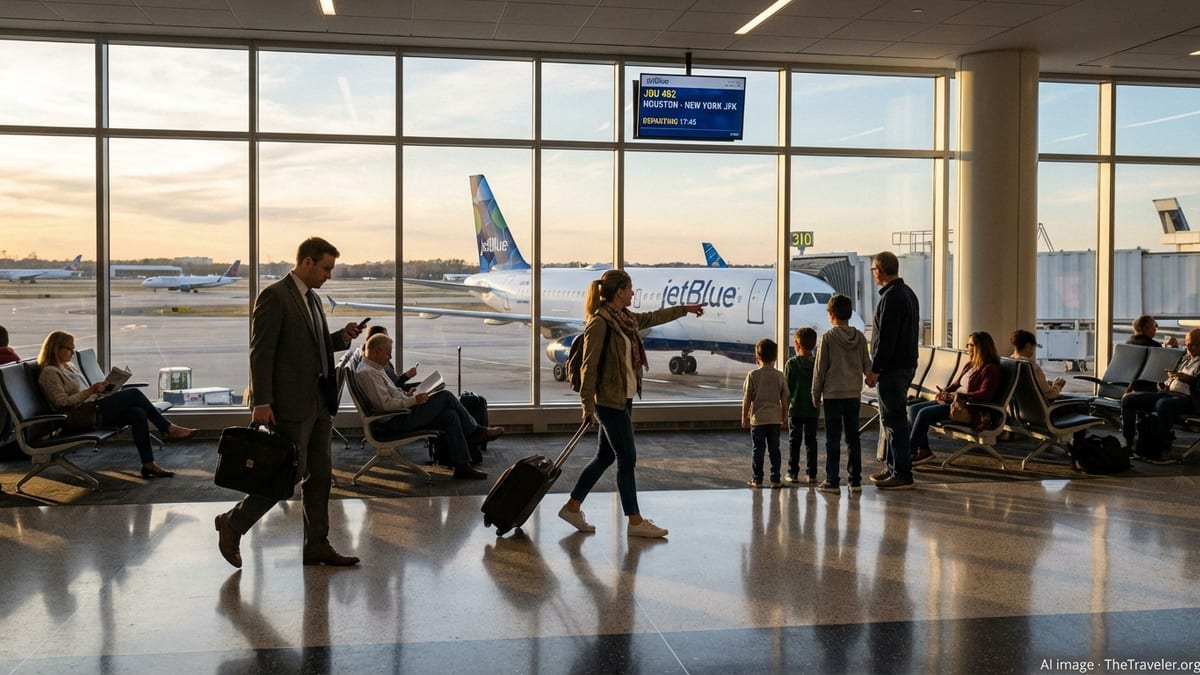
Twice-Daily Service Reconnects Two High-Powered Markets
JetBlue will restart nonstop service between Houston’s George Bush Intercontinental Airport and New York’s John F. Kennedy International Airport on May 21, 2026, operating two daily roundtrips that restore a link the carrier previously suspended in 2025. The move brings back what the airline describes as a “convenient connection between two major metropolitan areas,” with schedules tailored to both business and leisure travelers.
The new timetable offers morning and afternoon departures in each direction, giving travelers the option of same-day trips or longer stays on either end of the route. Flights from New York are scheduled to leave JFK at 7:54 a.m. and 1:41 p.m., arriving in Houston late morning and late afternoon, while returns from Houston depart at 11:50 a.m. and 5:44 p.m., feeding into early evening and late-night arrivals in New York.
JetBlue will use Airbus A320 aircraft on the route, adding capacity into a market already served by Delta Air Lines. For Houston, the flights complement JetBlue’s existing daily service to Boston, effectively positioning the carrier as a growing player in Texas–Northeast connectivity. For New York, they deepen JetBlue’s role as a gateway to its wider network in the United States, Latin America, the Caribbean and Europe.
Industry analysts note that the return to the Houston–JFK corridor underscores a broader trend among U.S. airlines: redeploying aircraft to routes where strong leisure demand and resilient corporate traffic can support high load factors and premium yields, particularly after several years of network reshuffling.
Tourism Officials Anticipate a Lift in Two-Direction Visitor Flows
Tourism agencies in both Texas and New York are closely tracking the restart of the route, viewing it as an opportunity to stimulate new visitor flows on top of already robust domestic tourism. Houston has increasingly marketed itself as a gateway to Gulf Coast beaches, NASA’s Johnson Space Center and a growing culinary scene, while New York continues to be a marquee destination for international and domestic travelers alike.
Nonstop connectivity is often a deciding factor for short breaks and long weekends, and the ability to travel between Houston and New York in under four hours without a connection is expected to make spur-of-the-moment leisure trips more attractive. Travel planners say the morning departures in each direction are particularly well suited to long weekend itineraries, enabling travelers to maximize time on the ground with minimal time off work.
The flights also create more seamless connections for inbound international visitors. Travelers arriving into JFK from Europe, the Caribbean or South America on JetBlue or partner airlines can now connect directly to Houston on the same carrier, supporting Texas itineraries that combine Houston with destinations like the Hill Country, the Gulf Coast or neighboring cities such as Austin and San Antonio.
Conversely, visitors from Latin America and the Caribbean who already use Houston as an entry point to the United States will gain easier one-stop access to New York via JetBlue’s expanding domestic network, potentially boosting hotel nights in both cities as travelers pair business commitments with leisure stays, a trend widely known as “bleisure” travel.
Corporate Travel and Energy Sector Demand in Focus
The economic ties between New York and Houston are extensive, dominated by finance, energy, healthcare and professional services. The resumed JetBlue service is expected to appeal strongly to corporate travelers, many of whom prize schedule flexibility and the ability to make same-day roundtrips for meetings, site visits and investor roadshows.
Houston’s role as a global energy capital means that executives, project teams and consultants regularly shuttle between Texas headquarters and financial centers in Manhattan and beyond. The early morning departure from JFK arriving in Houston before midday aligns with afternoon meeting schedules in Texas, while the late afternoon return gives travelers the option to wrap up business and fly back to New York the same day.
Travel managers say the added competition on the route could help moderate fares, particularly in the midweek periods most popular with business travelers. JetBlue’s product offering, which includes free high-speed Wi-Fi, seatback entertainment, and complimentary snacks and drinks, is also positioned as a draw for corporate customers seeking comfort and productivity without upgrading to a premium cabin.
With corporate travel recovery uneven across sectors, additional capacity on high-value business routes like Houston–New York is seen as a vote of confidence. It suggests that airlines believe there is sufficient demand from both large multinational firms and small and medium-sized enterprises to support more frequent flying over the medium term.
Major Hotel Chains Prepare for Higher Demand in Key Neighborhoods
Major hotel groups with portfolios in both metropolitan areas are closely watching booking patterns tied to the new schedule. Brands such as Marriott, Hilton, Hyatt and IHG have significant footprints across New York City and the Houston region, positioning them to capture incremental demand that may arise from the additional flights.
In New York, properties in Midtown Manhattan, Lower Manhattan and around the Queens corridor are likely to benefit most from increased arrivals via JFK. Revenue managers expect that more frequent nonstop service from Houston could translate into stronger shoulder-night performance, particularly on Sundays and Thursdays, as travelers stretch business trips into leisure stays or arrive earlier to enjoy the city before meetings begin.
Houston hotels, especially those clustered around the Galleria area, Downtown, the Texas Medical Center and the Energy Corridor, may see a bump in bookings from New York-based corporate and leisure travelers. Convention hotels in the vicinity of the George R. Brown Convention Center are also positioned to gain, as improved air access encourages meeting planners to consider Houston for national conferences drawing attendees from the Northeast.
Global hotel chains have increasingly invested in dynamic pricing and loyalty programs designed to respond quickly to changes in air capacity. As ticket sales ramp up ahead of the May launch, hoteliers are expected to adjust rate strategies, promotions and loyalty point redemption offers to align with JetBlue’s flight patterns and anticipated peaks in demand.
Connectivity Ripple Effects Across the JetBlue Network
While the new Houston–New York flights are domestic, the implications reach deep into JetBlue’s broader network. JFK serves as one of the airline’s main hubs, offering onward connections to major East Coast cities, popular Florida destinations, key markets in the Caribbean and several gateways in Europe.
Travel industry analysts say the reinstated route effectively plugs Houston into a larger web of one-stop itineraries under a single brand, particularly valuable for travelers who prefer to avoid mixing multiple airlines on a single journey. This could prove attractive for families and small groups arranging complex trips that combine city breaks, beach vacations and visits to family abroad.
For international visitors, the ability to connect in New York and fly straight to Houston on JetBlue may simplify logistics, especially for those unfamiliar with U.S. domestic carriers or routing options. As the airline continues to refine its schedule at JFK and invest in terminal upgrades, the Houston flights are likely to be woven into banked departure waves that minimize connection times.
The route also enhances JetBlue’s positioning in the competitive transcontinental and transatlantic markets. By feeding additional passengers from Houston into long-haul flights out of JFK, the carrier can potentially improve load factors on key services while offering travelers from Texas more choice when planning trips to London, Paris or Caribbean resorts.
Competitive Dynamics in the Houston–New York Corridor
The reentry of JetBlue into the Houston–New York market introduces fresh competition for Delta and other carriers that connect the two cities through different New York airports. While Delta already serves the Houston–JFK route, United focuses more heavily on flights between Houston and Newark, giving travelers multiple airport and airline combinations along the busy corridor.
JetBlue’s strategy appears to center on its distinctive onboard experience and fare structure, emphasizing complimentary amenities and a customer-friendly brand image. In a marketplace where many travelers face additional fees for seat selection or onboard Wi-Fi, the inclusion of free connectivity and entertainment at every seat could resonate strongly, especially with younger and tech-savvy passengers.
Airfare watchers anticipate promotional pricing in the months surrounding the route launch as airlines vie for market share. Introductory fares and loyalty bonuses are likely to target both first-time customers and travelers who previously flew the route with other carriers, aiming to lock in repeat business before schedules normalize later in the year.
For airports, the additional service underscores the importance of maintaining flexible slot and gate arrangements. George Bush Intercontinental and JFK have both invested in infrastructure and customer experience enhancements in recent years, with more improvements on the way, and the JetBlue flights will further test their ability to handle rising passenger volumes efficiently during peak travel periods.
Implications for Meetings, Conventions and Event Travel
The meetings and conventions industry stands to gain from the added capacity between Houston and New York. Event organizers often rank air access as one of the top factors in choosing a host city, and twice-daily nonstop flights from a major business center like New York strengthen Houston’s case in bids for national and international events.
Conference planners say the presence of multiple carriers on a route can provide attendees with more scheduling options, potentially increasing registration numbers and reducing the friction associated with long or complex travel days. The ability to fly out of New York in the morning and arrive in Houston before lunch, for example, allows participants to attend opening sessions on the same day they travel.
New York’s own convention business could see complementary benefits. As JetBlue markets the route across its network, more corporate teams may choose to base regional meetings in Manhattan or nearby boroughs, taking advantage of direct flights from Houston and convenient ground access from JFK to key business districts.
Major hotel chains that specialize in large group and convention business are expected to tailor packages and meeting offers around the new flight schedules. This may include bundled room and meeting space rates and coordinated marketing campaigns highlighting easy air access from Texas as a selling point for events staged in New York or Houston.
What Travelers and Hotel Partners Should Watch Next
With tickets already on sale, the next critical phase for JetBlue’s Houston–New York service will be the booking curve in the weeks and months leading up to the May 21 launch. Strong early demand could prompt the airline to consider future upgauging or schedule refinements, while a slower ramp-up might lead to targeted promotions designed to stimulate interest during off-peak travel windows.
Travelers will be watching for how the new flights perform in terms of punctuality, onboard experience and connection reliability, particularly for those making tight transfers at JFK. JetBlue’s operational performance on the route will be closely monitored by corporate travel managers and tourism partners seeking assurance that the new options are both convenient and dependable.
Hotel chains, meanwhile, will track changes in booking patterns tied to origin markets, length of stay and day-of-week demand. Data from loyalty programs can help identify whether the twice-daily schedule is encouraging more short city breaks, extended weekends or blended business and leisure itineraries, all of which influence revenue strategies and staffing plans.
As the U.S. aviation sector continues to adjust to shifting travel patterns, JetBlue’s decision to resume and expand Houston–New York service illustrates how a single route can ripple across tourism ecosystems, from airport terminals and aircraft cabins to hotel lobbies and convention halls in two of America’s most important cities.