

More news on this day
The inauguration of Noida International Airport at Jewar with a 1% tax on aviation turbine fuel is sharpening focus on Delhi’s far higher levy, intensifying concern over how fuel taxation will shape airline costs, route choices and passenger flows across the National Capital Region.
Get the latest news straight to your inbox!
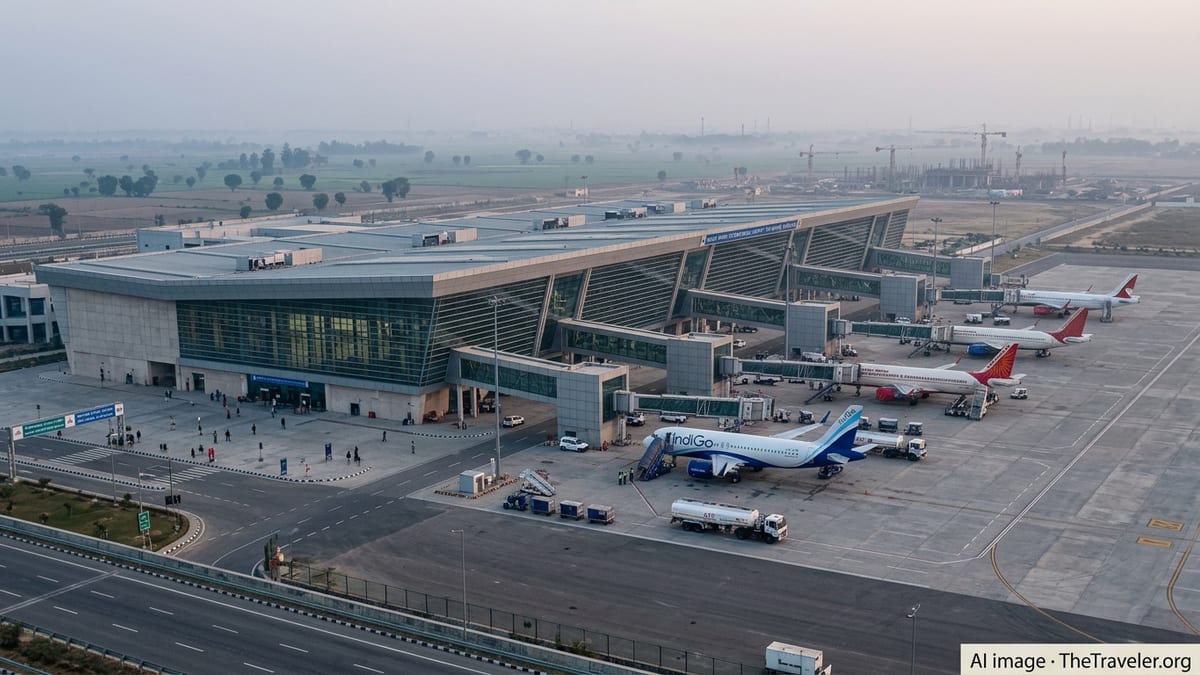
Jewar’s low-tax launch reshapes the NCR aviation map
Noida International Airport at Jewar is scheduled to begin operations with domestic services and cargo in late 2025, followed by a broader ramp-up of flights in the subsequent months. The greenfield hub in Uttar Pradesh is planned as the second major international gateway in the National Capital Region and is being closely watched for its impact on established traffic patterns at Delhi’s Indira Gandhi International Airport.
Reports indicate that Uttar Pradesh cut value added tax on aviation turbine fuel to 1% in December 2024, specifically to position Jewar as a cost-competitive alternative for airlines. That decision has become central to the airport’s launch narrative, turning what might have been a routine capacity addition into a test case for how state-level fuel taxation can redirect aviation growth.
The contrast with Delhi is stark. Publicly available information shows that ATF at IGI attracts a 25% state VAT, one of the highest rates among major Indian metros. Industry analyses have repeatedly highlighted that fuel accounts for around 40% to 45% of an Indian airline’s operating costs, meaning that even small tax differentials can translate into sizeable shifts in economics on short and medium-haul routes.
As Jewar prepares to welcome launch carriers on a sharply lower fuel tax, the airport’s pricing environment is being framed as a structural advantage rather than a temporary incentive. For airlines weighing new capacity in the region, the basic arithmetic is now anchored less in airport proximity and more in fuel uplift decisions and their impact on network-wide costs.
ATF tax gap raises questions over airline route and refuelling strategy
The 24 percentage point gap between Delhi’s 25% VAT on jet fuel and Jewar’s 1% creates a powerful signal for network planners. According to commentary in business publications, the differential is large enough to influence where airlines choose to base aircraft overnight, schedule maintenance and, critically, refuel their fleets serving the wider region.
For narrowbody aircraft operating high-frequency sectors, fuel uplift decisions are often made to balance payload, range and unit cost. With a 1% VAT at Jewar, carriers may find it attractive to tank more fuel there for round-trip operations, particularly on routes that can be efficiently routed through Uttar Pradesh without major schedule penalties. Analysts note that such practices could gradually shift a portion of airlines’ back-end operations, even if headline flight schedules continue to show strong presence at IGI.
The potential for route realignment is also drawing attention. Editorial commentary from Delhi-based outlets has warned that, once Jewar achieves meaningful scale, airlines looking to deploy additional capacity into the NCR might favour the low-fuel-tax airport over IGI for marginal expansion. Over time, this could mean new point-to-point connections from Jewar to tier-two and tier-three cities that might otherwise have been linked to Delhi.
Industry-focused reports add that the impact will not be uniform. Full-service and low-cost carriers with different fleet mixes and hub strategies are likely to respond in distinct ways. Some may use Jewar primarily as a cost-efficient satellite for select routes, while others may pursue a deeper shift in basing and crew patterns to exploit sustained fuel savings.
Delhi’s revenue, jobs and connectivity stake in the VAT debate
Delhi’s continuation of a 25% VAT on ATF has, until now, coexisted with robust passenger growth at IGI, which saw record traffic in the most recent full year. Opinion pieces in national dailies point out, however, that the emergence of a full-service international airport inside the same catchment, backed by a 1% fuel tax, materially changes the competitive equation.
Trade bodies representing local businesses have already urged the Delhi government to revisit its jet fuel tax structure, arguing that a high VAT risks diverting not just passengers but also associated aviation-linked commerce toward Uttar Pradesh. These groups highlight that airline operations anchor a broader ecosystem of jobs in ground handling, hospitality, logistics and retail that may gravitate to where airlines find it cheapest to operate.
Central government communications on aviation taxation have similarly flagged the broader impact of state-level levies. Policy documents note that high VAT on ATF magnifies the effect of global fuel price spikes and foreign exchange volatility, amplifying stress on carriers and, indirectly, on connectivity and consumer fares. In this context, the Jewar launch is being read as a catalyst that could force a rebalancing between revenue needs and competitiveness for states that host busy hubs.
For Delhi, the calculus is particularly sensitive. Lowering VAT could trim a significant revenue stream in the short term, but some analysts argue that preserving IGI’s status as a primary hub for North India may justify a more moderate rate. Others counter that the city’s diversified economy and strong demand fundamentals will allow it to retain its primacy even if some incremental airline growth shifts to Jewar.
What passengers might gain from the tax differential
For travellers, the visible impact of the ATF tax gap will be measured in fares, flight options and surface access times. Economic commentary suggests that, in theory, a 1% VAT at Jewar leaves airlines with more room to offer competitively priced tickets, especially on price-sensitive domestic sectors originating or terminating in the eastern and southern flanks of the NCR.
In practice, the immediate pass-through of tax savings to passengers is less certain. Carriers continue to face higher global fuel prices, rising financing costs and currency pressures, prompting several to add or increase fuel surcharges in recent months. Some airline communiqués have explicitly linked these surcharges to escalating ATF costs and taxes at major metro airports, indicating that any relief from low-tax locations may first be used to stabilise balance sheets.
Over the medium term, however, sustained fuel cost advantages at Jewar could help airlines experiment with lower introductory fares, new city pairs and increased frequencies. Combined with road connectivity via the Yamuna Expressway and planned rapid transit links, the airport is being positioned as an attractive option for passengers from Noida, Greater Noida, Agra and parts of western Uttar Pradesh who currently travel to Delhi for flights.
Observers also point out that price-sensitive segments such as migrant workers, small traders and regional tourists could be among the earliest beneficiaries if carriers deploy low-cost capacity from Jewar to smaller cities. The magnitude of any fare gap with Delhi will depend on how aggressively airlines compete for market share at the new airport and whether Delhi responds with a more competitive fuel tax.
National implications for aviation tax policy
The Jewar-Delhi contrast is unfolding against a broader national conversation about aviation taxes. Official and industry reports have long highlighted the patchwork of state VAT rates on ATF, which range from single digits in some regions to nearly 30% in others. Jewar’s 1% rate, locked in as part of the airport’s policy framework, is now seen as one of the most aggressive attempts to leverage tax policy to attract aviation investment.
Several states, including Bihar and others covered in recent infrastructure reporting, have reduced ATF VAT in the past year to draw more flights and improve regional connectivity. The Union government’s flagship regional connectivity scheme has also encouraged states to move toward 1% or lower fuel taxes at targeted airports, creating a template that Uttar Pradesh is now deploying at scale for a major metro-adjacent hub.
As Jewar’s operations ramp up, analysts expect its fuel tax regime to feature prominently in discussions between airlines and state governments across India. If the airport succeeds in capturing a meaningful share of NCR traffic while offering lower operating costs to carriers, other states hosting large airports may face pressure to revisit their own VAT structures to remain competitive.
For now, the launch of Noida International Airport has turned what might have been a technical detail of state taxation into a central storyline in India’s aviation expansion. The 1% ATF tax at Jewar, set against a 25% levy in Delhi, is emerging as a live case study in how fiscal policy at the state level can steer the trajectory of airline costs, airport growth and passenger choice in one of the world’s fastest-growing aviation markets.