

More news on this day
Hundreds of travelers at New York’s John F. Kennedy International Airport faced mounting delays and cancellations on Saturday as global air traffic reeled from US-Israel strikes on Iran, with at least 173 delayed flights and 17 cancellations reported at the New York hub and major disruptions hitting services operated by Emirates, El Al, Etihad Airways, Delta Air Lines and other carriers connecting through the Middle East.
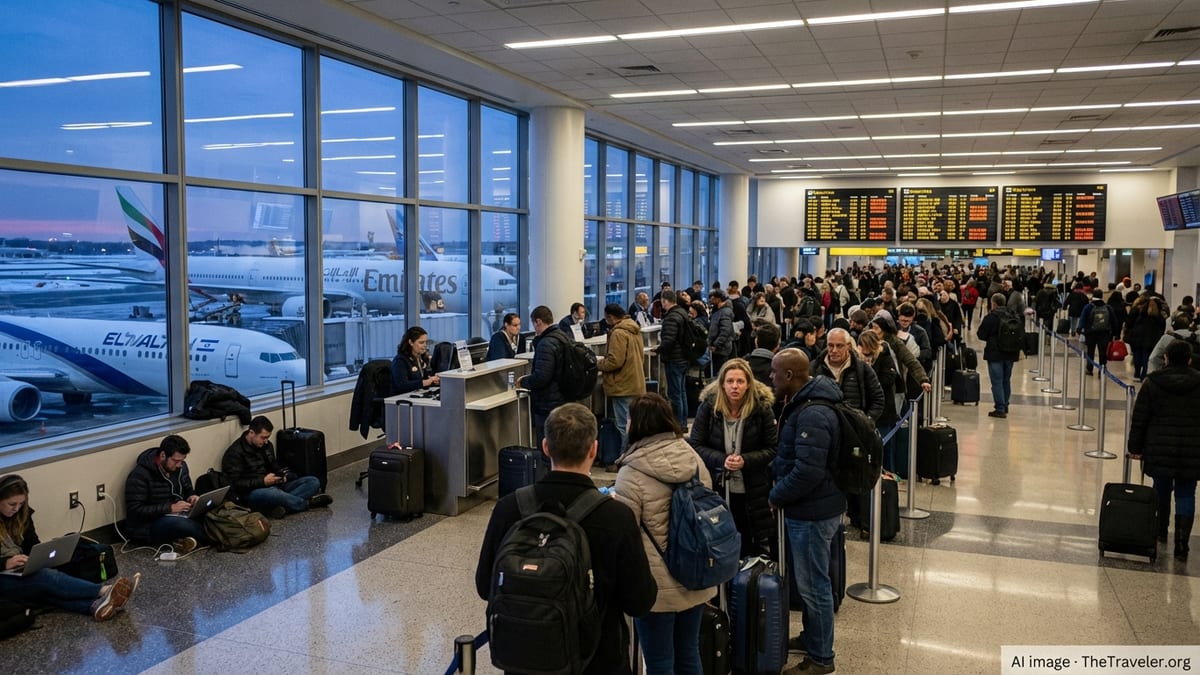
US-Israel Strikes Ripple Into New York Airspace
The disruption at JFK unfolded after joint US-Israel strikes on Iran early Saturday, February 28, triggered sweeping airspace closures across parts of the Middle East, including over Iran, Israel, Iraq, Jordan, Qatar and the United Arab Emirates. Aviation authorities in the region moved quickly to restrict or shut airspace, forcing airlines to cancel flights outright or reroute long-haul services that normally overfly these corridors.
Data from aviation analytics firms indicated that thousands of flights worldwide were delayed or cancelled as airports from Dubai to Tel Aviv effectively shut down normal operations for much of the day. With Gulf hubs such as Dubai International and Abu Dhabi’s Zayed International central to connecting traffic between North America, Europe, Asia and Africa, schedule shocks were felt far beyond the conflict zone.
In New York, those shocks translated into rolling delays, missed connections and extended waits on the ground. By late afternoon, JFK’s departure and arrival boards showed long lists of flights pushed back by hours, particularly those tied to Middle East hubs or reliant on transiting aircraft and crews from the affected region.
While JFK itself remained fully open and US airspace was not directly restricted, the loss of key routing options and the suspension of operations at major Middle Eastern hubs forced airlines serving New York to improvise, often with limited success as congestion built throughout the global network.
Emirates, Etihad and El Al Among Hardest Hit
Carriers with strong ties to the Middle East bore the brunt of the disruption at JFK. Emirates, which normally operates multiple daily services between New York and Dubai, faced widespread cancellations and rolling delays after authorities in the UAE temporarily halted flights and airlines scrambled to adjust to airspace closures. Some Dubai-bound passengers at JFK were held at the gate for hours before flights were scrubbed, while others were rebooked onto later services with no firm departure time.
Etihad Airways, linking JFK with Abu Dhabi, also endured significant operational disruption as Abu Dhabi’s airport curtailed departures and arrivals. With flights into the UAE suspended for much of the day, several Abu Dhabi services to and from North America were either delayed, diverted or cancelled outright. That left New York passengers bound for South Asia and Africa via Etihad’s hub facing missed onward connections and overnight layovers.
El Al, Israel’s flag carrier and a key operator on the New York–Tel Aviv route, was forced to curtail operations as Israel closed its airspace following the strikes. While some early services left before restrictions fully took hold, later departures were either postponed or cancelled, stranding passengers in both New York and Tel Aviv and complicating crew rotations that underpin the carrier’s transatlantic schedule.
Other international airlines with one-stop links from JFK to the Middle East, including major European carriers, also saw their New York flights knocked off balance as services to cities such as Tel Aviv, Doha and Dubai were paused or rerouted, pushing aircraft and crews out of position for subsequent transatlantic rotations.
Delta and Other US Carriers Warn of Knock-on Effects
Delta Air Lines, one of JFK’s dominant carriers, issued customer alerts warning that flights to Tel Aviv and Dubai would be cancelled or subject to significant delay in light of the evolving security situation and widespread airspace closures. Although US airlines do not maintain the same scale of direct operations into Gulf hubs as regional carriers, suspensions on Middle East routes can quickly cascade into broader schedule issues.
With aircraft and crew schedules finely tuned across global networks, a cancelled or heavily delayed long-haul flight can disrupt multiple subsequent services. At JFK, that meant some domestic and Caribbean departures operated by widebody aircraft were swapped or rescheduled as carriers sought to keep core transcontinental routes running while accommodating passengers removed from cancelled international sectors.
Other US airlines with service to the Middle East, as well as codeshare arrangements on partners operating through Dubai, Abu Dhabi and Doha, advised travelers to check flight status frequently and to expect last-minute changes. Airline representatives stressed that safety considerations were paramount, noting that decisions on whether to route flights around closed airspace or to suspend them entirely would be revisited as security assessments evolved.
For many travelers, particularly those heading to family visits or business meetings in Israel, the Gulf and South Asia, rebooking options were limited. With so many flights simultaneously affected, alternative routings via Europe quickly filled, leaving some passengers with no immediate way to reach their destinations.
Passengers at JFK Confront Long Lines and Uncertain Timelines
Inside JFK’s terminals, the impact of the Middle East crisis was visible in long queues at airline service desks, crowded seating areas and departure boards filled with yellow and red status updates. Passengers booked on Emirates, Etihad and El Al flights described a day of rapidly shifting information, as projected departure times were repeatedly pushed back before flights were eventually delayed further or cancelled.
Ground staff handed out meal vouchers and hotel information where required, but in many cases travelers reported difficulty securing accommodation near the airport due to the sheer number of disrupted passengers. Families with small children and elderly travelers were among those hardest hit, with some facing overnight waits in terminals as they awaited word on new itineraries.
Airport officials urged passengers with flights touching the Middle East, or connecting onto carriers based in the Gulf and Israel, to avoid heading to JFK without first confirming flight status directly with their airline. They also advised travelers to allow additional time for check-in and security screening, given the higher-than-normal number of people seeking assistance at service counters.
Travel agents and corporate travel managers reported a spike in calls as New York-based customers sought guidance on whether to proceed with upcoming trips, postpone non-essential travel or reroute via alternate hubs less affected by the airspace closures.
Global Network Strain Highlights Reliance on Middle East Hubs
The turbulence at JFK underscored the central role Middle East hubs play in global aviation. Emirates, Etihad and other Gulf-based airlines move tens of thousands of connecting passengers each day between continents, meaning that any closure of their airspace or suspension of operations reverberates across airports worldwide, including major US gateways.
Aviation analysts noted that prolonged closures in the Gulf and Israel would not only affect point-to-point traffic but also key connecting flows between North America and destinations in India, Southeast Asia and Africa. Many of those itineraries depend on a single daily connection at Middle East hubs, leaving limited alternatives when those flights are halted.
While some carriers can reroute around closed airspace, those longer paths add flying time, fuel burn and crew costs, and often require schedule adjustments that ripple through the network. As a result, even flights not directly operating to or from the conflict zone may experience delays as airlines juggle aircraft rotations and crew duty limits.
For JFK and other major US airports, the events of February 28 served as a stark reminder that geopolitical shocks far from American shores can quickly upend local travel plans. With aviation regulators and airlines warning that the situation remains fluid, New York passengers bound for or connecting with the broader Middle East were braced for further disruption in the days ahead.