

More news on this day
Travelers passing through New York’s John F. Kennedy International Airport faced a fresh wave of disruption this weekend as publicly available tracking data showed six flight cancellations and more than 100 delays involving services operated by Delta Air Lines, ITA Airways, Alaska Airlines, Qatar Airways and Kuwait Airways Corporation, with the impact spreading to major hubs including Rome, Doha, Fort Myers and Toronto.
Get the latest news straight to your inbox!
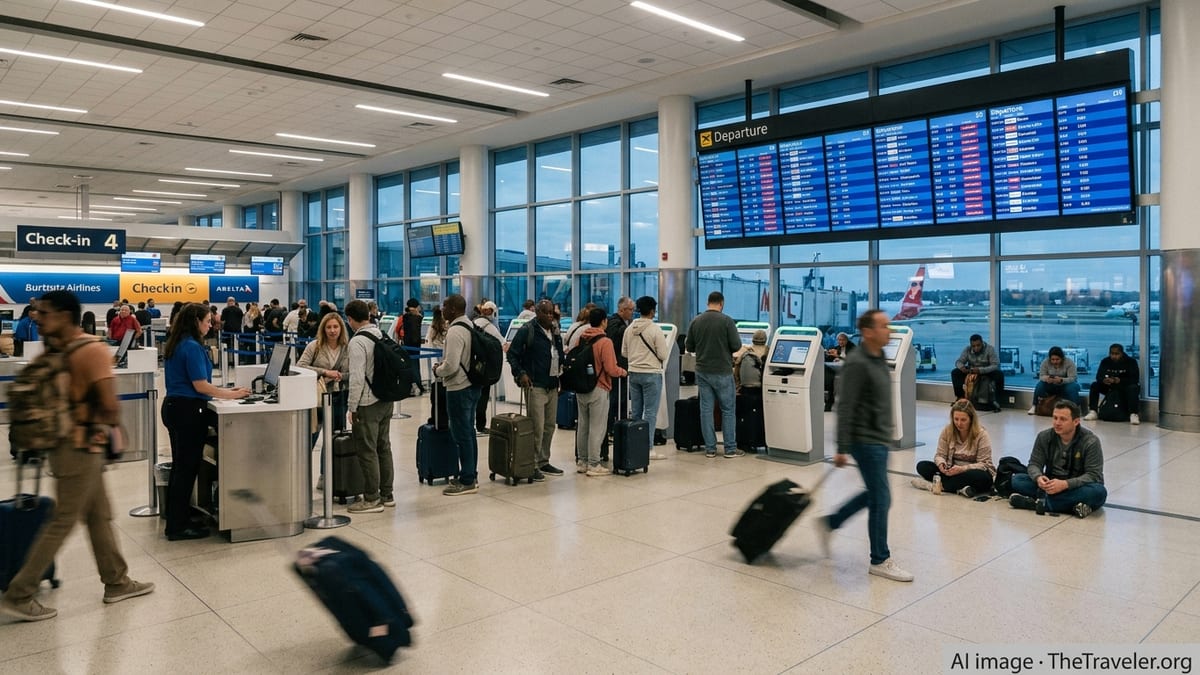
Heavy Operational Strain at John F. Kennedy International Airport
Recent tracking information indicates that John F. Kennedy International Airport has been operating under heavy strain, with a cluster of cancellations and a high volume of late departures and arrivals across multiple terminals. The affected services include transatlantic, transpacific and domestic routes, highlighting how quickly localized disruptions at a major hub can reverberate through global airline networks.
Delta Air Lines and Alaska Airlines, both significant players at JFK, recorded a combination of cancellations and extended delays on services linking New York with other key U.S. cities. Publicly available performance data and recent coverage of airline operations show that New York’s congested airspace, ongoing staffing challenges and volatile weather patterns have all contributed to a fragile operating environment that can tip into disruption with relatively little warning.
International carriers including ITA Airways, Qatar Airways and Kuwait Airways Corporation were also affected, underscoring JFK’s role as a critical gateway for transatlantic and Middle Eastern traffic. Flights connecting New York with Rome, Doha and Kuwait City are part of wider long-haul networks, so delays on departure from the United States can feed into rolling knock-on effects for onward connections in Europe, the Gulf and Asia.
For passengers, the result at JFK has been longer security lines, packed gate areas and reworked itineraries, as airlines attempt to re-accommodate travelers on later departures or alternative routings. Public information from airline advisories suggests that travelers have been urged to monitor their flight status closely and arrive early while operations stabilize.
Transatlantic Routes Between New York and Rome Face Added Pressure
Services between New York and Rome have been particularly exposed to the latest disruption. ITA Airways, which operates one of the principal nonstop links between JFK and Rome Fiumicino, has seen select flights affected, according to real-time schedules and airport boards. When irregular operations occur on this corridor, the consequences can extend beyond Italy and the United States, as Rome functions as a connection point for destinations across Europe, North Africa and parts of the Middle East.
Published industry data on transatlantic performance shows that eastbound overnight flights are especially sensitive to departure delays. A late evening takeoff from New York can cascade into morning arrivals that miss carefully timed banks of European connections, leading to missed onward flights and unplanned overnight stays for some travelers. In turn, aircraft and crews can be left out of position for subsequent departures back to North America.
In Rome, the disruption linked to the JFK delays has added to existing operational complexity. Fiumicino is balancing strong leisure demand, particularly ahead of the busy spring and summer travel seasons, with the challenges of handling aircraft arriving later than scheduled. Ground handlers, airport operators and airlines must adjust staffing and gate allocations in real time when several delayed long-haul flights arrive in close succession.
Travelers connecting through Rome on affected days have faced tighter transfer windows and, in some cases, involuntary schedule changes. Publicly available travel advisories encourage passengers on multi-leg itineraries involving JFK and Fiumicino to allow additional buffer time and to consider earlier departures when possible.
Gulf and Transcontinental Networks Disrupted via Doha and Beyond
Doha, a key global hub for Qatar Airways, has also felt the impact of disruption linked to the latest JFK irregular operations. Flights between New York and Doha serve as a bridge to an extensive network across Asia, Africa and Oceania, meaning a single delayed or cancelled flight on this route can affect hundreds of onward connections.
Recent coverage of airspace restrictions and regional uncertainty around the Gulf has documented how carriers such as Qatar Airways are already operating within a constrained environment. When complications at a distant hub like JFK are added to these broader regional factors, it increases the likelihood of schedule reshuffling, extended layovers and last-minute rebookings for passengers traveling through Doha.
Kuwait Airways Corporation operates its own long-haul links into the New York area, and publicly available schedule data show that irregular operations on those services can similarly disrupt connecting traffic through Kuwait City. Travelers heading onward to South Asia, the Indian subcontinent and regional Gulf destinations can see their journey times lengthen significantly when a North American departure does not run to plan.
For many long-haul passengers, the disruption manifests as missed connections, unexpected hotel stays or rerouted itineraries through alternate hubs. Information from travel forums and consumer reports suggests that some passengers have been offered rebooking via European or U.S. partner airlines when direct Gulf services are no longer viable on the original timetable.
Knock-On Effects at Fort Myers, Toronto and Secondary Gateways
While JFK is the focal point of the latest disruption, downstream effects have been registered at smaller but strategically important airports such as Fort Myers in Florida and Toronto in Canada. Delta and Alaska maintain domestic and transborder links that connect these cities to New York, and delays at the hub have translated into late arrivals, aircraft swaps and schedule changes on feeder routes.
Publicly available airline performance summaries show that when a hub like JFK experiences a large cluster of delayed departures in a short time, the recovery period can last for many hours. Aircraft that were scheduled to operate multiple segments in a single day may arrive late into Fort Myers, Toronto or other regional airports, compressing turn times for crews and ground staff and raising the risk of subsequent late departures.
In Fort Myers, where many travelers are leisure passengers or seasonal residents connecting to or from the Northeast, disruption can quickly translate into missed cruise departures or lost vacation time. In Toronto, where transborder flights are tightly slotted around busy domestic and international operations, prolonged delays from New York place additional pressure on gate availability and customs processing.
According to publicly accessible travel planning tools, some passengers affected on these secondary routes have opted to switch to alternative hubs, including Boston, Newark or Philadelphia, in an effort to avoid ongoing congestion around JFK. This behavior can, in turn, redistribute pressure across neighboring airports in the wider region.
Travelers Advised to Plan Around Ongoing Volatility
The current wave of cancellations and delays at JFK involving Delta, ITA Airways, Alaska Airlines, Qatar Airways and Kuwait Airways Corporation highlights how sensitive modern air travel remains to a mix of operational and external pressures. Weather, staffing levels, airspace constraints and high seasonal demand continue to converge, making it more difficult for airlines and airports to maintain tightly choreographed schedules.
Publicly available information from aviation analytics firms and government data sets shows that major U.S. hubs such as JFK, Atlanta and Chicago, along with key international gateways like Rome and Doha, have experienced recurring bouts of disruption over recent months. Analysts note that while airlines have invested in technology and planning tools to improve resilience, the margin for error remains narrow when networks are operating near capacity.
For travelers, recent events at JFK serve as a reminder to build additional flexibility into their plans. Consumer advocates commonly recommend booking longer connection windows, opting for earlier departures on critical travel days and keeping essential items in carry-on baggage in case of unexpected overnight stays. Monitoring flight status through airline apps and airport information screens remains essential, particularly for itineraries that depend on smooth transfers through busy hubs.
As airlines work to restore normal operations following the latest disruption, schedules at JFK and connected airports in Rome, Doha, Fort Myers, Toronto and other cities are expected to stabilize gradually. However, industry observers caution that further bouts of volatility are likely as the peak travel seasons of spring and summer approach, and that passengers should continue to expect occasional last-minute changes when flying through major global hubs.