

More news on this day
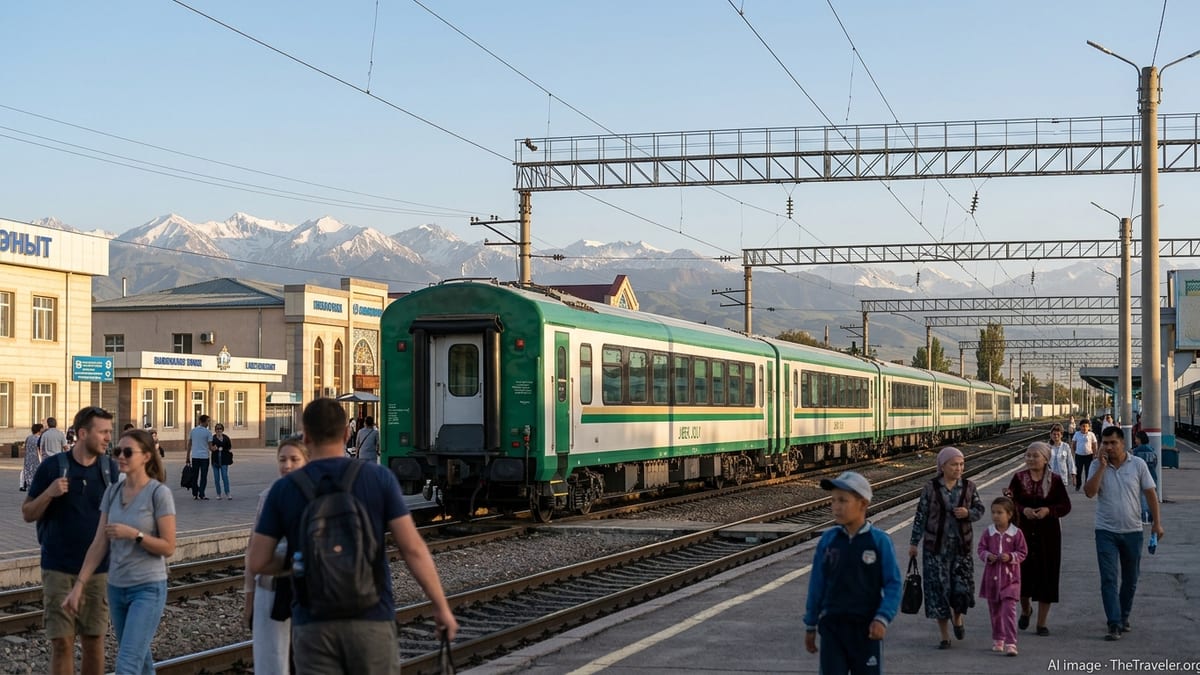
Kazakhstan is set to elevate Central Asia’s rail tourism with the Jibek Joly tourist train now charting a multi-country route through Uzbekistan and Tajikistan, transforming legendary Silk Road cities into a single, immersive journey for international travelers.
Get the latest news straight to your inbox!
A New Cross-Border Silk Road Rail Corridor
Publicly available information shows that Kazakhstan’s national railway operator has confirmed a new chapter for the Jibek Joly tourist train, which will, for the first time, link Kazakhstan, Uzbekistan and Tajikistan in one continuous cultural route. The expanded itinerary is scheduled to operate from March 20 to March 25, 2026, positioning the service as a seasonal flagship for regional tourism.
The route begins and ends in Almaty, Kazakhstan’s largest city, before tracing a loop through Turkestan in southern Kazakhstan, Samarkand and Tashkent in Uzbekistan, and the Tajik capital Dushanbe. Reports indicate that this is the first packaged rail tour to connect the three countries on a single branded service, reflecting a broader push by Central Asian governments to position the region as a coherent Silk Road destination.
Earlier iterations of the Jibek Joly train focused on the corridor between Almaty, Turkestan and Tashkent, with later extensions to Samarkand as bilateral tourism ties between Kazakhstan and Uzbekistan deepened. The latest upgrade, carrying the line into Tajikistan, is seen in regional coverage as a symbolic step that turns a popular bilateral excursion into a tri-national experience.
Regional media note that the timing of the inaugural extended journey coincides with Nauryz, the spring new year festival widely celebrated across Central Asia. The alignment with a major cultural holiday is expected to enhance the train’s appeal, offering passengers the chance to witness local festivities along the route.
Immersive Cultural Discovery Along the Route
The Jibek Joly itinerary is designed as much for cultural immersion as for scenic rail travel. According to published descriptions of the tour program, passengers spend multiple days disembarking for guided excursions, museum visits and access to historic monuments in each city. Onboard service is structured around multi-day touring rather than simple point-to-point transport.
Turkestan, one of the first major stops after Almaty, has emerged in recent years as a showcase of Kazakhstan’s spiritual and historical heritage, anchored by the UNESCO-listed Mausoleum of Khoja Ahmed Yasawi. Tourism coverage suggests that stopovers here are intended to introduce travelers to Turkic Sufi traditions and the architectural legacy of the Timurid era.
In Uzbekistan, the inclusion of Samarkand and Tashkent places passengers at the heart of the classical Silk Road narrative. Samarkand’s Registan Square, monumental madrasas and intricate tilework feature prominently in tourism campaigns, while Tashkent serves as a modern hub with Soviet-era boulevards, markets and museums documenting the region’s shifting political and cultural history.
The extension to Dushanbe adds Tajikistan’s distinct Persian-influenced cultural layer, expanding the story of the Silk Road beyond trade to encompass the literary and artistic currents that shaped Central Asia. Travel industry commentary highlights that this stop allows visitors to experience a different linguistic and cultural environment without leaving the comfort and continuity of a single rail tour.
Positioning Central Asia as a Unified Rail Tourism Destination
The Jibek Joly expansion aligns with a wider regional trend in which Central Asian states are easing travel procedures and coordinating tourism marketing. Earlier agreements between Kazakhstan and Uzbekistan linked the initial Jibek Joly services to Samarkand, and public statements by officials in both countries have referenced longer-term goals of simplifying cross-border movement for visitors.
In parallel, reports from regional outlets note that Kazakhstan and Uzbekistan have increased cooperation in railway infrastructure, with upgraded lines and border facilities supporting both freight and passenger flows. The tourist train benefits from this broader modernization, using established corridors that already handle regular international services.
Analysts tracking Central Asian tourism have emphasized that multi-country rail products can help the region compete with more established long-distance train journeys in Europe and East Asia. The appeal lies in combining several national tourism brands into one itinerary, making it easier for travelers to justify long-haul flights to a part of the world that remains relatively underexplored.
Industry observers also point out that rail-based touring resonates with growing interest in slower, lower-emission forms of travel. While detailed environmental impact assessments are not widely publicized, the very framing of Jibek Joly as a cultural and educational journey by train taps into a wider global narrative about more sustainable, experience-rich tourism.
Onboard Comfort for an International Audience
Descriptions of the Jibek Joly train emphasize upgraded rolling stock, compartment configurations designed for overnight comfort, and dining cars that showcase regional cuisine. The service is marketed toward an international clientele, with tourism agencies in Kazakhstan and Uzbekistan promoting the route in multiple languages and packaging it with hotel stays and transfers.
The tour format typically includes shared or private sleeping compartments, onboard catering, and organized sightseeing with local guides at each major stop. The model follows established patterns in European and trans-Siberian tourist trains, but with a distinctly Central Asian focus in terms of decor, menu planning and excursion content.
Regional travel agencies report rising interest in Central Asia among travelers seeking “next frontier” destinations that offer strong cultural identity but remain less crowded than classic European or Southeast Asian circuits. In this context, the Jibek Joly train functions as an accessible introduction to the region, offering logistical simplicity for first-time visitors wary of language barriers, visas and complex overland arrangements.
Pricing and departure frequency details are still evolving as operators test demand, but current information suggests that departures around key holiday periods, such as Nauryz, will anchor the calendar. Travel specialists expect that, if initial runs prove successful, more seasonal departures could follow, potentially integrating additional regional hubs over time.
A Catalyst for Wider Silk Road Tourism Development
Observers see the Jibek Joly expansion as part of a larger reimagining of the Silk Road as a modern tourism corridor rather than a purely historical concept. The branding taps into a powerful narrative of caravans, bazaars and cultural exchange, while the concrete product is a contemporary, comfort-focused train that moves efficiently across newly upgraded borders.
Neighboring countries have also invested in heritage restoration, new museums and visitor infrastructure in cities along or near the Jibek Joly route, creating a denser network of attractions. This clustering effect is expected to benefit not only rail passengers, but also independent travelers who use the same cities as bases for broader exploration.
Tourism analysts note that if the Jibek Joly service maintains reliability and high service standards, it could encourage further cooperation on themed routes, possibly incorporating other Central Asian states in the future. Such developments would reinforce Central Asia’s image as a connected region where travelers can move across borders in relative comfort while tracing one of history’s most storied trade arteries.
For now, the new tri-national Jibek Joly route represents a clear statement of intent: to turn the abstract romance of the Silk Road into a tangible, bookable journey that offers structured cultural discovery, cross-border connectivity and a fresh perspective on a part of the world long overshadowed in global tourism rankings.