

More news on this day
In the hills of Chongqing’s Banan District, Jiti Village is emerging as a quiet tourism success story, weaving smart agriculture, rural culture and seasonal flower fields into a growing countryside getaway.
Get the latest news straight to your inbox!
Flower Seasons Drive a Rural Tourism Boom
Recent coverage of Chongqing’s countryside tourism shows how flower landscapes have become powerful draws for urban visitors seeking short breaks in nearby rural areas. Reports highlight large-scale plantings of rapeseed, plum and cherry blossoms, hydrangeas and other blooms across Banan District, transforming once utilitarian farmland into colorful seasonal attractions that photograph well and invite leisurely walks among the fields.
Within this wider push, Jiti Village is positioning itself as part of a “flower economy” belt that links agricultural production with scenic viewing. Publicly available information shows that nearby scenic spots in Banan have already seen success with flower-sea concepts built around rapeseed and other high-altitude blooms, turning early spring and summer into peak visiting periods. Jiti is now tapping into similar patterns, using flowers not only as crops but also as a visual brand for its countryside tourism.
The model developing around the village echoes broader national trends in China, where “flower viewing plus countryside leisure” has been promoted as a way to extend the value of traditional agriculture. Visitors travel to see fields in bloom, but they also spend on local food, homestays and transport, converting natural and cultivated landscapes into a source of steady service income for rural communities.
Integrating Agriculture, Culture and Scenic Design
Jiti Village’s approach centers on integrating three elements that have often existed separately in China’s rural areas: production agriculture, cultural experiences and landscaped scenic areas. Industry reports on Chongqing’s rural revitalization note that Banan District has encouraged villages to move from single-function farming to multi-function spaces where crops, tourism and cultural activities are planned together.
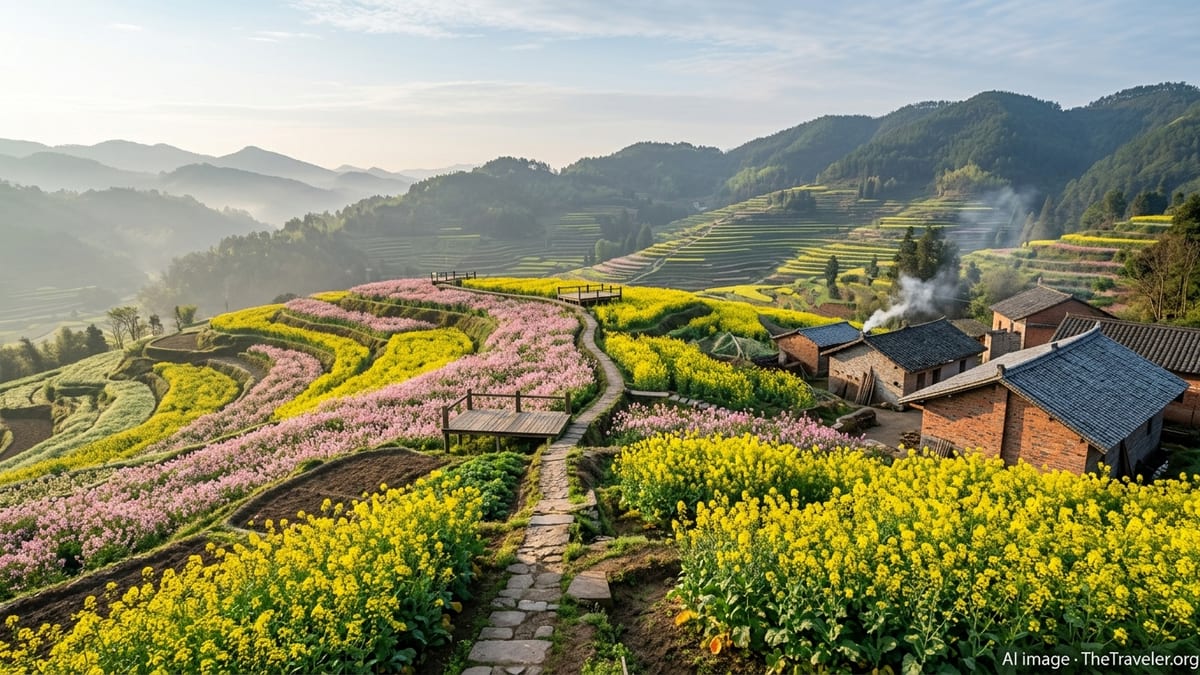
In practice, this means that flower fields around Jiti are arranged to provide both yield and visual impact, forming terraced or banded color blocks that can be appreciated from viewing platforms and walking paths. Agricultural plots are interspersed with small rest areas, photo spots and family-friendly corners, turning working land into a kind of open rural park while keeping the fields in active use.
At the same time, the village is promoting local culture as part of the visitor experience. Public descriptions of Banan’s rural tourism emphasize folk customs, local food and handicrafts as key additions to flower-viewing trips. In Jiti, this is reflected in agritainment businesses that combine farm-style meals, outdoor barbecues and seasonal produce tasting with views of the surrounding fields, giving visitors a sense of everyday countryside life rather than a purely decorative landscape.
Smart Agriculture Underpins Visitor-Friendly Fields
A notable feature that sets Jiti Village apart within Banan District is its early move toward smart agriculture infrastructure. According to information released about the area’s rural revitalization projects, Jiti hosts a digital “electricity post” system that monitors environmental indicators such as rainfall, light, temperature, carbon dioxide and soil conditions, feeding data into a central platform for analysis and remote control.
This networked system allows for more precise management of high-value crops, including ornamental flowers and specialty plants that depend on stable growing conditions. Automated adjustments to irrigation or shading can keep fields healthy through Chongqing’s humid summers and fluctuating spring weather, helping ensure that viewing periods align more reliably with promotional calendars for tourism.
The same infrastructure is also used to track electricity use patterns across rural tourism operators, greenhouses, homestays and small businesses in the village. Publicly available information indicates that this has created a comprehensive profile of local demand, making it easier to plan energy supply for busy weekends and holidays when visitor numbers peak. For travelers, this behind-the-scenes digital layer translates into more consistent services, while for residents it offers a foundation for upgrading agricultural production without sacrificing reliability.
Boosting Farmer Incomes Through Rural Revitalization
Jiti Village’s integration of agriculture, culture and tourism is tied closely to China’s wider rural revitalization agenda, which seeks to increase farmer incomes and diversify economic activity outside major cities. Recent reporting on similar flower-themed villages across the country indicates that well-managed scenic agriculture can significantly raise collective income and create new jobs in catering, accommodation and transport.
In Banan District, authorities have promoted “agritainment” and homestay development as complementary pillars to flower-based attractions, encouraging households to convert spare rooms or idle buildings into small-scale lodging and dining venues. Jiti’s participation in this model means that income from a single plot of land can now come from crop sales, tourism tickets or parking, and value-added products such as local snacks or processed agricultural goods.
While detailed village-level revenue figures for Jiti are limited in public reporting, the pattern observed in comparable flower-viewing destinations across Chongqing and wider China suggests that such integration can stabilize earnings and spread benefits more widely among residents. The combination of smart agriculture, seasonal scenic design and cultural hospitality offers multiple income streams within the same rural landscape.
Positioning Jiti Village in Chongqing’s Emerging Flower Economy
The rise of Jiti Village comes at a time when Chongqing is actively building a network of rural destinations branded around flowers, hot springs and mountain scenery. Nearby districts have promoted spider flower fields, chrysanthemum exhibitions and multi-species flower belts as centerpieces for short-stay tourism, with media coverage describing these projects as part of a “flower fragrance and flower sea” strategy that links villages along scenic routes.
By aligning with this trend, Jiti strengthens its visibility for domestic travelers who increasingly plan countryside trips around specific blooming windows. The village’s flower fields, backed by smart agricultural management and layered with rural culture experiences, fit the expectations of visitors who want both photogenic scenery and tangible contact with local life, from picking seasonal produce to tasting farmhouse dishes.
As China’s “flower appreciation economy” continues to expand, Jiti Village illustrates how a small settlement on the outskirts of a major city can reposition itself through integrated planning. By treating agriculture, culture and tourism as parts of a single system, the village is turning its hillsides and fields into assets that anchor both ecological conservation and economic growth, adding a new point of interest to Chongqing’s fast-developing rural tourism map.