

Travel across East Africa has been thrown into disarray after a workers’ strike at Nairobi’s Jomo Kenyatta International Airport led to hours-long delays, flight cancellations and scenes of confusion that left thousands of passengers stranded in packed terminals and grounded aircraft on the tarmac.
Strike Erupts at Kenya’s Busiest International Gateway
The disruption began in the early hours of Monday, February 16, when aviation workers at Jomo Kenyatta International Airport (JKIA) in Nairobi launched a planned industrial action over pay, benefits and working conditions. Despite a recent court order seeking to halt the strike, union members escalated a go-slow that quickly rippled through air traffic control and ground operations, slowing departures and arrivals to a crawl.
JKIA, one of Africa’s busiest hubs and a critical gateway linking East Africa with Europe, the Middle East, Asia and North America, saw departure boards fill with delayed and canceled flights. Airlines reported that aircraft were waiting for extended periods for take-off clearance, while inbound flights were forced into holding patterns or diverted to alternative airports.
Kenya Airways, the national carrier, issued urgent travel advisories telling passengers not to proceed to the airport without a confirmed flight status. The carrier warned of significant schedule adjustments as it tried to manage the mounting backlog, while foreign airlines also began revising timetables and advising travelers to check for updates before leaving home or hotels.
By mid-morning, the impact was evident across all terminals. Long lines formed at check-in counters, immigration desks and airline customer service points, as frustrated travelers tried to rebook flights, locate baggage or simply find seats in overcrowded waiting areas.
Passengers Stranded for Hours in Overwhelmed Terminals
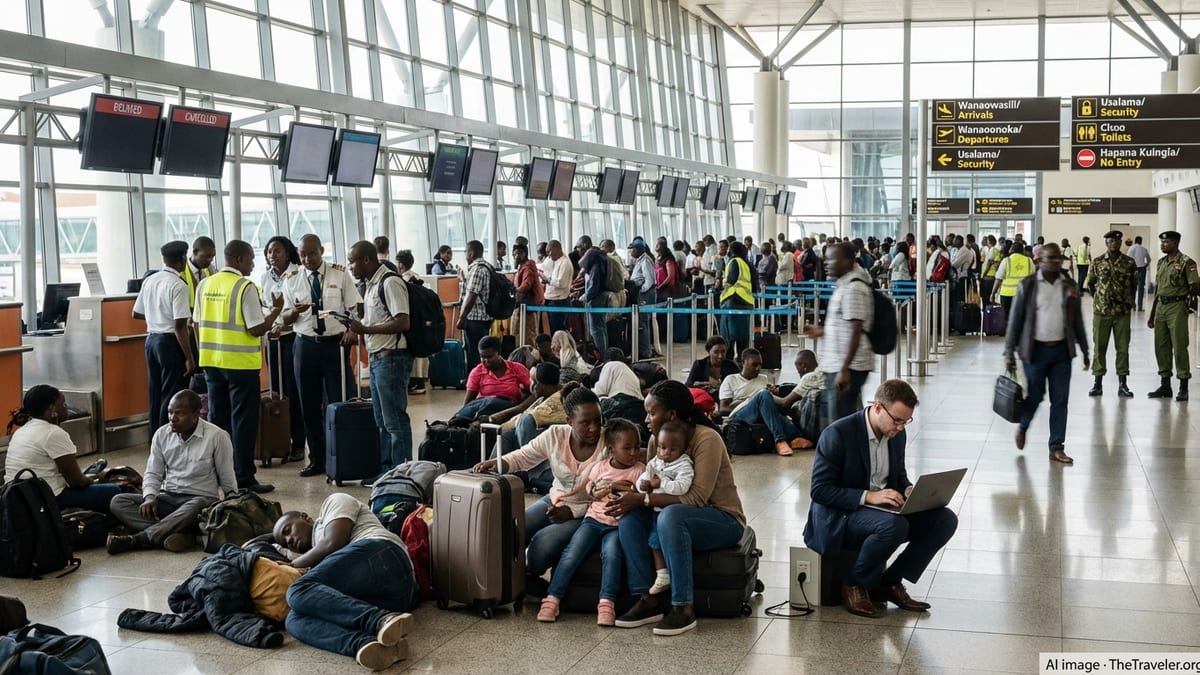
Inside JKIA’s terminals, scenes of exhaustion and anger played out as the strike dragged on. Families with young children sprawled on the floor beside their luggage, business travelers huddled around power outlets charging phones and laptops, and tour groups clustered near departure gates waiting for information that was often slow to arrive.
Many passengers reported being kept on board aircraft that had already boarded, only to be told of two to three hour delays due to a lack of air traffic control clearances. Social media posts showed cramped cabins where travelers said they had been seated on the runway with minimal communication from crews as they awaited updates.
Elsewhere in the terminal, travelers spoke of missed connections and lost hotel bookings as the strike disrupted tightly planned itineraries. Those with onward flights to regional destinations in Uganda, Tanzania, Rwanda and beyond were particularly hard hit, with some being told that rebooking options could stretch several days ahead depending on how quickly operations recovered.
For many, the most acute frustration stemmed from uncertainty. Public address announcements were intermittent and often generic, leading passengers to rely heavily on airline apps, social media feeds and staff at overwhelmed customer service desks. Airport seating, already in high demand at peak times, quickly became scarce, forcing many to stand for long periods or sit on the floor as they waited.
Union Demands and a Deepening Labor Dispute
The strike followed a formal notice issued last week by the Kenya Aviation Workers Union, which represents staff involved in critical airport and air traffic functions. The union has accused the Kenya Civil Aviation Authority and airport management of failing to fully implement a collective bargaining agreement and of delaying improvements in pay scales, allowances and working conditions for key technical and operational staff.
Union officials argue that staff responsible for high-stress, safety-critical roles, including air traffic controllers and key ground operations personnel, have faced increased workloads without commensurate compensation or investment in staffing levels and equipment. They say negotiations have dragged on without tangible progress, leaving workers feeling that industrial action was the only way to be heard.
Authorities counter that they have been engaging in talks and that any work stoppage at the country’s primary international gateway risks damaging Kenya’s reputation as a stable aviation hub. A labor court ruling issued late last week attempted to halt the planned strike, but on Monday workers began the go-slow regardless, contending that their grievances remained unresolved and that dialogue had not produced firm commitments or timelines.
The standoff has now become a test of how Kenya balances labor rights with the imperative of keeping a vital piece of national infrastructure functioning. Both sides insist that passenger safety remains paramount, but the sharp reduction in operational capacity has exposed how dependent the aviation system is on a relatively small group of specialized staff.
Ripple Effects Across East Africa’s Travel and Tourism Sector
JKIA’s disruption has not been confined to Nairobi. As the central hub for many regional routes, delays and cancellations quickly cascaded across East Africa, affecting flights to popular safari destinations and beach resorts as well as key business corridors.
Tour operators reported anxious calls from clients en route to game reserves in the Maasai Mara, Amboseli and Tsavo, many of whom faced unplanned overnight stays in Nairobi or missed connections onto smaller domestic carriers. Hotels near the airport moved rapidly to accommodate stranded travelers, but occupancy rose sharply, driving up last-minute rates and leaving some passengers struggling to find available rooms.
Regional carriers using Nairobi as a transfer point also felt the strain. Passengers bound for Entebbe, Kigali, Dar es Salaam, Zanzibar and other regional cities faced extended layovers and, in some cases, rebookings onto flights days later. For business travelers, missed meetings and conferences translated into lost opportunities, while cargo operators warned of delays in the movement of perishable goods and time-sensitive shipments.
Kenya’s tourism industry, a pillar of the national economy, is particularly vulnerable to shocks at JKIA. With many international visitors entering and leaving the country through Nairobi, the images of stranded tourists and overcrowded terminals risk denting confidence just as the sector continues to recover from past global disruptions.
Airlines Scramble to Manage Backlogs and Protect Safety
Airlines operating at JKIA have been walking a tightrope between trying to clear the growing backlog of flights and maintaining strict safety standards in a constrained operational environment. Carriers say they are prioritizing the most time-sensitive routes and long-haul services, while adjusting short-haul frequencies and consolidating some flights where possible.
Kenya Airways and other major operators have stressed that no compromises will be made on safety, even as they contend with pressure from passengers eager to depart. Air traffic flow has been deliberately reduced to match available staffing, a measure that significantly slows throughput but is designed to avoid overwhelming controllers and other critical personnel who remain on duty.
At the same time, airline customer service teams have been inundated with requests for rebookings, refunds and accommodation assistance. Many passengers have been moved onto later flights or rerouted through alternative hubs in the region where capacity allows. However, limited seat availability and crew duty-time regulations mean that recovery is expected to take time, even if the strike were to be resolved quickly.
Industry analysts note that the disruption could have financial repercussions for both airlines and the airport authority, with the cost of passenger care, schedule recovery and potential compensation adding to an already challenging operating environment marked by high fuel prices and currency pressures.
Government and Regulators Face Pressure to Restore Order
With images of stranded passengers circulating widely, Kenya’s government and aviation regulators are under mounting pressure to bring the situation under control. The Kenya Airports Authority has announced contingency plans aimed at keeping essential operations running, including redeploying non-striking staff, adjusting flight schedules and working with airlines to prioritize critical movements.
The Kenya Civil Aviation Authority has sought to reassure travelers that safety standards remain fully in place and that all aircraft movements are being managed according to established procedures. Officials say they are coordinating closely with airlines and air navigation service providers to gradually increase capacity as staffing levels permit.
Behind the scenes, efforts are underway to renew talks with union leaders in a bid to defuse the crisis. Government mediators are expected to push for a framework that addresses workers’ concerns while setting clear guarantees against future sudden stoppages at key aviation facilities. However, distrust built up over months of negotiations means that achieving a durable settlement may not be straightforward.
Political leaders are also acutely aware of the wider economic stakes. JKIA is not only a passenger hub but also a lifeline for cargo traffic, including horticultural exports that play a major role in Kenya’s foreign exchange earnings. Prolonged disruption could affect trade flows and investor confidence, compounding the immediate inconvenience to travelers with longer-term economic risks.
Travelers Weigh Future Plans Amid Uncertainty
As the strike continues to affect operations, travelers are reassessing their immediate and future plans involving Nairobi. Travel advisors and corporate travel managers are recommending that passengers with non-essential journeys scheduled over the next several days monitor developments closely and, where possible, consider flexible options such as holding tickets open or routing through alternative hubs.
Some international visitors have expressed concern about relying on JKIA for tight connections in the near term, particularly given the possibility that further industrial action could occur if the underlying dispute is not fully resolved. Frequent flyers and tour operators say they will be watching not just how quickly flights return to normal, but also whether authorities and unions can establish mechanisms to prevent similar disruptions in the high season ahead.
Travel insurance providers are also evaluating claims and coverage implications. Policies that include disruption due to strikes may help some passengers recover costs for missed connections and unexpected accommodation, though coverage terms vary. The situation has underscored the value of flexible fares and comprehensive insurance for travelers passing through major transit hubs.
For now, many stranded passengers at JKIA are focusing on short-term necessities: securing updated flight information, finding a place to rest and attempting to salvage disrupted itineraries. Their experiences are likely to inform how global travelers perceive Kenya’s reliability as a gateway, adding urgency to efforts by all parties to restore confidence in one of Africa’s most important aviation centers.