

More news on this day
Michigan Secretary of State and Democratic gubernatorial candidate Jocelyn Benson is putting an ambitious statewide high-speed rail network at the center of her vision for the state’s future, arguing that fast, reliable trains connecting Detroit, Grand Rapids, Lansing, Traverse City and other hubs could reshape how residents live, work and travel across Michigan.
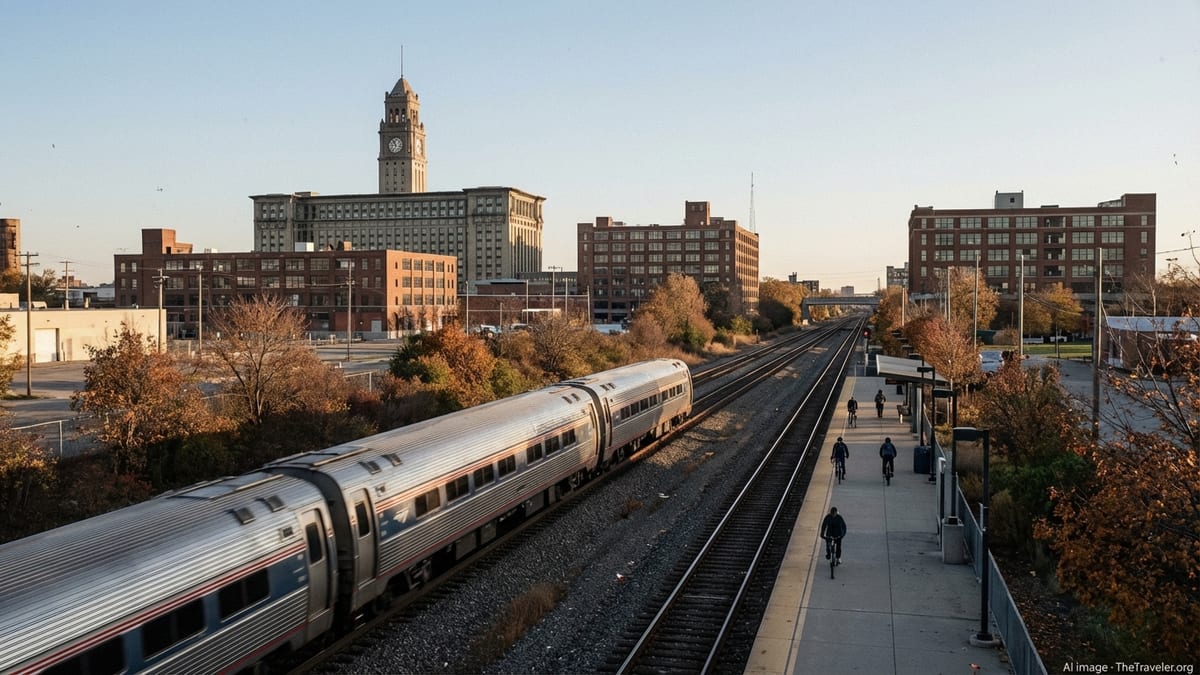
A Governor’s Race Defined by Mobility and Growth
Benson has been steadily broadening her platform from voting rights and clean government to a sweeping infrastructure agenda that she says is essential if Michigan is to compete for people, jobs and investment. On the campaign trail, she has begun sketching out what amounts to a new spine for the state: a modern passenger rail system linking major cities, regional airports and college towns, with connections into the broader Midwest.
Her pitch lands in the middle of an unusually infrastructure-focused political moment. Governor Gretchen Whitmer’s administration has already pursued billions of dollars in road repairs and has backed new rail planning, including efforts with the city of Detroit and private partners to restore expanded passenger service around the refurbished Michigan Central Station. Against that backdrop, Benson is arguing that the next governor should go further and faster, using the momentum of federal rail funding and regional partnerships to build a truly statewide network.
In interviews and public comments, Benson casts better mobility as a prerequisite for solving other challenges that dominate Michigan’s policy debate, from brain drain and housing shortages to uneven regional economic growth. A statewide high-speed rail system, she says, would be a long-term bet on making Michigan an easier place to stay, to move to and to do business in.
From Light Rail Concept to Statewide High-Speed Network
Benson’s most detailed remarks so far came during and after the 2025 Mackinac Policy Conference, where she floated the idea of a new rail network as a signature initiative if she wins the governor’s office. She described an interconnected set of routes radiating from Detroit, with trains running north to Traverse City via Flint and Saginaw, west to Grand Rapids through Lansing and Oakland County, and south and west to Detroit Metropolitan Airport, Ann Arbor and on to Chicago.
At the time, Benson framed the proposal in terms of “light rail,” pointing to examples in states such as Florida that have successfully launched privately backed, higher-speed passenger lines between major cities. Since then, her campaign has begun talking more broadly about high-speed and higher-speed rail, signaling that she is open to a mix of technologies as long as the end result is frequent, fast and competitive with driving for trips between Michigan’s biggest population centers.
In practical terms, that likely means building on existing Amtrak corridors where Michigan and the federal government have already invested in track improvements, signaling upgrades and planning work, while layering in new dedicated passenger segments and terminal projects around Detroit, Grand Rapids and other hubs. Benson has suggested that what matters most to travelers is not whether trains hit a particular top speed, but whether they can reliably move people between cities in less time and with less hassle than the highway.
Connecting Detroit, Grand Rapids, Lansing and the North
The geographic logic of Benson’s proposal is straightforward: most of Michigan’s population and economic activity is concentrated along a handful of corridors that are currently choked with highway congestion and offer limited alternatives to driving. A rail route from Detroit through Oakland County, Lansing and on to Grand Rapids would tie together the state’s largest metro areas, its capital, several major universities and key manufacturing regions on a single spine.
To the north, a Detroit to Traverse City corridor via Flint and Saginaw would knit together communities that have struggled with disinvestment but sit astride long-established rail rights of way. Tapping these paths for passenger service could bring visitors more directly to vacation destinations around Grand Traverse Bay while also giving residents of mid-Michigan cities a faster link to jobs and services in the southeast and west of the state.
On the southern flank, Benson has highlighted the importance of connecting Detroit to its primary airport at Romulus, then westward to Ann Arbor and onward toward Chicago. Much of this alignment overlaps with existing Amtrak Wolverine service, where Michigan already supports intercity trains and has partnered with federal agencies on higher-speed segments between Kalamazoo and Dearborn. Her vision would involve more frequent trains, reduced travel times and new or upgraded stations designed as multimodal hubs that integrate local buses, intercity coaches and emerging mobility services.
Riding a Wave of Federal Rail Investment
Benson’s timing is tied closely to a national wave of passenger rail investment. The federal infrastructure law signed in 2021 created multi-year funding streams for upgrading existing corridors and seeding new intercity routes. Amtrak and its Midwestern partners, including Michigan, have secured hundreds of millions of dollars for projects that improve capacity, reliability and speeds into and out of Chicago, the region’s main rail hub.
Michigan has already benefited from earlier rounds of federal funding aimed at making the Chicago to Detroit corridor a showcase for higher-speed rail. Grants have paid for the state to acquire and rehabilitate key segments of track, overhaul bridges and install advanced signal systems, allowing trains on parts of the Michigan Line to reach 110 miles per hour. State transportation officials are also advancing a series of service development plans to expand and enhance passenger rail offerings, signaling long-term institutional support for intercity trains.
For Benson, those investments represent a floor, not a ceiling. She has argued that Michigan should use federal grants, low-cost borrowing and private capital to accelerate the shift from incremental upgrades to a coherent statewide network plan, with clear timelines and performance targets. In her telling, the question is not whether Michigan can afford to pursue high-speed rail, but whether it can afford not to at a moment when rival states are moving quickly to secure long-term federal partnerships.
Public-Private Partnerships at the Core of the Plan
Central to Benson’s vision is the idea that government should not shoulder the rail buildout alone. She has repeatedly cited the role of public-private partnerships in other states, where private operators have financed and operate higher-speed services under agreements with state and local authorities that provide rights of way, station sites and regulatory support. That kind of model, she argues, could be adapted to Michigan’s geography and political culture.
In practice, that might mean a patchwork of arrangements along different corridors. For example, private investors could take the lead in developing premium express services linking Detroit, the airport and Grand Rapids, while the state focuses its capital on shared infrastructure such as bridges, signaling and multi-tenant stations that also serve conventional Amtrak routes and commuter lines. In more rural stretches toward northern Michigan, the state could prioritize safety upgrades and basic infrastructure work, leaving operations to a combination of Amtrak and regional partners.
Benson’s reliance on private capital is also a nod to fiscal realities in Lansing. While she has embraced the case for borrowing to fund long-lived infrastructure, she has acknowledged that any major rail initiative would have to compete with schools, healthcare and road projects for scarce state dollars. By inviting private players to take on some of the risk in exchange for long-term operating rights or development opportunities around stations, she hopes to make the proposal more palatable to skeptical lawmakers and taxpayers.
Economic, Environmental and Social Stakes for Michigan
Supporters of Benson’s high-speed rail concept see it as a tool for reshaping Michigan’s economic map. Faster links between Detroit, Lansing and Grand Rapids could make it easier for companies to recruit talent across metro boundaries, encourage the growth of multi-city “super-commuter” regions and open up new possibilities for conference, tourism and cultural exchange. Towns along the routes could market themselves as rail-accessible hubs for remote workers and small firms that want lower costs without sacrificing connectivity.
Environmental advocates, meanwhile, underline the potential climate benefits of shifting some medium-distance travel from cars and short flights to electric or more efficient rail. Michigan’s transportation sector is a major source of greenhouse gas emissions, and the state has set longer-term goals for reducing its climate footprint. High-speed or higher-speed trains running on cleaner power sources could play a role in meeting those targets while also reducing local air pollution in congested corridors.
There is also a social equity dimension. Many lower-income Michiganders, older residents and people with disabilities have limited access to reliable cars. Intercity buses serve some main routes but often with infrequent schedules and modest amenities. A robust rail network, paired with local transit improvements around stations, could give more people the option to access jobs, healthcare and education without owning a vehicle, particularly in areas where car insurance costs are high and public transit is thin.
Obstacles, Skepticism and Political Crosscurrents
The scale of Benson’s rail ambition guarantees pushback. Opponents question whether enough riders would switch from cars to justify the billions in capital spending that a full statewide network would require. Michigan’s history of uneven transit investment and sprawling development patterns fuels doubts about whether dense enough corridors exist outside the Detroit to Chicago axis to sustain high-frequency, high-speed service.
Political headwinds are another challenge. Benson’s campaign has already attracted partisan controversy on other fronts, including a finding by the state attorney general that she violated Michigan’s campaign finance law when she used a public building to launch her gubernatorial run, though no penalties were imposed. Her critics are likely to seize on the rail proposal as evidence of expansive government ambitions, while supporters will contend that the plan reflects the scale of investment needed to reverse decades of underbuilding in transportation.
Even among infrastructure advocates, debates persist over whether Michigan should prioritize rail over continued highway expansion, bus rapid transit or other mobility options. Some local leaders worry that a focus on intercity trains could divert attention and money from pressing needs like fixing neighborhood streets, upgrading water systems or building affordable housing. Benson has tried to answer those concerns by framing rail as part of a broader growth strategy, not a single-project moonshot, but the tradeoffs will remain a central point of contention in the campaign.
What Comes Next for Michigan’s Rail Future
For now, Benson’s high-speed rail vision exists primarily as a campaign blueprint rather than a detailed engineering plan. She has promised that, if elected, her administration would begin by commissioning a statewide rail strategy that could knit together ongoing projects at the Michigan Department of Transportation with new corridors and partnerships. Such a roadmap would likely identify phased investments, starting with corridors where rights of way are already in public hands and passenger demand is strongest.
In parallel, the state would need to deepen its engagement with federal agencies that administer competitive rail grants, ensuring that Michigan’s proposals are aligned with national priorities for network connectivity and resilience. That process is already underway in a limited form through existing Amtrak partnerships and planning efforts, but Benson wants to elevate it to the gubernatorial level, using the bully pulpit of the governor’s office to negotiate for larger shares of future funding rounds.
Whether or not Benson ultimately wins the governor’s race, the prominence she is giving to a statewide rail network underscores how quickly the conversation about mobility in Michigan is changing. Once a niche topic overshadowed by road funding battles, passenger rail is edging closer to the center of the state’s economic and political agenda. The coming months will reveal whether voters see high-speed and higher-speed trains as a realistic path to a more connected Michigan, or as an expensive detour from more familiar infrastructure priorities.