

More news on this day
John Wayne Airport in Orange County is facing a spell of travel disruption, with travelers reporting scattered cancellations and mounting delays as national weather problems, system strains and strong regional winds ripple through the Southern California hub.
Get the latest news straight to your inbox!
National Turbulence Reaches a Local Airport
While John Wayne Airport is not among the country’s largest hubs, it has been swept into a broader pattern of flight disruptions affecting U.S. aviation in mid-March 2026. A multi-day storm complex moving across North America between March 13 and March 16 has triggered significant weather impacts in several regions, contributing to thousands of cancellations and delays nationwide. As schedules compress and aircraft and crews fall out of position, ripple effects are reaching secondary airports such as Santa Ana.
Published coverage of national operations shows that large hubs in the Midwest and East have borne the brunt of weather-related chaos, especially where snow, thunderstorms and low visibility have forced extended ground stops and runway closures. However, when airlines proactively trim schedules or attempt to reconstruct networks after major storms, smaller airports can experience abrupt timetable changes, including same-day cancellations and rolling delays, even under clear skies.
According to recent travel and aviation reports, the United States has already endured multiple high-impact weather events in 2026 that disrupted thousands of flights over just a few days at a time. This context helps explain why Orange County passengers who normally count on John Wayne’s reputation for relatively smooth operations are now encountering fuller departure boards, long rebooking queues and, in some cases, sudden schedule changes with little advance notice.
The result is a form of “imported chaos”: problems that begin at distant hubs, or in weather-affected regions, but surface locally as delayed inbound aircraft, crew time limits or tight connection windows that no longer work. For travelers starting or ending their journeys at John Wayne Airport, the experience feels chaotic even when local conditions appear calm.
Santa Ana Winds, Power Risks and Local Weather Factors
Beyond the national storm pattern, Southern California has been dealing with its own weather complications. Forecasters and regional outlets recently highlighted back-to-back Santa Ana wind events bringing strong, dry offshore winds to the area, increasing the risk of downed trees, power lines and localized outages. These conditions raise the possibility of short-notice operational adjustments for airports across the region, including John Wayne.
Gusty conditions can affect airport operations even without heavy rain or low clouds. Strong crosswinds may lead airlines to adjust runway usage, impose more conservative weight limits, or accept temporary delays for safety margins in takeoffs and landings. If utility providers implement targeted power shutoffs for wildfire prevention, terminals and airfield systems must rely more heavily on backup power, which can, in turn, slow certain ground processes.
Publicly available information on Orange County’s hazard and resilience planning has long noted the potential for wind-driven power interruptions near the airport corridor. While major power failures affecting John Wayne remain rare, the combination of strong winds and a strained regional grid keeps the risk in focus during active Santa Ana periods. Travelers may not always see the direct connection, but a bout of unusually gusty weather can coincide with gate holds, altered departure sequences or slower-than-expected turnarounds.
For passengers, the key takeaway is that even in generally mild Southern California, transient local weather events and related infrastructure concerns can add one more variable to an already fragile national flight system. On a busy travel weekend, that extra variable can be enough to push some flights into delay or cancellation.
How the Disruptions Are Playing Out for Passengers
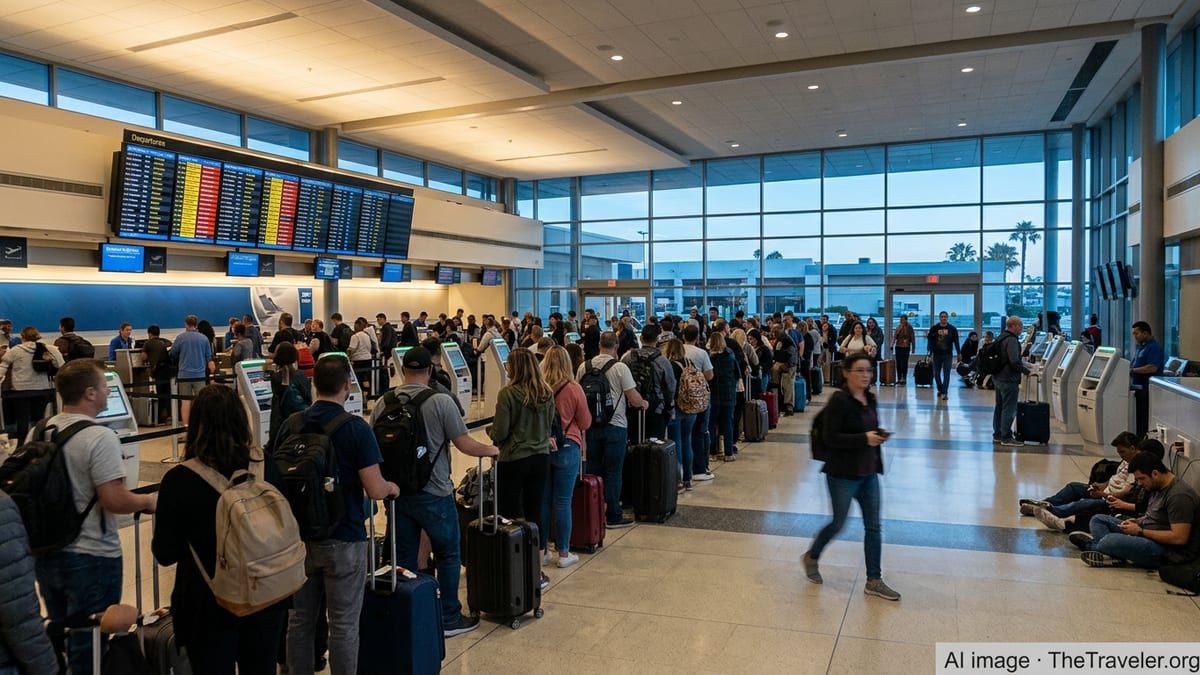
Recent traveler accounts from Orange County and other U.S. airports describe scenes of crowded check-in halls, stretched security lines and departure boards filled with amber and red status changes. While each airport’s situation is different, the pattern is similar: flights delayed as aircraft and crews arrive late from previous legs, connections missed because of earlier storms, and some routes preemptively dropped from the schedule to keep the rest of the network moving.
John Wayne Airport, which typically benefits from shorter lines and quick gate-to-curb times compared with larger Southern California airports, is feeling the strain when multiple delays cluster within the same time window. Morning departures that rely on inbound aircraft from weather-affected regions, or evening flights that sit at the end of already stretched daily rotations, appear especially vulnerable to timing problems.
Public discussions among frequent flyers in the region suggest that many of the recent disruptions at Santa Ana have less to do with any single local failure and more to do with national constraints. Airlines are juggling aircraft utilization, crew duty limits and tight turnaround times at a moment when travel demand remains strong and major storms are repeatedly closing or slowing critical hubs. When that balancing act falters, smaller stations like John Wayne can see entire blocks of flights pushed back or scrubbed.
For travelers on the ground, the effect is immediate and personal: missed connections through Denver or Chicago, unexpectedly long layovers at Phoenix or Dallas, and, in some cases, forced overnights as rebooking options dry up. Even passengers on short-hop routes within the Southwest or up the California coast have reported extended waits as carriers attempt to realign schedule gaps.
What Travelers Through John Wayne Airport Should Expect Now
With the North American storm system still influencing national operations as of March 16, travelers flying to or from John Wayne Airport should be prepared for continued uneven performance, even if the most acute phase of the weather has passed. After any large-scale disruption, airlines need time to reposition aircraft and crews and to clear backlogs of stranded passengers. This recovery period can last several days, during which schedule changes and rolling delays remain a possibility.
Published industry analysis of recent events emphasizes how vulnerable U.S. aviation remains to large, complex storms and overlapping operational challenges. A single day with several hundred cancellations and thousands of delays across the system can echo well into subsequent days, especially around peak travel times such as Sunday evenings and Monday mornings. John Wayne, as a spoke airport feeding into multiple national hubs, sits squarely in the path of these delayed aftershocks.
Travelers should not assume that early-morning departures from Santa Ana are immune to wider problems. If the aircraft planned for the first flight of the day arrived late the previous night, or if a crew has already reached its duty limit because of prior storms, even the first outbound can be rescheduled. Similarly, evening flights that depend on tight turnarounds from inbound legs may be reslotted or cancelled if upstream delays cascade.
The near-term outlook suggests that, while outright gridlock at John Wayne is unlikely, passengers should anticipate a less predictable experience than usual. More time in queues, more frequent schedule updates and a higher likelihood of missed connections are all realistic possibilities as the national system gradually recalibrates.
Practical Tips to Navigate the Current Chaos
Given the volatility, travelers using John Wayne Airport in the coming days may want to build in additional safeguards. Industry trackers and consumer travel coverage consistently recommend arriving earlier than usual, particularly for morning departures when queues can spike unexpectedly after overnight disruptions. An extra buffer of 30 to 60 minutes at the airport can provide crucial breathing room if check-in, baggage drop or security processing slows down.
Flexibility with routing can also help. When storms or system issues are affecting a particular hub, some travelers report better outcomes by accepting rebookings through alternative connection points, even if they add an extra stop. For passengers departing Santa Ana, that may mean being open to connecting through different Western hubs or accepting a slightly longer itinerary in exchange for a more reliable seat.
Experts who study aviation reliability stress that disruptions often cluster later in the day, as early delays propagate through the schedule. When possible, choosing the earliest feasible departure from John Wayne for longer journeys can reduce exposure to cascading delays. At the same time, travelers should keep expectations realistic: given the scale of recent national weather impacts, even early flights are not guaranteed to run on time.
Finally, travelers should expect that conditions may change rapidly and without obvious local cues. A sunny afternoon in Orange County does not necessarily signal a smooth travel day if thunderstorms in the central United States, snow in the Northeast, or strong winds elsewhere are disrupting the broader network. In this environment, staying informed and allowing generous margins of time remain the most reliable strategies for navigating John Wayne Airport’s current wave of cancellations and delays.