

More news on this day
Passengers traveling through John Wayne Airport in Orange County are encountering a turbulent stretch of cancellations and delays, as regional weather, national staffing pressures, and wider U.S. airspace congestion converge to disrupt one of Southern California’s busiest suburban gateways.
Get the latest news straight to your inbox!
How the Disruptions Are Playing Out at SNA
Recent days have brought an uptick in flight cancellations and late departures at John Wayne Airport, according to publicly available flight-tracking data and local reports from travelers. While overall numbers remain lower than those seen at major hubs such as Los Angeles International and San Diego International, even a modest spike in disruption at a smaller airport like SNA quickly becomes palpable in packed gate areas and security queues.
Departures to key West Coast and transcontinental markets have been particularly sensitive, as aircraft and crews arriving from other disrupted airports on the national network reach Orange County behind schedule. When an inbound aircraft is delayed or diverted, its subsequent rotation out of John Wayne Airport often departs late, creating a cascading effect that can ripple across an entire day’s schedule.
Because John Wayne Airport operates within tight noise and curfew restrictions, extended delays are harder to absorb than at some larger airports. Flights that face significant schedule slippage toward the late-evening cutoff window are more vulnerable to outright cancellation, leaving travelers with fewer same-day options to rebook or connect onward.
Weather, Staffing, and Systemwide Strain
The recent turbulence at John Wayne Airport has not developed in isolation. Across the United States, a series of winter and early spring storms in 2026 has triggered repeated waves of disruptions, with thousands of flights canceled or delayed nationwide on multiple days. When severe weather closes runways or reduces arrival rates at key hubs, secondary airports like SNA often feel the aftershocks hours later as missed connections, diverted flights, and crew misalignments work their way through airline networks.
At the same time, ongoing staffing pressures in areas such as air traffic control and security screening continue to weigh on the aviation system. Publicly available coverage of the partial federal government shutdown and subsequent funding disputes has highlighted how even modest staffing shortfalls at control centers or TSA checkpoints can force traffic slowdowns or limit the number of security lanes in use, extending wait times for passengers and narrowing the operational cushion for airlines.
Southern California’s dense airspace amplifies these challenges. John Wayne Airport shares skies and regional routings with Los Angeles, Long Beach, Ontario, and San Diego, among others. When one of these airports experiences a ground stop, low-visibility conditions, or staffing-triggered flow restrictions, air traffic managers may meter departures and arrivals across the broader region. That environment can quickly turn routine afternoon congestion into rolling delays that last well into the evening.
What Travelers Are Experiencing on the Ground
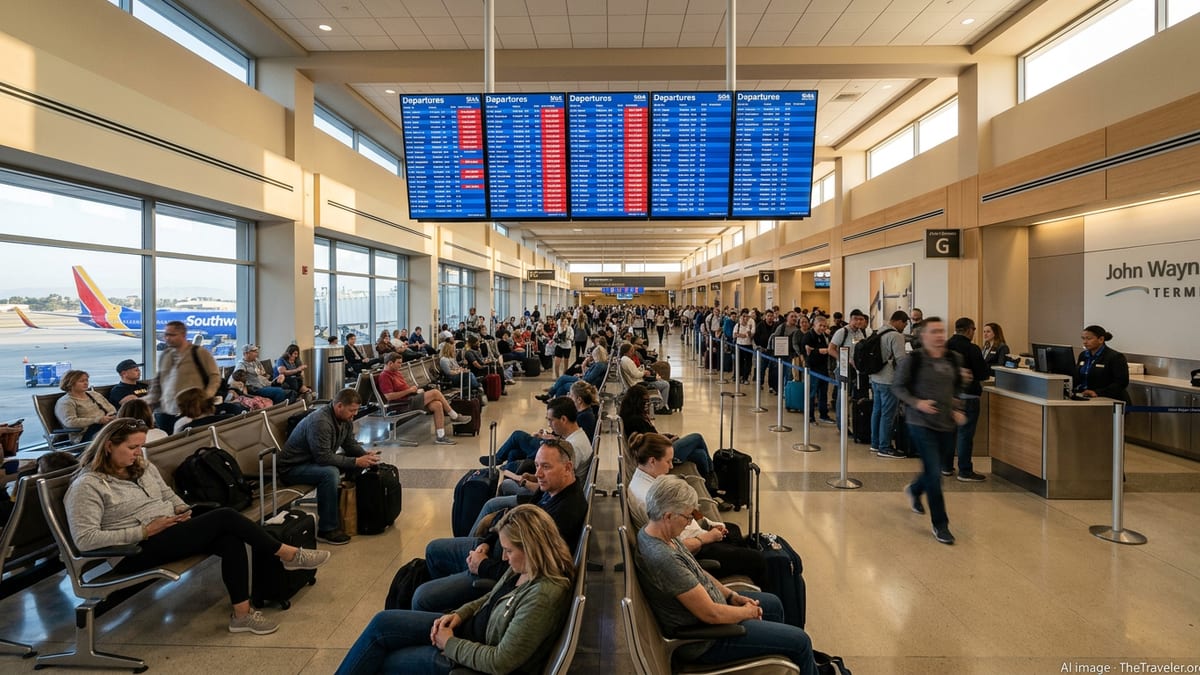
For passengers at SNA, the most visible signs of the current disruption are crowded departure areas, full standby lists, and frequent schedule changes on departure boards. Travelers report that departure times have been shifting throughout the day, with some flights creeping from minor delays into longer holds as inbound aircraft wait for clearance from upstream airports affected by storms or staffing-related restrictions.
Security screening experiences have varied by time of day. While some periods still resemble John Wayne’s traditionally brisk throughput, busier peaks have seen lines stretching toward the ticketing area as passenger volumes collide with resource constraints. In a compact terminal, even a modest backup can feel significant and increase anxiety for travelers trying to make tight departure windows.
Once at the gate, passengers are coping with a familiar pattern of rolling notifications and gate changes. Airlines have been attempting to consolidate lightly booked flights, swap aircraft to recover schedules, and rebook disrupted travelers onto alternative routings through other hubs. Those efforts can help reduce outright cancellations, but they also introduce added complexity as travelers adjust to new itineraries, seats, and connection times.
Practical Steps for Flying Through John Wayne Airport Now
For travelers with upcoming flights from or through John Wayne Airport, preparation has become more critical. Same-day monitoring of flight status through airline channels and flight-tracking services is essential, particularly for early morning departures that may depend on aircraft arriving the previous night from weather-exposed regions. Checking status repeatedly in the 24 hours before departure can provide early warning of creeping delays that might affect connections.
Arriving at the airport earlier than usual is also advisable while disruption persists. Many seasoned Orange County travelers have long relied on SNA’s reputation for quick security lines, but recent volatility across the aviation system means that assumption can no longer be taken for granted on busy days. Building in extra time at check-in and screening helps cushion against any sudden slowdown triggered by staff shortages, equipment issues, or surges in passenger traffic.
Passengers with tight onward connections, especially those involving separate tickets or self-arranged links to international flights, may want to consider retiming itineraries by a few hours or even a full day to reduce the risk of misconnection. In a period of heightened cancellations and delays, itineraries with longer layovers and fewer separate components generally prove more resilient.
What This Means for Spring and Summer Travel Plans
The recent disruptions at John Wayne Airport are a reminder that the broader U.S. aviation system remains vulnerable to a mix of weather extremes, staffing constraints, and rising demand. Even as airlines and airports work to add resilience, the combination of severe storms, constrained staffing at key federal agencies, and busy holiday or school-break peaks can still push day-to-day operations to the edge.
Looking ahead to the spring break and early summer travel periods, travelers using SNA should plan for continued volatility, particularly on peak days such as Fridays, Sundays, and holiday eves. Historic patterns suggest that days following major storms or national-scale disruptions elsewhere in the country can be especially bumpy, as airlines reposition aircraft and crews and clear backlogs.
For many passengers, John Wayne Airport remains an attractive alternative to larger Southern California hubs, with its compact layout and shorter drive times from much of Orange County. However, the current wave of cancellations and delays underscores that even relatively efficient regional airports are tightly bound to the fortunes of the national air travel network. Flexible planning, generous time buffers, and close attention to evolving conditions will be essential tools for anyone hoping to keep their next trip through SNA running on schedule.