

More news on this day
As shifting air routes and renewed security concerns continue to unsettle travel to Israel, Jordan is positioning itself as a comparatively stable alternative for visitors and transit passengers looking to access the wider Middle East.
Get the latest news straight to your inbox!
Regional Turbulence Reshapes Travel Patterns
Recurring disruptions to flights serving Israel, including pauses and resumptions by major international airlines, have unsettled itineraries for leisure and business travelers across the region. Published coverage shows that carriers have repeatedly adjusted or suspended services to Tel Aviv in response to missile strikes, airspace closures, and changes in risk assessments. These interruptions have pushed some travelers and tour operators to look for more predictable gateways nearby.
Reports indicate that missile strikes and drone attacks targeting Israeli infrastructure have led to temporary shutdowns at Ben Gurion Airport and short-lived cancellations by a range of global airlines. Each flare-up has prompted new reviews of overflight permissions and routes, further eroding traveler confidence in the reliability of direct access to Israel. While some services have returned intermittently, the pattern has reinforced a perception of volatility.
At the same time, broader geopolitical tensions, including confrontations involving Iran and regional militias, have narrowed available air corridors between Europe, the Gulf, and Asia. Carriers have rerouted around conflict zones, lengthening flight times and concentrating traffic in safer airspace. Within this environment, Jordan’s airspace and infrastructure are being reassessed by the industry as part of a more resilient regional network rather than just an add-on to itineraries focused on Israel.
Travel analysts note that this shift is occurring as global demand for Middle East tourism and religious travel remains strong. With traditional patterns disrupted, airports and tourism boards across the region are vying for a new role in how visitors access heritage sites, pilgrimage routes, and resort areas that straddle national borders.
Jordan Emphasizes Relative Stability and Safety
Publicly available advisories from several Western governments describe Jordan as facing localized security risks but not the widespread conflict seen in neighboring states. Travel guidance typically focuses on specific border regions and isolated incidents rather than nationwide instability, a distinction that has become more prominent as violence around Israel and in parts of Syria and Iraq continues.
Jordan’s authorities have periodically taken precautionary steps, such as short-term airspace closures during episodes of cross-border missile fire, but these measures have usually been framed as temporary and preventive. Aviation regulators and local media have stressed that the objective is to protect civil aviation and reassess risk rather than signal an open-ended shutdown of the country’s skies. Once perceived threats subside, restrictions have generally been lifted and flight operations restored.
Domestic tourism stakeholders, including hotel operators and tour companies, have long marketed Jordan as a safe base for exploring the broader Holy Land and Red Sea region. Even as bookings fell during the early months of the Israel–Gaza conflict, industry representatives quoted in regional outlets repeatedly underlined that daily life inside Jordan remained calm and that key destinations such as Amman, Petra, Wadi Rum, and the Dead Sea were operating normally.
This narrative of relative stability has gained renewed relevance as travelers search for alternatives to disrupted routes via Israel. While no destination in the region is completely insulated from geopolitical risk, Jordan is increasingly framed in travel coverage as a country where security conditions are more predictable, and where tourism infrastructure has experience managing regional crises without widespread internal unrest.
Queen Alia International Airport Builds Its Hub Role
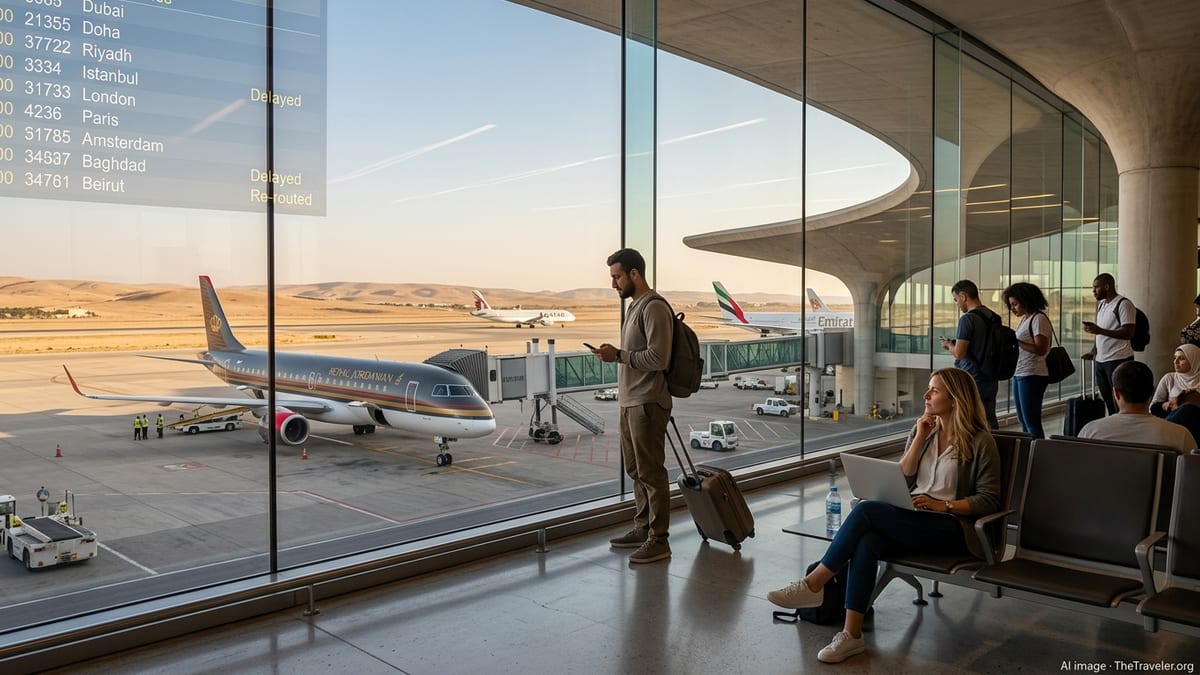
Jordan’s main gateway, Queen Alia International Airport near Amman, is central to the country’s pitch as a reliable transit point. Data released by Jordanian aviation regulators and airport operators show that passenger numbers, which declined during periods of heightened regional tension, have been recovering as airlines reinstate services and travelers regain confidence.
Recent local reporting notes that several carriers which temporarily suspended flights into Amman amid wider Middle East disruptions have resumed operations. Officials cited in that coverage describe a gradual improvement in air traffic, with a growing list of airlines once again using the airport for links between Europe, the Gulf, and South Asia. This recovery supports Jordan’s ambition to serve as a mid-sized hub connecting multiple regions, not just a point-to-point leisure market.
Royal Jordanian, the national carrier, has also adjusted its strategy in response to the shifting landscape. Interviews and financial disclosures reported in business media show the airline leaning more heavily on transit traffic routed through Amman, while working to contain the additional costs of longer diversions around conflict areas. Plans to open or expand long-haul routes, including to North America, are framed as steps toward deepening Queen Alia’s role in global networks.
The concentration of east–west traffic into safer corridors has arguably increased the strategic value of Jordanian airspace. With many airlines avoiding certain neighboring skies, routings via Amman offer one of several viable options to maintain schedules between Europe, the Levant, the Gulf, and beyond. For travelers wary of last-minute cancellations closer to active conflict zones, the perception of operational continuity at Queen Alia can be a deciding factor in itinerary planning.
Tourism Industry Pivots Away From Israel-Linked Itineraries
Before the latest round of conflict, Jordan’s tourism model relied heavily on twin-center trips that combined sites in Israel and the occupied Palestinian territories with Jordanian highlights such as Petra and the Dead Sea. Tour operators often marketed seamless itineraries that moved visitors across borders by land or short flights, presenting the region as a single, integrated destination.
The sharp deterioration in security conditions around Israel, repeated airspace adjustments, and periodic closures of key land crossings have disrupted this model. According to regional tourism coverage, bookings tied to combined Israel–Jordan packages fell sharply after October 2023, with some agencies suspending departures or rerouting clients through alternative gateways. Jordan’s sector has responded by emphasizing standalone itineraries within the kingdom and promoting longer stays that do not depend on cross-border excursions.
Campaigns highlighted in local media have shifted messaging toward Jordan’s own depth of attractions, from Nabataean archaeology and biblical sites to desert eco-lodges and wellness resorts on the shores of the Dead Sea. By decoupling their offerings from conditions in Israel, operators aim to reassure potential visitors that a trip to Jordan can proceed even when neighboring routes are disrupted.
Industry observers note that this pivot is not merely tactical but could reshape regional travel patterns for years to come. If uncertainty around access to Israel persists, a growing share of visitors may opt to route directly through Amman, treat Jordan as their primary destination, and add regional excursions only when circumstances clearly allow. In that scenario, Jordan’s positioning as a comparatively safe and stable travel base could become one of its most valuable tourism assets.
Travelers Weigh Evolving Advisories and On-the-Ground Reality
Despite Jordan’s efforts to project stability, international travelers still face a complex information environment. Government advisories for Jordan and the wider Middle East are being updated frequently, sometimes urging heightened caution or even departures from the region in response to escalations involving Iran, Israel, and various armed groups. These broad warnings, which often cover multiple countries at once, can create confusion about conditions in specific destinations.
Travel experts quoted in media analyses recommend that visitors differentiate between nationwide prohibitions and localized restrictions within Jordan, such as limits near certain border areas, while also monitoring the status of regional airspace. Many tour operators now encourage clients to build flexibility into their itineraries, purchase robust travel insurance, and stay informed about flight changes affecting neighboring hubs even if their primary destination is Amman.
On travel forums and social platforms, recent posts from visitors to Jordan typically describe calm conditions in major tourist areas, but they also reference occasional disruptions such as precautionary airspace closures or rescheduled flights during spikes in regional tension. These firsthand accounts often stress the contrast between television images from conflict zones and the relative normalcy experienced in Jordanian cities and resort areas.
For now, Jordan’s emergence as a perceived safe harbor for Middle East travel depends on its ability to preserve that sense of normalcy while navigating the same geopolitical storms affecting its neighbors. As airlines and travelers continue to adjust to an unsettled security landscape, the country’s mix of operational resilience, tourism assets, and measured risk management may determine how firmly it secures its place as a preferred alternative to disrupted routes via Israel.