

More news on this day
A two hour hop between Seoul and Tokyo, currently regarded by industry trackers as the world’s shortest regularly scheduled Airbus A380 route, is set to become even busier as airlines lean on the superjumbo to capture fast-growing premium demand on key Asian city pairs.
Get the latest news straight to your inbox!
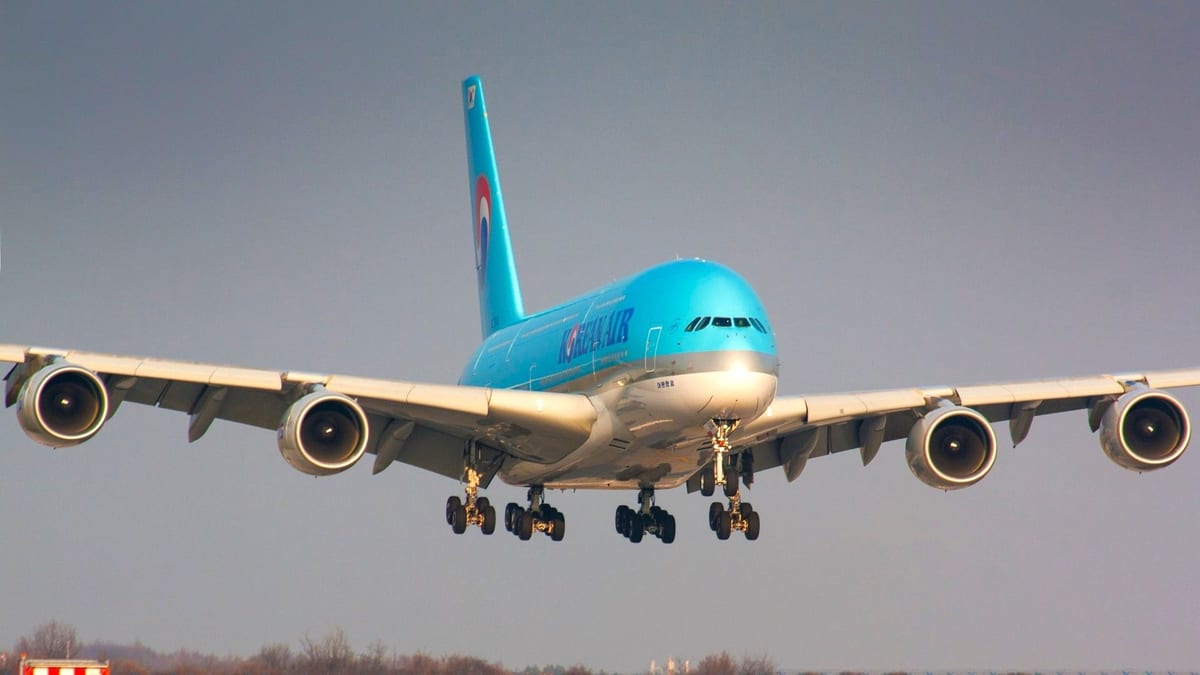
Image by Simple Flying - Aviation News
A Superjumbo on a Short Hop
According to recent network analyses, the Airbus A380 operated by Asiana Airlines between Seoul Incheon and Tokyo Narita covers a distance of around 780 miles, with a scheduled block time of roughly two hours. Aviation datasets and specialist coverage identify this as the shortest regularly scheduled A380 operation in the world by stage length and time.
The superjumbo, designed for long haul services linking major global hubs, is therefore being used in a way that contrasts sharply with its original mission profile. Instead of ultra long flights such as Dubai to Auckland or Los Angeles, the aircraft is carrying passengers on a route shorter than many domestic services in larger countries.
Industry reports suggest that the combination of dense demand, constrained airport slots and strong appetite for premium cabins has encouraged airlines to place the A380 on sectors once dominated by twin engine widebodies and narrowbodies. On the Seoul to Tokyo pairing, the aircraft’s ability to offer a high number of seats across four cabins on a single slot has become a strategic advantage.
For travelers, the result is an unusual experience: a brief regional hop with all the trappings of a flagship long haul product, from spacious upper deck lounges to large first and business class suites, albeit with a service flow compressed into roughly two hours gate to gate.
More Frequencies as Demand Climbs
Published schedules for the current northern summer season show that the short Seoul to Tokyo A380 run is being reinforced with additional flights, particularly around peak travel periods. Capacity projections compiled by route tracking platforms for 2025 and early 2026 indicate more A380 rotations on this city pair compared with previous years.
The growth reflects robust two way demand between South Korea and Japan, which has recovered strongly since international borders reopened. Travel trade commentary points to a mix of leisure traffic, business trips and connecting passengers using the short sector as a link between long haul services to Europe, North America and Oceania.
Analysts note that deploying extra A380 frequencies can be more efficient for carriers than adding a new type on the same route. Concentrating demand on one very large aircraft type simplifies crew scheduling, maintenance and product consistency, while providing a visible marketing boost for a route that is already well known among aviation enthusiasts.
In practical terms, the expanded schedule means that passengers now have more options to experience the A380 on a flight that takes little longer than many intra European or domestic Asian sectors. It also spreads demand more evenly across the day, easing pressure on particularly busy early morning and evening departures.
How This Flight Compares With Other Short A380 Routes
Short haul A380 operations are not new, but they remain rare. Historically, airlines such as Emirates briefly used the type on extremely short routes including Dubai to Doha and Dubai to Muscat, with scheduled times close to one hour. More recently, Emirates has deployed the aircraft on regional links like Dubai to Jeddah and Dubai to Madinah, with flying times of around two and a half hours, often timed to coincide with peak religious travel seasons.
Industry publications that track aircraft deployment list several other comparatively short A380 sectors in the current and upcoming seasons, including Dubai to Amman, Dubai to Mumbai and a number of trans Tasman services between Australia and New Zealand operated by Singapore Airlines and Qantas. Most of these flights fall in the range of three hours or slightly less.
Within that context, the Seoul to Tokyo Narita sector stands out because it is both short and regularly scheduled throughout the season, rather than a temporary or one off upgauge in response to a specific event. That regularity is one of the key reasons it is widely cited as the world’s shortest ongoing A380 service at present.
By contrast, the longest active A380 routes can exceed 14,000 kilometers and more than 17 hours in the air, connecting Dubai to cities such as Auckland and Christchurch. The extremes highlight the flexibility with which airlines are now using a type once considered viable only on the very longest and busiest trunk routes.
Why Airlines Put a Giant on a Two Hour Route
Network planners quoted in recent analytical pieces point to several structural reasons for the trend toward short haul A380 missions on select city pairs. First is slot scarcity at large hub airports in Asia and the wider region. When runway access is capped, using a higher capacity aircraft can grow passenger numbers without increasing movements.
Second is the rising share of connecting traffic. Major hubs at both ends of the Seoul to Tokyo route funnel long haul passengers from Europe, North America and Southeast Asia. Putting an A380 on the link allows both ends of the network to be synchronized around a widebody capable of handling banks of inbound and outbound flights, smoothing connections and reducing missed transfer risk.
Third is the desire to showcase a carrier’s flagship product on routes that attract high yielding passengers. Corporate travelers, frequent flyers and affluent leisure customers often value the ability to enjoy a familiar long haul style cabin even on a short sector. For airlines, offering that consistency can support fares at a time of rising costs.
The aircraft itself also benefits. With production of the A380 having ended and several operators choosing to reactivate stored frames, finding productive flying hours for the type has become an important consideration. Shorter regional missions like Seoul to Tokyo help keep utilization high while complementing overnight long haul rotations.
What Passengers Can Expect Onboard
For travelers curious about trying the world’s shortest regular A380 route, the onboard experience blends the novelty of a very large aircraft with the pace of a typical regional flight. Boarding typically begins well before departure to allow for the number of passengers, but once airborne there is little time to spare.
Cabin crews adapt the service pattern to the compressed timeline, often providing a simplified meal or snack service and a limited window for duty free sales. Entertainment systems, however, are usually fully available, so passengers can sample movies, television and music even if they are unlikely to finish a feature film before descent.
Premium cabin passengers benefit from lie flat seats that are more commonly associated with overnight long haul journeys, as well as spacious lavatories and, on some airlines, access to small lounge style areas on the upper deck. Economy travelers still gain from the A380’s relatively quiet cabin and open feeling, even on a short hop.
With additional frequencies now in place, enthusiasts have more chances to schedule itineraries that include this unusual sector. For many, the appeal lies not in the distance or duration of the flight, but in the contrast between the aircraft’s scale and the short length of the journey.