

More news on this day
JW Marriott Tucson Starr Pass Resort & Spa in Arizona has completed a significant refresh of its meeting and event spaces, unveiling updated interiors and technology aimed at capturing more group business in the competitive Southwestern meetings market.
Get the latest news straight to your inbox!
Desert Resort Marks Milestone in Multi‑Year Upgrade
The completion of the revamped meeting and event venues at JW Marriott Tucson Starr Pass Resort & Spa marks a key milestone in a broader property-wide renovation program timed around the resort’s 20th anniversary in 2025. Publicly available information indicates that the Tucson resort, which opened in 2005 in the foothills of Tucson Mountain Park, has been undergoing phased upgrades across guestrooms, public areas and group facilities.
Recent coverage in meetings-focused publications describes the renewed focus on the resort’s group offering, highlighting that the indoor meeting inventory of roughly 40,000 to 41,000 square feet has now been refreshed, with attention to both aesthetic and functional improvements. The wider complex offers more than 80,000 square feet of flexible event space when outdoor terraces and lawns are included, keeping the property positioned as one of Southern Arizona’s major conference venues.
The meeting-space renovation follows earlier enhancement projects at the resort, including previous investments in the spa and lobby areas. Industry reports suggest that the current work is part of a larger capital plan estimated in the tens of millions of dollars, with guestroom renovations scheduled to extend into 2026, while meeting facilities reach completion sooner so the resort can remain competitive for high-value conference and incentive business.
Southwestern Design Refresh Anchors the New Look
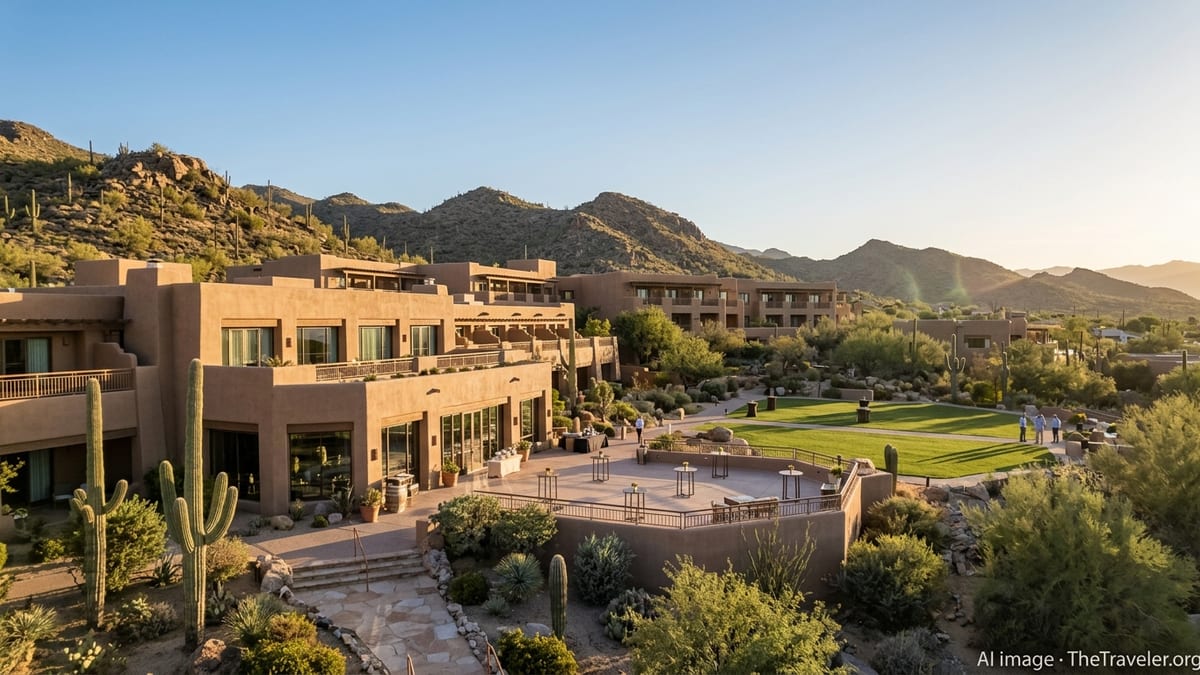
The redesigned meeting and event spaces at JW Marriott Tucson Starr Pass are framed around a contemporary interpretation of the Sonoran Desert landscape. Reports indicate that the design team drew from the property’s adobe-style exterior, desert light and surrounding saguaro-studded hillsides to inform a more modern interior scheme.
Neutral palettes now dominate many of the refreshed rooms, with warm sand tones, muted terracotta and deep cactus greens replacing older, heavier color combinations that were common when the resort first opened. According to published coverage, updated carpeting patterns and wall treatments echo desert textures and topography, while new furnishings are intended to feel more residential, with cleaner lines and softer seating that can transition from board meetings to social gatherings.
Art and decorative elements also lean into the resort’s setting on the western edge of Tucson. Public information about the project notes the use of locally inspired motifs and materials, including patterns referencing traditional Southwestern textiles and forms reminiscent of regional rock formations. The overall effect is designed to align the interior spaces more closely with the panoramic views visible from many of the resort’s terraces and large meeting-room windows.
Upgraded Ballrooms and Flexible Breakouts for Planners
For meeting planners, the most visible changes are in the resort’s primary indoor venues, including the large Arizona Ballroom and the Tucson Ballroom, along with numerous breakout rooms. Industry data describes the Arizona Ballroom as the flagship space, offering nearly 20,000 square feet and accommodating more than a thousand attendees for banquets or general sessions. The recent renovation has focused on refreshed finishes, updated lighting and improved acoustics to support a range of program formats.
Smaller rooms and breakout spaces have also been rethought for flexibility. Reports from meetings publications note that several meeting rooms feature floor-to-ceiling windows and direct access to patios, allowing events to take advantage of Tucson’s climate while maintaining climate-controlled interiors. New layouts and furnishings are intended to make it easier to move from classroom-style meetings during the day to receptions or networking events in the evening.
Outdoor function areas were already a signature asset at JW Marriott Tucson Starr Pass, with lawns and terraces overlooking the surrounding desert. With the meeting-space refresh, planners can more easily pair indoor sessions with open-air receptions, using upgraded audiovisual infrastructure and refreshed outdoor lighting. This combination of indoor and outdoor venues is promoted as a way to integrate wellness breaks, stargazing experiences and other destination-driven programming into multi-day events.
Technology, Sustainability and the Meetings Market
Beyond aesthetics, the renovation of the meeting and event spaces has focused on technology and operational efficiency. Publicly available descriptions of the upgrades highlight state-of-the-art audiovisual capabilities, enhanced connectivity and infrastructure designed to handle hybrid events, which remain a consideration for many organizations. While detailed technical specifications are not widely disclosed, the resort positions its meetings offering as compatible with current expectations for high-bandwidth presentations, streaming and complex staging.
Sustainability forms another part of the resort’s message to planners. Information shared through destination and meetings-industry guides notes that JW Marriott Tucson Starr Pass participates in broader environmental initiatives, and the latest refresh has reportedly incorporated energy-efficient lighting and other back-of-house improvements. For groups prioritizing responsible meetings, these updates provide additional context alongside the natural setting next to Tucson Mountain Park.
The investment in refreshed meeting venues comes at a time when Tucson is working to strengthen its profile as a meetings and incentives destination. Regional overviews for Arizona emphasize concurrent upgrades at other area properties and at local event infrastructure, suggesting competitive pressure within the market. By completing its meeting-space renovation ahead of the full guestroom overhaul, JW Marriott Tucson Starr Pass is positioning itself to capture events scheduled in the near term while signaling longer-term enhancements still to come.
What the Revamp Means for Groups and Tucson Tourism
For corporate, association and incentive planners, the completed renovation of the JW Marriott Tucson Starr Pass meeting and event spaces broadens options in Southern Arizona for groups that want a resort environment with substantial conference capacity. The property now offers a refreshed alternative to downtown convention facilities and other resort venues in the region, particularly for programs that want to emphasize outdoor experiences, golf or wellness.
Destination guides highlight the resort’s combination of 27 holes of golf, a full-service spa and guided desert activities alongside its sizable meeting footprint. With the newly updated interiors, planners can market programs around modern, light-filled spaces that connect more directly to the desert setting. This is likely to appeal to incentive groups, leadership retreats and conferences seeking a distinctive backdrop that differs from urban convention centers.
The timing of the meeting-space completion also intersects with broader travel patterns. Industry analysis suggests that group demand in the Southwest remains resilient, particularly during shoulder seasons when desert temperatures are most comfortable. With refreshed ballrooms, flexible breakouts and enhanced technology, JW Marriott Tucson Starr Pass aims to capture that demand, using its upgraded spaces as a key differentiator as the resort approaches its 20th year in operation.