

The trek to K2 Base Camp ranks among the world’s great multi-day hikes, a demanding journey that threads up Pakistan’s remote Baltoro Glacier to Concordia and the foot of the world’s second-highest mountain. It is wilder, rougher and more committing than the treks to Everest Base Camp or Annapurna Sanctuary, yet for strong and well-prepared walkers it is an achievable goal that delivers some of the most dramatic mountain scenery on the planet.
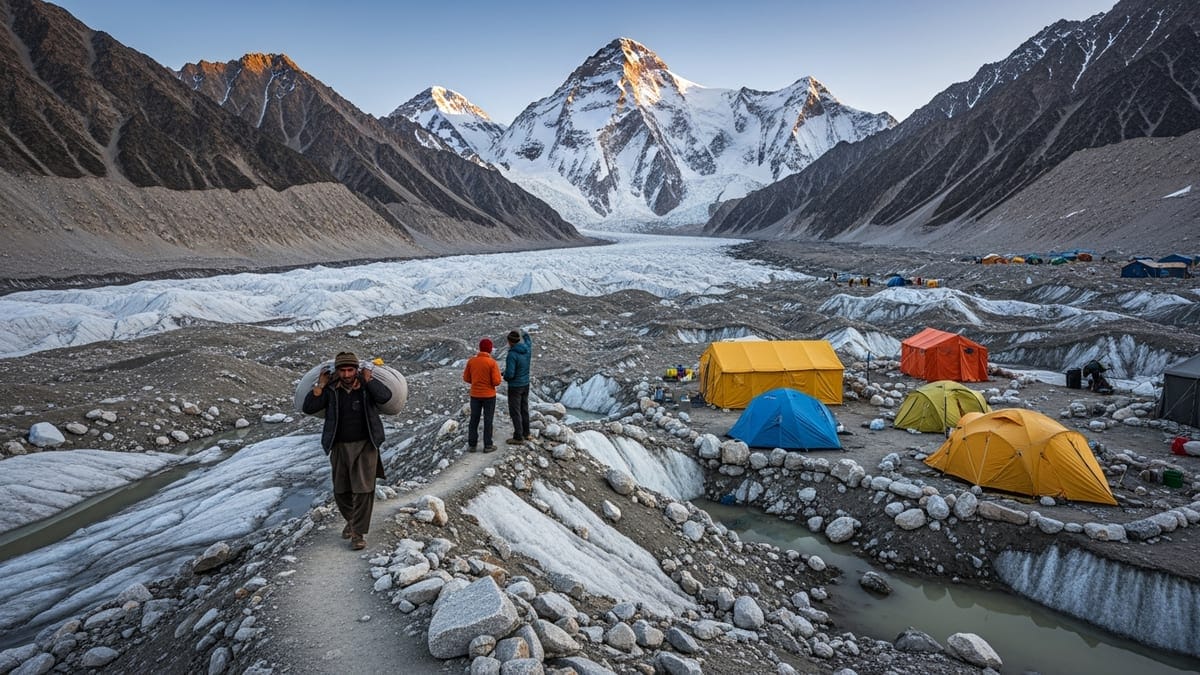
Understanding the K2 Base Camp Trek
K2 Base Camp is not a single trail but a journey that combines long travel days in Pakistan with more than two weeks of trekking on rough glacial terrain. Most commercial itineraries today run between 18 and 22 days round trip from Islamabad, with approximately 12 to 15 actual trekking days between the roadhead at Askole and Concordia, the famous confluence of glaciers beneath K2.
Many treks include a day trip from Concordia to the expedition base camp on the Godwin Austen Glacier at around 5,150 meters before returning to sleep back at Concordia.
Unlike in Nepal, independent trekking to k2 base camp in this region is not realistic. K2 lies within Pakistan’s Gilgit-Baltistan region and the Central Karakoram National Park, and the approach follows the Baltoro Glacier through a tightly controlled frontier valley.
Current regulations require foreign trekkers to join a licensed Pakistani operator, and logistics such as porter support, camping and food are bundled into all-inclusive packages. This is not a lodge trek: you will be camping every night once you leave the road, and you rely heavily on your local team.
Physically, K2 Base Camp is a demanding but non-technical trek. There is no need for rope work or technical climbing gear if you follow the standard route and do not cross Gondogoro La. However, trekkers must be ready for long days of 6 to 8 hours on their feet, walking on loose moraine, rubble and ice. The altitude and remoteness amplify the challenge: Concordia sits at roughly 4,600 to 4,700 meters, and most nights after Paiju are above 4,000 meters, which slows the pace and increases the risk of altitude-related problems for the unacclimatized.
In return, the rewards are profound. As you work up the Baltoro, the skyline evolves from rock spires to an amphitheater of 7,000 and 8,000 meter peaks: Trango Towers, Masherbrum, Gasherbrum IV, Broad Peak, and finally K2 itself, a sharp pyramid rising above the Godwin Austen Glacier. Concordia has long been nicknamed the “throne room of the mountain gods,” and standing there at dawn as the sun touches K2 is for many trekkers the defining moment of their mountain lives.
Route Overview and Typical Itinerary
Most K2 Base Camp itineraries begin with an arrival in Islamabad, Pakistan’s capital, where operators conduct a gear check, finalize permits and wait on the domestic flight to Skardu. When weather cooperates, a short flight over Nanga Parbat delivers you to Skardu in about an hour. However, flights are frequently canceled due to conditions, so itineraries usually build in flexibility and a backup plan for a long but scenic road journey along the Karakoram Highway and Indus Valley.
From Skardu, jeeps or 4x4s carry trekkers along a rough road through the Shigar Valley to the village of Askole, the traditional roadhead for Baltoro expeditions. Depending on road conditions, some trips may now start slightly farther up the valley if new tracks are passable, but Askole remains the main staging point. Here you meet the full support team and porters, redistribute loads and begin walking.
The classic on-foot route runs from Askole to Jhula or Korophon, then on to Paiju at the snout of the Baltoro Glacier. From Paiju, you climb onto the glacier itself, following its undulating, rubble-covered back toward camps at Khoburtse or Liligo, then Urdukas, Goro I and Goro II, before reaching Concordia.
This progression typically takes six to seven trekking days with a rest or acclimatization day at Paiju. Many itineraries then spend one or two nights at Concordia, offering a full daytrip to K2 Base Camp and sometimes Broad Peak Base Camp, before reversing the same route back to Askole and returning to Skardu.
Day-by-day variations depend on operator preference and conditions, but most follow a similar pattern: 5 to 7 hours of trekking per day between lower camps, stretching to 7 or 8 hours as you approach Concordia and while visiting K2 Base Camp. Distances on the glacier can be deceptive; a section that appears short on the map may involve detours around crevasses and unstable ice, so time on foot is a better measure than kilometers.
For those seeking an extra challenge, some itineraries add a crossing of Gondogoro La, a high pass above 5,500 meters that links Concordia to the Hushe Valley, but this requires fixed ropes, crampons and favorable conditions, and is best reserved for experienced trekkers comfortable with exposure.
Best Season, Weather and Conditions
The trekking season to K2 Base Camp is compact and strongly dictated by Karakoram weather patterns. The vast majority of departures operate from late June through late August, with some extending into early September in warmer years.
Unlike the Himalaya in Nepal, this part of Pakistan sits in a partial rain shadow and is less affected by the South Asian monsoon, which means mid-summer often delivers relatively clear skies. However, this does not mean stable or predictable weather. Storms, wind and occasional snowfall are possible at any time, especially higher up the Baltoro.
Temperatures on the trek vary dramatically between the lowlands and glacier. In Islamabad during June and July, daytime highs often exceed 40 degrees Celsius, and Skardu can climb above 30. Even Askole can feel hot and dusty in the afternoons. As you gain altitude, conditions cool sharply. Around Concordia and K2 Base Camp in peak season, daytime temperatures may hover between freezing and 10 degrees Celsius, while nights in a typical season often drop to between minus 10 and minus 20. Sudden cold snaps can push temperatures even lower, especially in early June and late August.
Recent seasons have also highlighted the impacts of climate change. Reports from 2024 and 2025 describe episodes of extreme heat in northern Pakistan, increased rockfall and unpredictable snow conditions on high passes. On the Baltoro itself, hotter summers accelerate melt, making the glacier surface more broken and unstable later in the season.
Trekkers considering late August or early September departures should be prepared for wet, slushy conditions and possible fresh snowfalls higher up. Early season treks in late June can encounter lingering snow on the upper glacier approaches and around Concordia, making some sections slower and more strenuous.
In terms of choosing dates, many operators still favor departures from early July to mid-August as a compromise between stable glacier conditions and longer daylight. June departures can be quieter but colder and more snow-affected, while late August itineraries may enjoy slightly cooler air at lower elevations but risk more changeable weather and more broken ice. Because domestic flights to Skardu are so weather-dependent, having at least one spare day at the start of your itinerary is sensible, and it is prudent to avoid tight connections for your international flight home.
Costs, Inclusions and Permits in 2026
The K2 Base Camp trek is one of the more expensive classic hikes in Asia, mainly because of its remoteness, the requirement to use a licensed local operator and the large support teams needed to move camps up the Baltoro.
For 2026 planning horizon, most reputable Pakistani outfitters advertise group trek prices typically between about 1,800 and 2,600 US dollars per person for a 18 to 21 day package starting and ending in Islamabad. Prices near the lower end usually cover “trek only” services from Skardu or Askole, while higher-priced packages include hotels in Islamabad and Skardu, domestic flights, more comfortable camping setups and additional acclimatization days.
Recent price lists from Skardu-based specialists show a 20 day K2 Base Camp and Concordia trek starting around 2,050 to 2,400 US dollars per foreign trekker for all-inclusive itineraries, with longer 24 day schedules or routes via Gondogoro La typically priced 100 to 300 dollars higher. Some operators structure tiers such as “silver,” “gold” and “diamond” packages, where the cheaper tiers include standard camping and shared tents and the premium tiers add single room supplements in hotels, upgraded camping gear and sometimes extra support staff.
Group size has a strong influence on cost: solo or private small-group treks can easily exceed 3,500 to 4,000 dollars per person, while larger shared departures of 10 to 14 participants may drop per-person costs closer to 1,800 to 2,000 dollars, depending on the company and exact inclusions.
When comparing quotes, it is important to understand what is included. A typical all-inclusive K2 Base Camp package for foreign trekkers covers accommodation in Islamabad and Skardu, domestic flights or road transfers, permits and park fees, liaison officer costs, all group camping equipment, three meals per day on trek, cooks and porters, and local guides.
Items usually excluded are international flights, visa fees, individual travel insurance, personal trekking gear, tips for staff, bottled drinks and meals in cities. Domestic flights between Islamabad and Skardu are a special case: some operators include them in the package price, while others quote a land-only cost and add internal flights at current market rates, which have been volatile.
On the regulatory front, the landscape has shifted in the last few years. After discussions in 2024 about sharply increasing royalty fees for both climbing expeditions and trekking permits across Gilgit-Baltistan, local tribunals and tourism authorities decided to delay major fee hikes until at least 2026.
As of early 2026, climbing fees for major peaks such as K2 remain at levels broadly comparable to those of 2023 and 2024, and trekking permits for the Baltoro and Central Karakoram National Park are still managed through licensed operators. For trekkers, this means that while overall trek prices have crept up mainly due to inflation, porter wages and transport costs, they have not spiked as dramatically as some feared. That said, it is prudent to confirm with your chosen operator which permits and fees are currently required and whether any changes are expected for your intended season.
Physical Demands, Altitude and Training
The K2 Base Camp trek demands robust fitness and mental resilience rather than technical climbing skills. Most days involve 6 to 8 hours on the trail, often longer on the glacier as you approach Concordia and on the day trip to K2 Base Camp. Elevation gain per day is not extreme by Alpine standards, but the combination of altitude, rough surfaces and repeated days of exertion wears on even fit walkers. Camps on the middle and upper Baltoro sit from roughly 3,800 to over 4,500 meters, and the continuous exposure to thin air makes recovery slower than at sea level.
Underfoot conditions are one of the main challenges. After Paiju, the trail spends most of its time on the Baltoro Glacier, which is covered in rubble, boulders and lateral moraine. The “path” weaves across ice ridges and melt streams that can change season by season and sometimes day by day. You will balance on loose blocks, step across small crevasses and navigate uneven slopes of ice and rock. Good balance, strong ankles and a patient pace are critical. Trekking poles prove valuable for stability and to reduce strain on knees during long days.
Acclimatization strategy is built into the standard itineraries, with gradual height gain and at least one rest day, usually at Paiju or Urdukas. However, individual responses to altitude vary widely. Some trekkers develop mild acute mountain sickness symptoms such as headache, poor sleep or reduced appetite above 3,500 meters, while others adapt easily.
Responsible operators build in flexibility to add an unscheduled rest day if a significant portion of the group struggles. Having prior high-altitude trekking experience, such as in Ladakh, Nepal or the Andes, helps you understand your own tolerance and how your body reacts beyond 4,000 meters.
For training, a structured 3 to 6 month program focusing on endurance is ideal. This typically means regular long hikes with a pack, stair or hill climbs and cardiovascular activities such as running, cycling or swimming. Aim to comfortably walk 15 to 20 kilometers in a day on hilly terrain by the time you depart.
Strength work for legs and core helps with stability on rough ground, and practicing with the boots and pack you will use on the trek reduces the risk of blisters or overuse injuries. Older trekkers or those with cardiac or respiratory conditions should seek medical clearance and may benefit from planning a slightly longer itinerary with more acclimatization.
Life on the Trail: Camps, Food and Culture
Life on the K2 Base Camp trek is dominated by the rhythms of the trail and by the Balti and porter culture that supports it. Once you leave Askole, you camp every night, usually in large tented sites that serve multiple groups.
Operators provide double or sometimes single sleeping tents, a mess tent where meals are served, and a kitchen tent. Some higher-end operators also set up simple toilet tents and provide foam mattresses, while others expect trekkers to bring their own sleeping mats. Early starts are the norm, with wake-up tea and breakfast before breaking camp to walk in the cooler hours of the morning.
Meals are substantial and tailored to high-energy days. Breakfasts commonly feature porridge, eggs, chapati, jam and tea or coffee. Lunch might be served hot during a longer break or as a hearty picnic, with items such as rice, lentils, vegetables and canned fish.
Dinners are typically multi-course affairs in the mess tent, starting with soup and followed by rice or pasta, meat or beans and vegetables, with fruit or custard to finish when supplies allow. Operators are increasingly familiar with vegetarian needs, and many can also accommodate basic dietary requests if notified in advance, although strict diets are harder to manage as fresh ingredients run out farther up the glacier.
Interaction with local porters and support staff is an integral part of the experience. The Baltoro has a long history as a trade and expedition route, and many porters come from villages in the Shigar and Skardu regions. They carry heavy loads between camps, often in plastic sandals or basic shoes, and their efficiency on the glacier is humbling.
In recent years, regulations and pressure from international organizations have strengthened porter welfare standards, specifying load limits, proper equipment and insurance, but conditions vary with operators. Choosing a company with a clear commitment to fair treatment and reasonable loads is one of the best ways to ensure your trek has a positive impact.
Evenings in camp often bring a communal atmosphere. After dinner, guides typically brief the group on the next day’s distance, expected terrain and any hazards such as river crossings or sections of unstable moraine. On clear nights, the stars over the Baltoro are spectacular, and silhouettes of peaks such as the Trango Towers or Masherbrum loom above.
Communication with the outside world is extremely limited. Satellite messengers and satellite phones are used by guides for logistics and emergencies; trekkers may be able to send brief messages but should plan to be largely offline from the time they leave Skardu until they return.
Safety, Risks and Responsible Travel
Any journey into the high Karakoram carries objective risks. While the K2 Base Camp trek itself is non-technical, it runs beneath steep rock walls and along glacial terrain where rockfall, icefall and landslides can occur. The upper Baltoro is a dynamic environment, and conditions change from year to year as climate patterns shift. Incidents of rockfall and avalanches in recent seasons have underscored the need to travel with experienced guides who understand local hazards and know when to alter or turn back from a planned route.
Altitude-related illness remains a key concern. Although standard itineraries are structured for gradual ascent, factors such as individual susceptibility, dehydration or overexertion can trigger acute mountain sickness, high-altitude pulmonary edema or high-altitude cerebral edema.
Reputable operators train their guides to recognize symptoms and carry basic medical kits, including pulse oximeters, oxygen and sometimes portable altitude chambers on larger expeditions. Evacuation is logistically complex: helicopter rescue is possible in good weather for serious cases, but it is expensive and not always immediately available. Comprehensive insurance that explicitly covers trekking up to at least 5,500 meters in Pakistan, including helicopter evacuation, is essential rather than optional.
Environmental impact is another critical issue. The Baltoro route has seen decades of expedition activity, and waste management has been an ongoing challenge. In recent years, the Central Karakoram National Park authorities and responsible operators have tightened regulations about waste disposal, fuel use and campsite management.
Trekkers are increasingly encouraged to minimize single-use plastics, use purification methods for water instead of relying on bottled supplies, and follow a strict pack-in pack-out ethic. Participating in or supporting clean-up initiatives and choosing outfitters who demonstrate strong environmental practices help preserve the fragile glacier ecosystem.
For personal safety and cultural respect, modesty in dress in villages such as Skardu and Askole is appreciated, especially for women. Long trousers and shirts that cover shoulders are the norm. Alcohol is restricted, and public displays of intoxication are frowned upon.
Photography is generally welcomed in the mountains but always ask before taking close-up portraits, particularly of women or in conservative communities. Political and security conditions in Gilgit-Baltistan have been relatively stable for trekking in recent years, but travelers should stay informed through their foreign office advisories and their operator, and avoid unnecessary movement outside planned logistics in cities.
Planning, Booking and Essential Preparation
Because of the logistical and regulatory complexity of the K2 Base Camp trek, planning ideally begins at least 6 to 12 months before your intended departure. This allows time to choose a reputable operator, secure a place on your preferred departure date, arrange visas and international flights, and build a physical training base. Summer departures, especially those aligned with prime K2 climbing windows in late July and early August, often fill well in advance.
Selecting an operator is perhaps the most consequential decision after deciding to go. Pakistan hosts both long-established local companies based in Skardu or Islamabad and international adventure travel brands who partner with local outfitters. When evaluating options, look beyond price.
Consider group size caps, guide-to-client ratios, porter welfare policies, emergency protocols, experience on the Baltoro, and how transparent they are about inclusions and exclusions. Reading recent client reports and independent reviews can provide insight into how they handled weather disruptions, flight cancellations and health issues in the last few seasons.
On the paperwork side, most nationalities require a visa for Pakistan and additional documentation in the form of a trekking letter of invitation or climbing permit support from your operator. Pakistan’s online visa portal is now the main channel for applications, and processing times can range from a week to more than a month depending on nationality and time of year.
Your operator will typically provide scanned documents and reference numbers needed for the application, and in some cases they coordinate with authorities in Gilgit-Baltistan to clear your group permits in advance. It is prudent to start the visa process as soon as you have confirmed your trek and flights.
Gear preparation should prioritize warmth, durability and comfort over ultralight minimalism. A four-season sleeping bag rated to at least minus 15 to minus 20 degrees Celsius, an insulated sleeping mat, waterproof boots with good ankle support, and layered clothing for conditions ranging from desert heat in Skardu to sub-freezing nights at Concordia are essential.
Many operators provide group tents, but some expect you to bring your own. Because internal flights to Skardu often impose strict baggage limits, operators typically offer a separate porter allowance on trek, for example 15 to 20 kilograms per trekker, and ask you to leave city clothes and unnecessary items in storage at your hotel in Skardu or Islamabad.
The Takeaway
The K2 Base Camp trek is not a casual holiday. It is a demanding, remote and logistically complex journey into one of the world’s most dramatic mountain arenas, and it requires a level of preparation, resilience and risk acceptance that goes beyond more popular Himalayan treks. Yet for those ready to meet the challenge, it offers a rare immersion in the raw architecture of the Karakoram: mile-wide glaciers, sky-piercing granite towers and an encircling amphitheater of 7,000 and 8,000 meter peaks crowned by K2 itself.
As of the 2026 season, the route remains accessible to strong trekkers through experienced local operators, and while costs have risen with global inflation, thoughtful planning can still make the journey achievable. Careful operator selection, realistic physical training, attention to altitude and safety, and a commitment to traveling responsibly are the keys to a successful experience. This is a trek that rewards patience and humility: the Karakoram sets the terms, and the privilege is to move briefly through its vastness under your own power.
If you are drawn to wild glaciated landscapes, comfortable with camping and willing to commit the time and resources, standing at Concordia and looking up at K2 can be a life-marking moment. The journey to reach that vantage point is hard, but for many who make it, there is no question that it is worth every step.
FAQ
Q1. How difficult is the K2 Base Camp trek compared with Everest Base Camp?
In pure trekking terms, K2 Base Camp is generally considered more demanding. The trail spends more time on rough glacier moraine, camps are higher on average, and the region is more remote with full camping and no lodge infrastructure. Daily walking hours can be similar, but the cumulative fatigue from rough terrain and continuous camping makes this trek tougher for many people than the standard lodge-based Everest Base Camp route.
Q2. How much does a K2 Base Camp trek typically cost in 2026?
Most foreign trekkers can expect to pay roughly 1,800 to 2,600 US dollars for an 18 to 21 day group trek, depending on whether the package is “trek only” from Skardu or fully inclusive from Islamabad with domestic flights and hotels. Private or very small-group departures can cost significantly more per person, while very large groups may secure slightly lower rates. International flights, insurance, visas and personal gear are additional.
Q3. Can I trek to K2 Base Camp independently without a guide or agency?
No, in practical terms this is not an independent trek. The Baltoro and K2 region are within restricted zones of Gilgit-Baltistan, and current regulations require foreign visitors to be accompanied by a licensed local operator with the appropriate permits and liaison arrangements. The remoteness, porter logistics and park regulations make it unrealistic and unsafe to attempt this trip without an organized support team.
Q4. What is the best month to trek to K2 Base Camp?
The most popular window is from early July through mid-August, when glacier conditions are usually most manageable and temperatures at higher camps are relatively moderate, though still cold at night. Late June can offer quieter trails but may involve more snow on the upper Baltoro, while late August and early September departures risk more changeable weather, slushier glacier surfaces and occasional fresh snowfalls.
Q5. Do I need technical climbing skills or special equipment?
For the standard K2 Base Camp and Concordia trek, you do not need technical climbing skills or ropes. Good trekking boots, poles and appropriate cold-weather clothing are usually sufficient. However, if your itinerary includes crossing Gondogoro La or side trips to high viewpoints beyond the normal route, basic mountaineering skills, crampons and sometimes harnesses may be required, and these should only be attempted with experienced guides in suitable conditions.
Q6. How serious is the altitude risk on this trek?
Altitude is a significant factor, as you sleep above 4,000 meters for several nights and spend time close to or above 5,000 meters at Concordia and K2 Base Camp. Most trekkers experience at least mild symptoms such as shortness of breath and poorer sleep. Serious altitude illness is less common on well-structured itineraries but can occur. Traveling with an operator that emphasizes gradual ascent, rest days and clear emergency protocols helps mitigate the risk, but no trek at these elevations is entirely without danger.
Q7. What kind of training should I do beforehand?
A program centered on cardiovascular endurance and leg strength is ideal. Over three to six months, build up to regular long hikes on hilly terrain, ideally 15 to 20 kilometers with a loaded pack. Complement this with cycling, running or stair workouts several times a week and strength exercises for legs and core. The goal is to be able to walk for 6 to 8 hours on uneven terrain day after day without excessive fatigue.
Q8. Is it safe to travel to the K2 region in Pakistan?
Safety has improved considerably over the past decade along the Karakoram Highway and in Gilgit-Baltistan, and thousands of trekkers and climbers visit the K2 region each summer without incident. However, conditions can change, and there are always inherent risks in high mountain travel. It is wise to monitor your government’s travel advisories, choose an experienced and reputable operator, follow local guidance in cities and villages, and stay within the logistics framework of your trek.
Q9. What insurance do I need for the K2 Base Camp trek?
You should obtain comprehensive travel insurance that explicitly covers trekking up to at least 5,500 meters in Pakistan and includes medical evacuation by helicopter in case of serious illness or injury. Many standard policies exclude high-altitude trekking or restrict coverage by country, so read the fine print carefully and confirm with the insurer in writing that your specific itinerary is covered.
Q10. How far in advance should I book my K2 Base Camp trek?
Booking at least 6 to 12 months ahead is advisable, especially if you plan to travel during peak weeks in July and early August or are restricted to specific dates. Early booking helps secure preferred departure dates, internal flight seats to Skardu, and time to complete visa formalities and physical preparation. Late bookings may still be possible in some seasons but usually involve less flexibility and can be harder to coordinate with international flight deals.