

More news on this day
Türkiye’s next-generation KAAN fighter program is edging into a multi-prototype flight phase just as Istanbul cements its role as a crowded crossroads for Russian, European, British and American travelers, a convergence that is reshaping airline strategies and supercharging a hotel building boom led by global groups from Marriott and Hilton to Accor.
KAAN’s Multi-Prototype Phase Underscores Strategic Airspace
Turkish defense planners are preparing for a pivotal stretch in the KAAN fighter program, with Turkish Aerospace Industries moving beyond the single proof-of-concept jet that flew in February 2024 toward a test fleet of multiple prototypes. Officials have outlined a roadmap calling for six aircraft dedicated to flight and ground testing, a structure that will allow parallel campaigns for aerodynamics, avionics and weapons integration through the late 2020s.
The first prototype, known as P0, has already completed several sorties and key ground trials, including twin-engine afterburner runs that clear the way for higher-performance test profiles. A second prototype, P1, is in advanced assembly with its first flight now targeted for spring 2026 after schedule adjustments, while a third, P2, is slated to follow later in the year with more complete mission systems and sensors on board.
For Turkish policymakers, this multi-aircraft phase represents more than an incremental technical step. It signals that the country’s long-term plan to field an indigenous stealth fighter is maturing just as its commercial air corridors become some of the most heavily trafficked anywhere between Europe and Asia. That dual reality, military and civilian, is turning Turkish airspace into a strategic asset watched closely by airlines and investors alike.
Industry analysts say progress on KAAN also reinforces Ankara’s ambition to act as both a security and transit anchor between Russia, the European Union, the United Kingdom and the United States. With Eurocontrol data showing record numbers of daily overflights across Türkiye’s skies in early 2026, the emergence of a homegrown fighter platform adds another layer of leverage in regional aviation and defense diplomacy.
Turkish Airlines and Global Rivals Crowd Istanbul’s Skies
Turkey’s flag carrier has seized the moment. Turkish Airlines carried roughly 92.6 million passengers in 2025, cementing its position among the world’s largest international airlines and outpacing rivals such as Emirates, Qatar Airways and Lufthansa in total traffic. International-to-international transfer passengers climbed strongly, underscoring Istanbul’s role as a megahub linking Russia, Europe, the Middle East and North America.
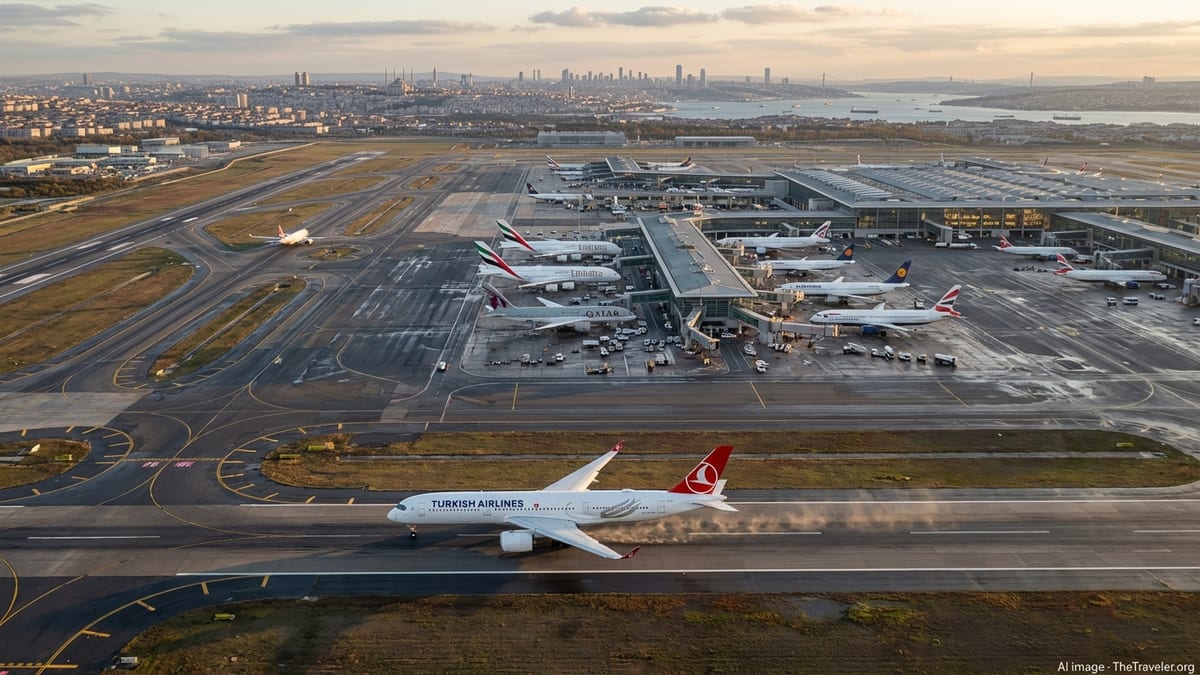
Istanbul Airport, already Europe’s busiest by several measures, has been scaling up to match that demand, expanding annual capacity toward 120 million passengers while implementing triple independent runway operations to boost hourly movements. That infrastructure is critical for carriers like Lufthansa and British Airways, which rely on tight connection windows for premium customers feeding into Europe and transatlantic networks.
Russian demand stands out as a powerful driver. With direct flights between Russia and much of the European Union still constrained, Istanbul has emerged as a de facto bridge to the West, with intense frequencies on routes such as Istanbul–Moscow Vnukovo. Turkish Airlines plans to maintain seven daily services on that corridor through the winter 2025–26 season, and Moscow now ranks among the largest city pairs in the airport’s European network.
At the same time, demand from Germany, the United Kingdom and the United States continues to rebound, filling long-haul and medium-haul services operated by Lufthansa, British Airways, Emirates and Qatar Airways alongside Turkish Airlines’ own flights. The result is crowded airspace above Türkiye and fuller terminals on the ground, a dynamic that is beginning to test capacity even as it delivers record revenue for carriers.
Russia, Germany, UK and US Travelers Drive a New Tourism Mix
Tourism figures for 2025 confirm how sharply international demand has swung in Türkiye’s favor. The country welcomed just under 64 million visitors last year, a historic peak that generated more than 65 billion dollars in tourism revenue and pushed per-night spending above 100 dollars. Russians ranked as the largest single inbound market, followed closely by Germans and then British travelers.
Istanbul has captured a growing share of that traffic. The city set visitor records in 2024 and continued to climb in 2025, building on its appeal as a culture, gastronomy and shopping hub that complements Türkiye’s traditional coastal resort offering. Data from the Culture and Tourism Ministry show strong arrivals not only from Russia and Germany but also from the United States and the United Kingdom, where city-break and heritage tourism are surging.
For legacy European carriers such as Lufthansa and British Airways, this multi-market demand presents both an opportunity and a competitive challenge. Their Istanbul flights now serve overlapping segments: point-to-point business and leisure travelers, Russians and other non-EU nationals using Istanbul as a bridge into Europe, and high-yield passengers connecting onward to the Gulf or North America. In many cases they are competing head-to-head with Turkish Airlines, Emirates and Qatar Airways on the same corridors.
US-based travelers, meanwhile, are feeding longer stays and higher-spend city trips, helped by sustained transatlantic capacity and aggressive marketing campaigns positioning Istanbul as a cosmopolitan alternative to Western European capitals. This diversified visitor base is particularly attractive to global hotel brands that prefer markets less exposed to a single source country.
Marriott, Hilton and Accor Lead a Hotel Construction Surge
The surge in arrivals is fuelling one of Europe’s most active hotel development pipelines, and Istanbul is at the center of it. International groups including Marriott, Hilton and Accor are accelerating openings and signings across the city, betting that the combination of rising air connectivity and tourism diversification will support sustained occupancy and rate growth into the next decade.
New branded properties are clustering along major business corridors on both the European and Asian sides of the city, as well as in historic districts popular with international visitors. Developers are targeting a mix of upscale and select-service hotels, seeking to capture the full spectrum of demand from Russian holidaymakers and German tour groups to British weekenders and American corporate travelers.
Executives at major chains describe Istanbul as a market where group and events business, driven by a rebound in conferences and exhibitions, converges with seasonal leisure peaks. They also point to a growing base of Turkish travelers returning from abroad and staying in branded hotels, adding a domestic cushion when long-haul markets soften.
Yet the building wave is not without risk. Analysts warn that if capacity growth outpaces actual visitor gains, pressure on average daily rates could intensify. For now, though, most operators say room demand is keeping up with supply, especially around Istanbul Airport, where early-morning bank departures and late-night arrivals support strong demand for airport and convention-focused properties.
Strategic Crossroads for Aviation and Hospitality
The intersection of military modernization and commercial expansion is giving Istanbul an unusual profile among global cities. On one side, KAAN’s prototype test fleet promises to deepen Türkiye’s role as a security provider in its neighborhood, potentially reshaping future defense-industrial partnerships with countries from the United Kingdom to the United States. On the other, record civilian air traffic and hotel construction are locking the city more tightly into global tourism and business travel flows.
For airlines such as Turkish Airlines, Lufthansa, Emirates, Qatar Airways and British Airways, the coming years will likely revolve around securing slots, fine-tuning schedules and defending market share at a hub where demand is still climbing. Their strategies will determine how efficiently the growing streams of visitors from Russia, Germany, the UK and the US can be connected through Istanbul without overwhelming its runways and terminals.
Hotel operators, meanwhile, are monitoring both KAAN’s progress and air traffic trends as leading indicators. A more secure regional environment, robust national carrier and deepening global links could extend Istanbul’s boom cycle, but geopolitical shocks or economic slowdowns in key source markets remain persistent risks. Many brands are responding by diversifying within the city, balancing core tourist districts with emerging neighborhoods and secondary hubs.
What is clear is that Istanbul’s transformation is far from over. As KAAN moves through its multi-prototype test phase and air traffic sets new records, the city’s dual identity as a military and commercial aviation crossroads is likely to sharpen, drawing in even more attention from airlines and hotel groups seeking a stake in Türkiye’s fast-evolving travel economy.