

More news on this day
Tourism and civilian air travel in southern Afghanistan face fresh disruption after a fuel depot used by private carrier Kam Air near Kandahar airport was destroyed in recent airstrikes, sharply constraining jet fuel supplies for domestic and regional flights.
Get the latest news straight to your inbox!
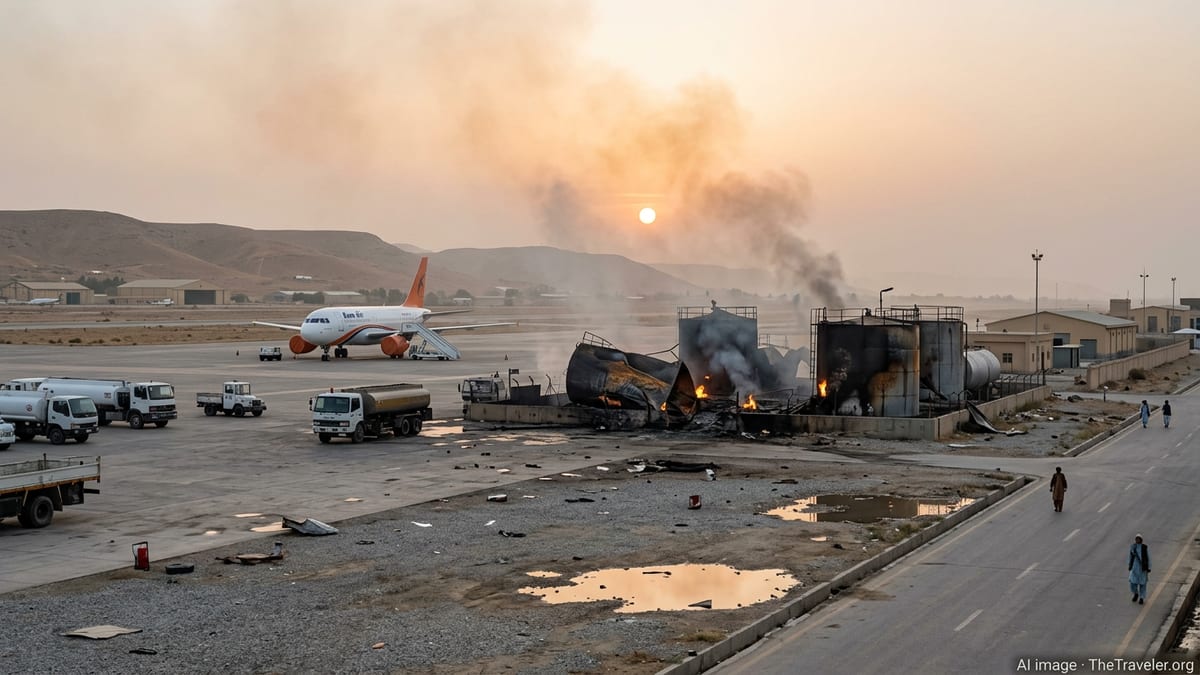
Airstrike Near Kandahar Hits Private Airline Fuel Stocks
Publicly available information in mid-March indicates that recent Pakistani airstrikes in southern Afghanistan struck a fuel storage facility associated with Kam Air near Kandahar airport. Commentary shared by Afghan officials and airline representatives in local media describes the site as a key depot for supplying commercial and humanitarian flights serving Kandahar and nearby provinces.
Reports circulated on Afghan and regional news platforms describe large fires and secondary explosions at the depot, suggesting a near-total loss of stored fuel. Social media footage geolocated to the vicinity of Kandahar airport shows flames and smoke rising from an installation adjacent to the airfield, consistent with descriptions of a commercial fuel depot used by Kam Air.
Regional political coverage frames the strike as part of a wider escalation along the Afghanistan Pakistan border, with Pakistan describing cross border attacks as responses to militant threats and Afghan authorities denouncing the operations as violations of sovereignty. Within this broader security context, the destruction of private aviation fuel stocks is emerging as a significant setback for civilian connectivity in the south.
Kam Air has not released comprehensive public details on its remaining reserves, but aviation-focused commentary and translated television reports suggest that a substantial portion of the company’s southern fuel inventory was concentrated at the Kandahar facility, leaving operations in the region heavily exposed.
Flight Cancellations and Reduced Connectivity
In the days following the strike, flight schedules serving Kandahar and nearby provinces show noticeable disruption, with reduced frequencies and short notice cancellations reported on Afghan travel booking channels and by regional travel agents. Publicly accessible timetable information indicates that some Kam Air services have been rerouted through Kabul or temporarily suspended, while other carriers appear cautious about ramping up operations amid fuel uncertainty.
Travel industry observers tracking Afghan routes note that airlines operating in the country typically rely on a small number of storage points for jet fuel, often located inside or adjacent to major airports such as Kabul, Kandahar, Herat and Mazar e Sharif. The loss of a dedicated commercial depot in Kandahar therefore has an outsized operational impact, even if runway and terminal infrastructure remain physically intact.
For passengers, the immediate effect is a reduction in options and higher unpredictability. Afghan travelers posting on social media and messaging groups in Kandahar and neighboring Helmand describe rebookings, long overland detours and, in some cases, the need to travel via Kabul for connections that previously operated more directly from Kandahar. Travel agents in the wider region, including those handling South Asia to Gulf itineraries, are reporting schedule checks and rerouting requests linked to the situation at Kandahar.
Industry analysts caution that if replacement fuel supplies are not secured quickly through alternative depots or overland tanker deliveries, the disruption could extend beyond a matter of days into a more prolonged period of constrained capacity, particularly affecting routes that rely on high aircraft utilization and tight turnaround times.
Impact on Pilgrimage, Business and Emerging Tourism
The timing of the strike coincides with preparations for religious travel, including Hajj and Umrah journeys that often begin with domestic legs from provincial cities to Kabul or direct departures from regional airports. Afghan media reports suggest that the affected Kam Air depot had been earmarked to support outbound Hajj related operations from Kandahar, raising concerns that southern pilgrims may face additional hurdles or longer, more expensive itineraries.
Business travelers and aid workers who rely on Kandahar as a hub for access to southern Afghanistan are also confronting renewed logistical challenges. International organizations and nongovernmental groups typically use a mix of commercial flights and charter arrangements; the loss of dedicated civilian fuel storage at a key airfield may reduce the flexibility of such arrangements and increase dependence on a smaller set of corridors routed through Kabul.
The disruption comes at a delicate moment for any potential revival of tourism in the region. While Afghanistan’s overall visitor numbers remain modest due to security and insurance constraints, specialized tour operators have in recent years promoted limited cultural and historical itineraries, including trips that route through southern cities for heritage sites and traditional bazaars. Travel blogs and niche adventure tour platforms had begun to highlight southern Afghanistan’s landscapes and historic routes, often stressing that air access was essential to avoid long, hazardous road journeys.
With flight options from Kandahar curtailed and perceptions of heightened risk around key aviation infrastructure, these tentative tourism initiatives are likely to pull back. Operators already face significant regulatory and safety scrutiny when marketing Afghanistan, and the image of burning fuel tanks near a major airport is likely to reinforce doubts among insurers, risk managers and potential visitors.
Strain on Local Economy and Hospitality Sector
The effects of reduced air connectivity extend beyond ticket counters and boarding gates into Kandahar’s broader urban economy. Hotels, guesthouses and small restaurants that depend on transient traffic from government delegations, aid missions, business visitors and the small pool of foreign tourists are likely to experience declining occupancy and revenue if flight schedules remain unstable.
Local transport services, including taxi drivers and private hire operators based around the airport, face similar uncertainty. Online testimonies and local reporting over recent years have highlighted how even modest improvements in air connectivity in Kandahar brought more predictable income for drivers, interpreters and guides. A sudden drop in arrivals can reverse these gains, pushing workers back toward informal or seasonal labor.
Tourism adjacent sectors, such as handicraft sellers, carpet traders and market stall owners in historically visited neighborhoods, have already endured years of volatility linked to conflict and the pandemic. Any further decline in visitor flows, even from domestic travelers and diaspora Afghans, risks weakening fragile supply chains of artisans and small wholesalers who rely on occasional high value purchases.
Economists who monitor Afghanistan’s domestic air market observe that reliable flights also underpin investment in logistics, perishable exports and medical travel. Reduced confidence in Kandahar’s aviation fuel security may discourage entrepreneurs from basing operations in the south, potentially diverting projects and spending to other cities perceived as more stable hubs.
Uncertain Outlook for Restoring Fuel Supplies
As of mid March, publicly available reporting does not indicate a clear timeline for fully restoring Kam Air’s fuel storage capacity near Kandahar. Commentators familiar with regional logistics note that rebuilding tanks, securing new fuel shipments and reestablishing safety certifications can take weeks or months, particularly in areas exposed to renewed airstrikes or cross border tensions.
Some aviation analysts suggest that temporary workarounds may be possible, such as trucking fuel from other depots or prioritizing select routes for the limited supplies that remain. However, these interim measures often come with higher costs and operational constraints, including tighter restrictions on payload and route planning, which ultimately filter through to travelers in the form of reduced service and higher fares.
Insurance considerations add another layer of complexity. Underwriters evaluating risk at Kandahar airport and nearby fuel installations may adjust premiums or impose additional conditions following the incident, affecting not only Kam Air but also other carriers considering expansion into southern Afghanistan. Higher insurance costs can quickly erode the narrow margins of domestic flight operations, further limiting incentive to restore previous capacity.
For now, potential visitors, humanitarian staff and diaspora Afghans planning trips to Kandahar are being advised by travel intermediaries to monitor airline announcements closely and to factor in the possibility of last minute changes, longer routings through Kabul, or overland segments. Until stable fuel supplies and a more predictable security environment are established, the prospects for meaningful tourism growth in southern Afghanistan appear constrained.