


The quiet provincial town of Kampong Cham is one of Cambodia’s most rewarding detours for travelers who want temples with atmosphere rather than crowds. Here, beside the Mekong River, ruined sanctuaries sit next to living pagodas, incense curls in the shade of Angkorian stone, and village lanes lead to forgotten towers half swallowed by jungle.
At the heart of this experience is Wat Nokor, also known as Banteay Prei Nokor, an 11th century temple complex later woven into a modern Theravada monastery. Around it, a constellation of lesser known ruins and sacred hills invite slow exploration, creating a compact introduction to Cambodia’s religious history without the intensity of Angkor.
Understanding Kampong Cham’s Sacred Landscape
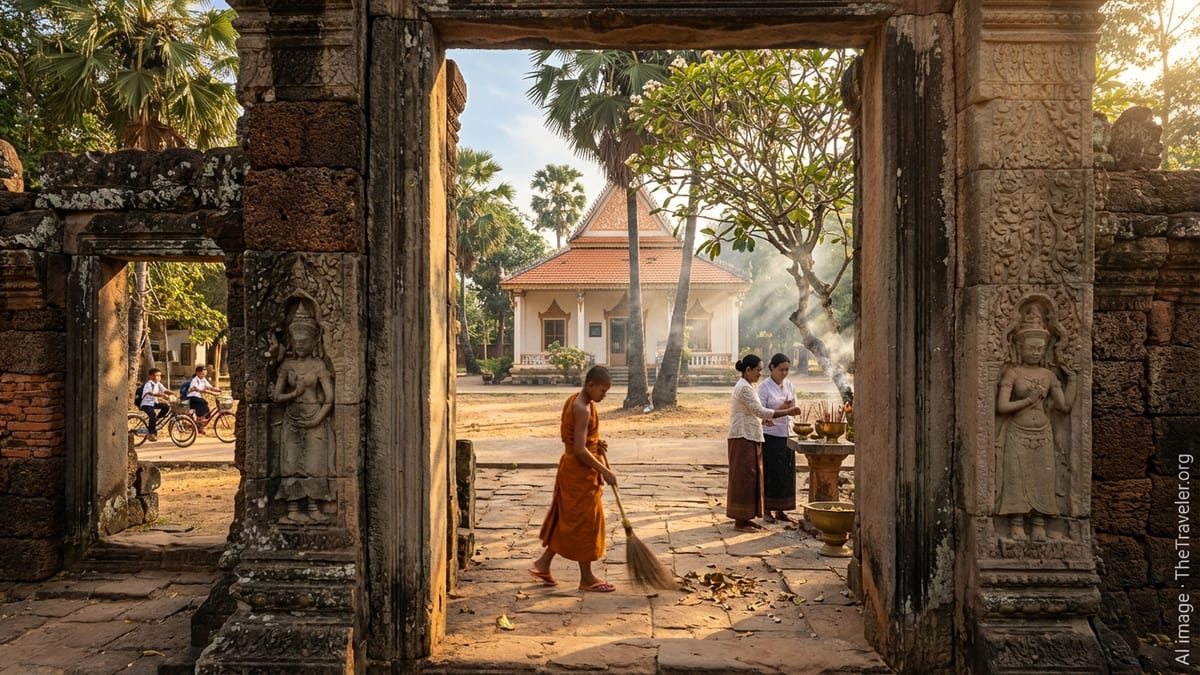
Kampong Cham lies around 120 kilometers northeast of Phnom Penh, along the Mekong River in southeastern Cambodia. Historically, this region sat at the crossroads of river trade routes linking Angkor, the coast and the highlands, which helps explain why so many shrines and monasteries dot its countryside. Unlike the monumental concentrations of temples at Siem Reap, the ruins around Kampong Cham are dispersed among rice fields, villages and low hills, creating a softer, more lived in setting. Travelers encounter schoolchildren cycling past laterite walls, farmers leading cows along dike paths and monks in saffron robes walking through 900 year old gateways.
The religious landscape here spans more than a millennium. Ancient Khmer rulers sponsored Hindu and Mahayana Buddhist temples built in brick and laterite. Over centuries, these sites were absorbed into the Theravada Buddhist culture that now defines Cambodia’s spiritual life. Today, active pagodas often rise inside or alongside the ruins, with new prayer halls, stupas and shrines set against weathered towers and galleries. Rather than preserving monuments as isolated museum pieces, Kampong Cham shows how sacred places evolve and continue to function at the heart of community life.
Wat Nokor embodies this continuity particularly clearly, but it is not alone. Smaller temple sites such as Cheung Ang and older pilgrimage hills like Phnom Pros and Phnom Srey are part of the same religious geography. Together, they offer an accessible overview of Cambodian temple architecture, from early Angkorian designs to 20th century monastic buildings painted with vivid mural cycles. For travelers, this makes Kampong Cham an ideal bridge between the country’s ancient past and the Buddhist practices of the present day.
Wat Nokor / Banteay Prei Nokor: History and Legend
Wat Nokor, signed locally as Nokor Bachey Temple, stands just a couple of kilometers west of central Kampong Cham. The core of the complex dates to the 11th century and is commonly attributed to the reign of King Suryavarman II, the same ruler traditionally linked with Angkor Wat. Known in older sources as Banteay Prei Nokor, it was once a significant regional center, commanding a rectangular enclosure more than 400 meters long and surrounded by a reservoir, or baray, which stored water and symbolized the cosmic ocean in Khmer cosmology.
The temple was originally a Mahayana Buddhist or Hindu sanctuary aligned on an east west axis, as was typical of Angkorian religious architecture. Pilgrims would have approached along laterite causeways, passed through gopura gatehouses and entered a central shrine crowned by towers representing Mount Meru, the cosmic mountain. Over time, however, the spiritual orientation of the site shifted. As Theravada Buddhism spread through Cambodia between the 14th and 16th centuries, the old sanctuary was gradually reinterpreted as a Theravada monastery, and new wooden and masonry structures were added among the stone ruins.
Local legends intertwine with the formal historical record. In village telling, the word “Nokor” links both to “Angkor” and to the notion of a fortified city, evoking an era when this area was a royal stronghold before power moved definitively to Angkor in the northwest. Elders sometimes describe Wat Nokor as a place that saved people during periods of upheaval, including wartime, when villagers sought refuge in its thick laterite galleries. These stories give the site a protective aura, reinforcing its role as a spiritual bastion for people living in the surrounding districts.
By the 20th century, Wat Nokor had fully become a living monastery complex, with resident monks, daily offerings and new halls painted with Buddhist narratives. Yet the core Angkorian stonework survived relatively intact compared with many provincial temples. Today, visitors walk through a layered palimpsest of faith and history: lintels carved with apsaras and guardian figures frame doorways that open onto modern Buddha images, while crumbling courtyards shelter donation boxes, plastic chairs and the sound of chanting.
Architecture and Atmosphere of Wat Nokor
Approaching Wat Nokor, travelers first encounter the outer laterite walls and gate towers that give the complex its fortresslike character. Laterite, a reddish, iron rich stone common in Cambodian temple construction, weathers into rough blocks streaked with lichen. In the soft light of early morning or late afternoon, these walls glow deep orange brown, contrasting with the bright robes of monks and visitors’ umbrellas. The main entrance lies to the east, reached along a short road that branches from the national highway, but side paths through local houses and small shops underscore the site’s integration with everyday life.
Inside the outer enclosure, a network of galleries, courtyards and shrines leads gradually toward the central sanctuary. Unlike the grand, soaring vistas of Angkor Wat, the spaces at Wat Nokor feel compressed and intimate. Doorways are sometimes low, corridors narrow and floors uneven where stones have shifted. In several places, you walk beneath sandstone lintels carved with deities and mythological scenes that, though worn, still show the fluent classical style of the 11th century Khmer sculptors. False doors and windows are framed by colonnettes, and in the shade of inner passages you may spot remnants of carvings that have escaped modern repainting.
What makes Wat Nokor particularly distinctive is the way a contemporary vihara, or prayer hall, has been built directly inside the old Angkorian enclosure. The modern hall houses large seated Buddha statues surrounded by offerings of flowers, incense, candles and banknotes. Its walls are covered in brightly colored murals depicting episodes from the life of the Buddha and Jataka tales, creating a vivid contrast with the subdued, time darkened sandstone outside. Standing in the doorway, you can look back through stone arches older than many European cathedrals, then turn to face fluorescent lights illuminating freshly painted scenes of the Buddha teaching under Bodhi trees.
The atmosphere shifts with the time of day. In the early morning, monks sweep the courtyards and local women arrive to make offerings, moving quietly from shrine to shrine. At midday, harsh sunlight penetrates courtyards and picks out the textures of blocks and carvings, and tour groups, if they come at all, tend to appear then. Late afternoon offers the most evocative light, with long shadows stretching across the galleries and the faint sound of chanting carrying from the inner halls. Even at its busiest, Wat Nokor rarely feels crowded, which allows for moments of solitude that are increasingly hard to find at larger Cambodian sites.
Other Ancient Ruins Around Kampong Cham
Wat Nokor is the best known temple in Kampong Cham Province, but it is only one part of a wider constellation of ruins that reward curious visitors. To the northeast lies Cheung Ang temple, or Prasat Cheung Ang, an early 10th century brick sanctuary set within a square moat. This compact temple, once dedicated to Shiva in 932, follows the classic Khmer plan of a central tower oriented toward the east, with carved lintels above the entrance and inscribed door jambs that scholars use to date the monument. Today, a Buddha statue occupies the main chamber, illustrating again how Hindu sacred spaces have been repurposed within the Theravada tradition.
Traveling further afield, travelers encounter sites like Prey Nor Kor Knong Krov, an ancient complex southeast of Kampong Cham near Ponhea Krek district. Although not as structurally complete as Wat Nokor, its scattered towers, laterite platforms and fragments of sandstone sculpture stand amid rural landscapes that see far more farmers than foreign visitors. Reaching these ruins requires a combination of highway travel and smaller dirt roads, often taken by motorbike or tuk tuk. Along the way, views of rice paddies, sugar palm trees and small hamlets underline how Cambodia’s monumental past and agrarian present coexist.
Even where physical remains are modest, local communities remember the old temples as powerful spiritual sites. Village shrines, spirit houses and small pagodas are often built beside or atop older foundations, blending animist practices with Buddhist worship. Many of these places are not formally documented in guidebooks, which means visiting them is as much about engaging with local people as it is about studying architecture. A monk or elder might point out an overgrown mound that once supported a tower, or show a reused sandstone block incorporated into a modern staircase.
For travelers interested in the broader sweep of Khmer architecture, Kampong Cham’s ruins also connect conceptually with temple sites just across provincial boundaries, such as the laterite and brick sanctuaries of Kampong Thom. While those lie beyond the scope of a day trip from Kampong Cham town, they help frame this region as part of a continuum of sacred structures stretching from the Mekong corridor to the great Angkorian heartland. Exploring Kampong Cham’s temples can be seen as both a stand alone experience and a gentle introduction before tackling the scale of Angkor itself.
Phnom Pros, Phnom Srey and Living Pilgrimage Traditions
Northwest of Kampong Cham town rise two low hills whose names are woven into Khmer folklore: Phnom Pros, the Hill of Men, and Phnom Srey, the Hill of Women. These twin elevations, reachable by road and stairways, host active pagodas and scattered ruins that show yet another side of the region’s sacred heritage. While not strictly Angkorian temple complexes, they are essential to understanding how local people practice Buddhism today and how myth shapes the landscape.
Phnom Pros, with its relatively gentle slopes and road access to the summit, is crowned by a modern temple modeled on classical Khmer forms, with multiple peaks echoing earlier designs from sites like Banteay Srei. Around it stand pagoda buildings, large Buddha statues and monks’ residences that serve the surrounding villages. From the top, views extend over the flat countryside of Kampong Cham, with the Mekong and its floodplains visible in the distance. The hill carries a tragic recent history as well, having served as a detention and execution site during the Khmer Rouge period, a memory that adds a somber dimension to contemporary pilgrimages.
Phnom Srey, the Hill of Women, is steeper and approached by more than 300 stone steps. At its summit lies a small ruined temple, partially collapsed and maintained primarily by nuns who live there and organize donations to preserve the site. The combination of ruined brickwork, simple dwellings and the presence of female religious caretakers gives Phnom Srey a markedly different atmosphere from the more developed Phnom Pros. The twin hills are especially popular during major Buddhist festivals such as Khmer New Year and Pchum Ben, when crowds from surrounding areas climb to pray, picnic and enjoy the views.
The folklore associated with Phnom Pros and Phnom Srey concerns a legendary contest between men and women to build mounds of earth overnight, a story sometimes invoked to explain the differing heights of the hills and the broader social roles of men and women in traditional Cambodian society. Whether or not visitors delve deeply into the myth, the hills offer a powerful illustration of how natural features, historical events and religious practice combine into layered pilgrimage landscapes. Together with Wat Nokor and the smaller ruins, they complete a picture of Kampong Cham as a living sacred region rather than a static archaeological park.
Planning Your Visit: Access, Seasons and On the Ground Practicalities
Getting to Kampong Cham from Phnom Penh is straightforward. Regular buses and minivans depart throughout the day, taking around two and a half to three hours to cover the 120 kilometer journey along National Highway 6 and 7. Prices are modest by international standards, with air conditioned buses operated by national companies and smaller private services. Some travel agencies also arrange private cars for those who prefer a direct transfer. From other regional towns such as Kratie or Kampong Thom, travelers will typically find at least one or two daily bus or minibus connections, though schedules can be less predictable and may change with demand.
Within Kampong Cham town, tuk tuks and motodops are the most convenient ways to reach Wat Nokor and the outlying temple sites. Drivers are usually familiar with the main attractions, and most guesthouses can recommend trusted contacts. It is advisable to agree on a circuit and price in advance, especially if you want to include several stops such as Wat Nokor, Phnom Pros, Phnom Srey and rural ruins. Bicycle rentals are also available from some hotels and shops, and cycling can be a pleasant option for the closer sites during the cooler hours of morning and late afternoon.
Wat Nokor typically keeps standard pagoda hours, opening in the early morning and closing around dusk, with a small entrance fee applied to foreign visitors that contributes to maintenance. While details can change, fees remain relatively inexpensive compared with the major Angkor sites. There is usually no formal ticket booth for the smaller temples in the countryside; visitors may be asked for small donations by local caretakers or pagoda committees, which helps fund upkeep and festivals. Carrying a supply of small U.S. dollar bills or Cambodian riel notes makes these interactions smoother.
The best time to visit Kampong Cham’s temples is during the dry season from roughly November to March, when skies are clearer and rural roads are more reliable. The wet season brings lush rice fields and dramatic clouds, but heavy rains can make dirt tracks muddy and sometimes impassable, particularly for motorbikes. Temperatures are hot year round, often rising sharply by late morning, so planning temple visits early or late in the day is sensible. As with much of Cambodia, national and religious holidays can affect transport schedules, accommodation availability and the atmosphere at religious sites, sometimes making them livelier and more crowded.
Etiquette, Conservation and Responsible Temple Travel
Visiting active temples in Kampong Cham calls for basic cultural sensitivity. Dress modestly, with shoulders and knees covered for both men and women, especially if you plan to step inside prayer halls or climb sanctuaries that are still in use. Footwear should be removed before entering enclosed sacred spaces and sometimes before mounting platforms; when in doubt, follow local practice or ask a monk or attendant. Speaking softly, avoiding disruptive photography during prayers and steering clear of restricted areas marked for monks or nuns help maintain the serenity of the sites.
Monks are central figures in the social as well as spiritual life of Kampong Cham’s communities. It is acceptable to greet them respectfully and offer small donations, but there are protocol differences to keep in mind. Women generally should not touch monks or hand items directly to them, instead placing offerings on a cloth or tray. Men may interact more freely but are still expected to be courteous and avoid overly casual behavior. Children often play in the temple compounds; photographing them is usually fine if done respectfully, but asking permission from guardians when possible is considerate.
From a conservation perspective, many of Kampong Cham’s ruins are fragile. Stones may be loose, edges crumbling and carvings eroded by centuries of weather. Climbing on structures that are not clearly designated as accessible risks both personal injury and further damage to the monuments. Touching carvings, tracing inscriptions with fingers or leaning against delicate walls gradually wears away detail that cannot be replaced. Responsible travelers can help by keeping to obvious paths, avoiding graffiti or candle smoke near vulnerable stone surfaces, and reporting any signs of looting or vandalism to local authorities.
Buying souvenirs from small vendors near the temples, hiring local guides and using locally owned transport services can distribute the economic benefits of tourism more equitably. At the same time, it is important to avoid purchasing any artifacts, old statuary or fragments of carvings, which may have been illicitly removed from heritage sites. Supporting legitimate crafts such as basketry, woven scarves and simple paintings offers a positive alternative. In this way, a visit to Wat Nokor and the surrounding ruins can contribute directly to the communities that have preserved these sacred landscapes across difficult decades.
The Takeaway
Kampong Cham’s temples offer an experience distinct from Cambodia’s headline attractions. At Wat Nokor, travelers encounter a rare fusion of Angkorian stone architecture and an active Theravada monastery, where incense curls around centuries old pillars and brightly painted Buddha images. Nearby hills and countryside shrines, from the twin peaks of Phnom Pros and Phnom Srey to little visited ruins like Cheung Ang, extend this encounter into a broader, more intimate engagement with the country’s spiritual geography.
Rather than rushing through a checklist of monuments, visitors who linger in Kampong Cham find a rhythm of life in which sacred sites remain deeply woven into daily routines. Early morning offerings, children cycling past laterite walls, monks tending gardens beside crumbling towers and families picnicking on festival days all reinforce the idea that these temples are not relics frozen in time but evolving centers of belief. For travelers seeking a quieter, more reflective window into Cambodia’s religious history, Kampong Cham’s Wat Nokor and surrounding ancient ruins provide exactly that.
In a country where tourism often clusters around a few ultra famous destinations, choosing to spend time in Kampong Cham is also a conscious act of diversification. It helps spread income to provincial communities, encourages local stewardship of heritage and allows visitors to connect with people and places beyond the busiest circuits. Whether as a side trip from Phnom Penh or a slower stop on a longer overland journey, Kampong Cham rewards those who approach its temples with curiosity, patience and respect.
FAQ
Q1. Where is Wat Nokor located within Kampong Cham?
Wat Nokor lies a short distance west of central Kampong Cham town, just off the national highway, around two kilometers from the riverside area where many guesthouses and restaurants are found.
Q2. How old is Wat Nokor and who built it?
The core of Wat Nokor dates to the 11th century and is generally associated with the period of King Suryavarman II, placing it in the same broad era as Angkor Wat, although on a much smaller scale.
Q3. What makes Wat Nokor different from temples in Angkor?
Wat Nokor stands out because an active modern Buddhist monastery has been built inside and around the original Angkorian stone complex, creating an unusual blend of ruins and living religious spaces without the heavy crowds of Angkor.
Q4. Do I need a guide to visit Wat Nokor and the nearby ruins?
A guide is not strictly necessary, but hiring a local guide or tuk tuk driver who knows the sites can add context, help navigate smaller roads and open conversations with monks or villagers you might not manage on your own.
Q5. What is the best time of day to photograph Wat Nokor?
Early morning and late afternoon offer the most atmospheric light, with softer shadows on the laterite and sandstone, fewer visitors and a better chance to observe daily rituals such as offerings and chanting.
Q6. Are Phnom Pros and Phnom Srey suitable for all fitness levels?
Phnom Pros is accessible by road almost to the summit and requires only short walks, while Phnom Srey involves climbing more than 300 steps, which can be challenging in the heat for those with limited mobility or heart conditions.
Q7. Is there an entrance fee for Wat Nokor and the other temples?
Foreign visitors usually pay a modest entrance fee at Wat Nokor, whereas smaller rural shrines and hills may operate on a donation basis, with contributions going toward maintenance and religious activities.
Q8. What should I wear when visiting temples in Kampong Cham?
Dress modestly, covering shoulders and knees, and wear footwear that is easy to remove, since you will often be asked to take off shoes before entering inner halls or climbing onto sacred platforms.
Q9. How much time should I allocate for exploring Kampong Cham’s temples?
A full day is enough to visit Wat Nokor, Phnom Pros and Phnom Srey comfortably, while adding extra time allows for slower exploration of countryside ruins and more relaxed interactions with local communities.
Q10. Is Kampong Cham a safer and quieter alternative to more touristed areas?
Kampong Cham is generally calm and feels less pressured than major tourist centers, offering a quieter environment, though standard precautions with belongings and nighttime movement are still advisable as in any small city.