

More news on this day
On a quiet stretch of Cambodia’s southern coastline, the Kampong Samaki fishing community in Kampot province is turning its mangrove-fringed waters into a growing eco-tourism draw, using conservation-led tourism to diversify incomes and protect one of the country’s most fragile ecosystems.
Get the latest news straight to your inbox!
A Mangrove Community at the Heart of Kampot’s Coast
Publicly available information describes Kampong Samaki Community Fishery as a coastal cluster of villages about 10 kilometers from Kampot town, surrounded by a patchwork of mangrove forests, seagrass beds and nearshore reefs. The community-managed fishery area covers close to 580 hectares, including roughly 70 hectares of mangrove under formal community management and additional zones for seagrass and marine resources.
Historically, most households here have relied on small-scale marine and estuarine fishing, using the mangrove channels as nursery grounds for fish, crabs and shrimp. Reports indicate that around two-thirds of residents still depend on fishing as a primary source of income, supported by small rice plots and micro-enterprises such as drying shrimp, selling fuel and basic goods, and raising livestock.
In recent years, the coastal landscape has shifted from being known mainly as a working fishery to being recognized as a tranquil nature destination. Coverage from Cambodian media and development organizations highlights how tranquil waterways, birdlife and mangrove shade have attracted a mix of domestic visitors from Phnom Penh and Sihanoukville alongside a smaller number of international travelers exploring Kampot beyond its riverside cafes.
The community’s location, slightly off the main tourist circuit yet within easy reach of Kampot, has allowed Kampong Samaki to position itself as a quieter alternative to more commercialized beach destinations. This relative seclusion is emerging as an advantage for travelers seeking low-key experiences focused on nature, community life and local seafood rather than nightlife or large resorts.
Ecotourism Facilities: Walkways, Bridges and Boat Tours
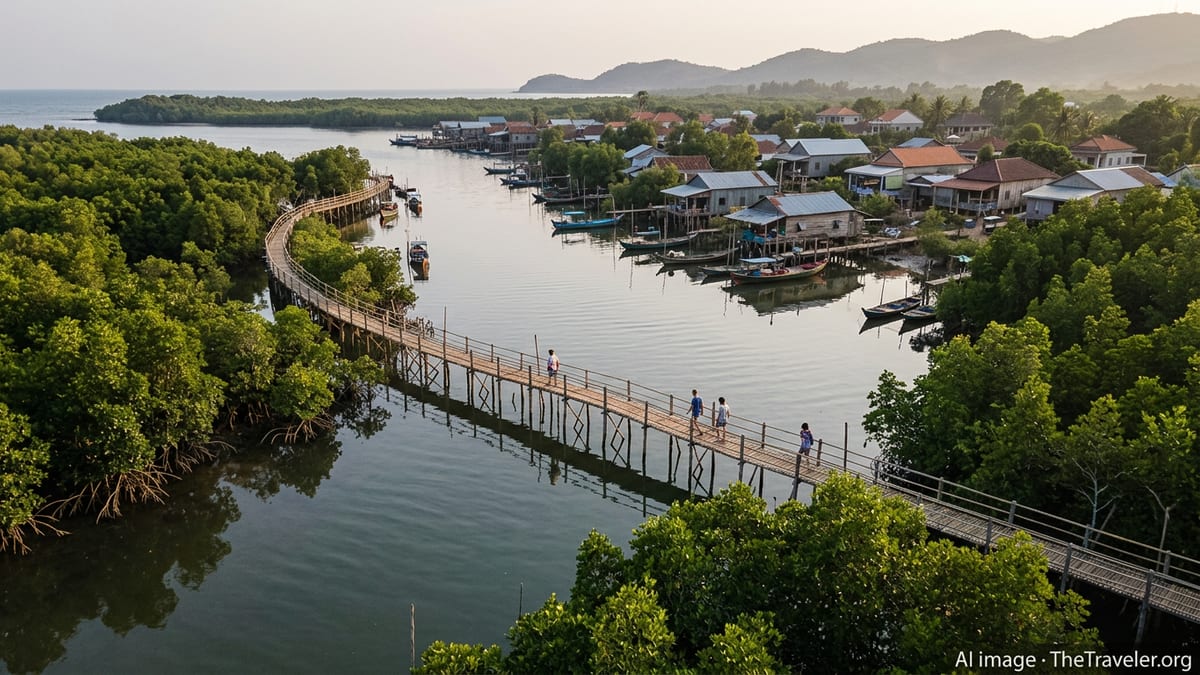
Today, the most visible symbols of Kampong Samaki’s tourism shift are its elevated walkways and bridges weaving through the mangrove forest. Published descriptions of the site highlight a long bamboo or wooden bridge structure built over the tidal channels, designed to bring visitors into the heart of the mangroves without disturbing root systems or sensitive mudflats.
Earlier reports from Cambodianess and other outlets noted that a 400 meter walking bridge through the mangrove canopy quickly became a highlight for visitors, offering views of the forest at high and low tide. More recent project updates from civil society groups describe a new bamboo bridge of more than 300 meters at the community eco-resort area, further extending access for tourists while providing a distinctive visual landmark for the site.
Boat tours remain another central tourism product. Community members operate small wooden boats that take guests along narrow canals lined with mangrove trees and out towards open coastal waters. These trips are typically paired with simple homestyle meals featuring crab, fish or shellfish sourced from nearby traps, reinforcing the link between the ecosystem and local livelihoods.
Facilities at the landing point remain modest, consisting mostly of small community-run shelters, basic catering arrangements and resting areas. Available information suggests that the deliberate choice has been to keep infrastructure small-scale and community-owned rather than invite large private developers, in line with Cambodia’s broader push for community-based ecotourism in sensitive coastal zones.
Replanting Mangroves and Protecting Coastal Ecosystems
The rise of ecotourism in Kampong Samaki has been closely tied to mangrove restoration. Over the past decade, multiple campaigns by Cambodian and international organizations have supported the community to plant tens of thousands of mangrove seedlings along eroded shorelines and abandoned shrimp ponds. One widely reported initiative concluded with more than 100,000 mangrove trees planted across Kampot’s coast, with Kampong Samaki among the flagship sites.
Environmental features compiled by local media and non-governmental groups recount how community members, students and youth networks have participated in planting events, sometimes adding hundreds or thousands of seedlings in a single day. These efforts have been framed not only as conservation but also as investment in the long-term viability of eco-tourism, as dense mangrove stands provide shade for walkways, reduce wave energy, and enhance the scenic value of boat trips.
Technical project documents associated with recent regional environmental initiatives list Kampong Samaki as a pilot site for integrated coastal management. These reports emphasize the community’s mixed habitats of mangroves, seagrass meadows and nearshore coral as important nurseries for commercially valuable species. They also underline that better protection of these ecosystems is expected to stabilize fish catches over time and increase the appeal of the area for nature-focused travelers.
Beyond tree planting, local rules on illegal fishing, mangrove cutting and conversion of coastal land to intensive aquaculture are being gradually formalized through community fishery regulations. While enforcement capacity remains limited, the integration of tourism revenues and conservation messaging appears to be strengthening social support for keeping remaining mangrove forests intact.
Tourism Income Diversifies Livelihoods for Fishing Families
Coverage of Kampong Samaki’s eco-tourism model indicates that tourism is still secondary to fishing for most households but is becoming an increasingly important income supplement. Families earn from guiding boat tours, preparing meals, renting small huts or platforms for day visitors, and selling refreshments and local products near the boat landing.
Women in particular are reported to be taking on more visible roles in tourism-related catering, handicrafts and homestay-style hosting. This participation builds on their longstanding responsibilities in processing and marketing fish products, yet offers more direct engagement with visitors and a chance to capture higher value from each trip.
Some initiatives documented by development partners include small-scale seabass farming and other aquaculture activities introduced with technical support. These efforts aim to reduce pressure on wild stocks while providing additional attractions for visitors interested in learning how fish are raised in floating cages along the mangrove channels.
Seasonality remains a challenge, as monsoon weather and school calendars influence domestic travel patterns. However, reports from the past few years suggest that weekend and holiday visits by Cambodian families have become a core market, helping to stabilize income that once relied heavily on unpredictable fish catches and market prices.
Balancing Visitor Growth With Climate and Conservation Pressures
As Kampong Samaki gains visibility through social media, domestic travel blogs and project reports, questions are emerging about how much growth the area can sustain without undermining the very ecosystems that attract visitors. Coastal erosion, salinity intrusion and extreme weather events linked to climate variability are already affecting mangrove health and fisheries across Cambodia’s southern provinces.
Recent baseline assessments carried out under regional pollution and river basin projects identify Kampong Samaki as a location with strong ecotourism potential but also note vulnerabilities, including upstream pollution, solid waste management and the risk of unregulated tourism expansion. These documents emphasize the need for better zoning, visitor monitoring and infrastructure planning to keep development aligned with conservation objectives.
Observers also point to shifts in Cambodia’s tourism patterns, with a faster rebound of domestic travel compared to international arrivals in the years following global travel disruptions. For Kampong Samaki, this has reinforced the importance of remaining accessible and affordable to Khmer visitors, while offering experiences that reflect local culture and environmental stewardship rather than mass-market entertainment.
For now, Kampong Samaki’s mangrove-fringed channels, simple bamboo bridges and community-run boats place it firmly within Cambodia’s emerging network of coastal ecotourism sites. How the community navigates the next phase of growth, climate stress and investment interest will determine whether it can remain both a refuge for marine life and a model for sustainable tourism along the Gulf of Thailand.