

More news on this day
Domino-effect delays at Kansas City International Airport have rippled through the US air travel system, stranding thousands of passengers and underscoring how quickly disruptions at a single hub can snarl nationwide flight networks during the busy spring travel period.
Get the latest news straight to your inbox!
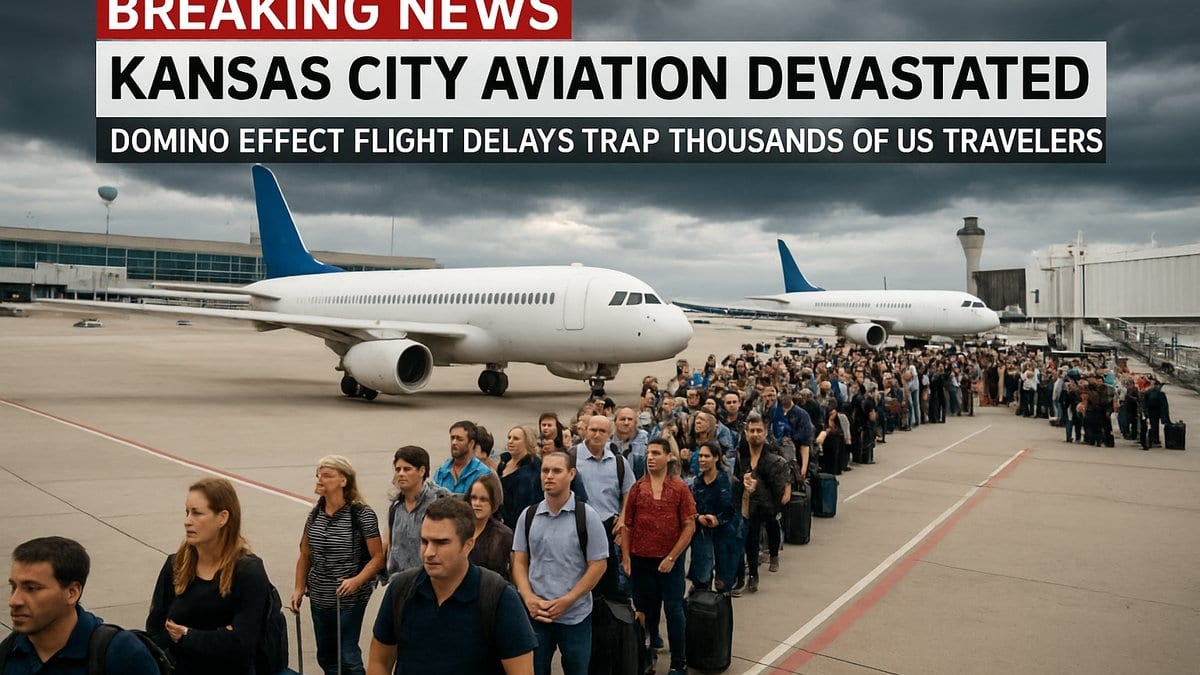
Stranded Passengers as Delays Stack Up at MCI
Data compiled from real time flight tracking platforms on April 3 indicated that operations at Kansas City International Airport were under acute strain, with a dense cluster of cancellations and rolling delays hitting many of the airport’s busiest domestic routes. Reports described aircraft waiting for gates, crews timing out and departure banks slipping later into the evening, as the schedule buckled under the pressure.
The resulting gridlock left departing and connecting passengers facing extended waits in terminal seating areas and at crowded gate podiums. Publicly available information from traveler forums and flight status dashboards showed multiple services to key hubs such as Chicago, Dallas and Denver pushed back by hours or scrubbed entirely, forcing last minute rebookings and overnight stays.
Operational data reviewed for April 3 and the early hours of April 4 showed that even flights that did depart often did so out of sequence, with airlines prioritizing aircraft positioning and crew schedules over strict adherence to the published timetable. That pattern amplified uncertainty for passengers already at the airport, many of whom saw projected departure times shift repeatedly over the course of the day.
While Kansas City International has worked in recent years to promote its reputation for low delay times and efficient operations, the latest disruption highlighted how even a modern, award winning new terminal complex remains vulnerable when multiple routine stress factors converge at once.
How a Local Breakdown Became a National Problem
Published coverage and federal transportation data consistently describe US air travel as a tightly coupled system in which a disruption at one node can quickly cascade into wider problems. The situation in Kansas City over April 3 aligned with that pattern, as delays at MCI intersected with weather related congestion and equipment issues at other major hubs to create a network wide shock.
Earlier in March, technical issues and equipment outages at large Midwestern and Great Lakes airports had already produced periodic slowdowns, forcing ground delay programs and flow restrictions on flights across multiple states. Those bottlenecks, combined with seasonal storms and heavy spring passenger volumes, left airline schedules with little spare capacity by the time problems intensified in Kansas City.
Industry analyses of recent airline performance note that once key aircraft and crews are stranded out of position, delays tend to propagate throughout the day. A late arriving aircraft into Kansas City can mean a missed departure window for the next leg, which in turn disrupts flights waiting for that same plane in other cities. This cascading effect was visible on flight tracking maps on April 3, which showed knock on delays on routes touching Kansas City well beyond the immediate region.
By the evening, disruptions initially centered on Missouri were contributing to growing pockets of delay at secondary airports that rely on Kansas City for connections. Passengers traveling between smaller Midwestern and Southern markets found themselves caught in the middle of a complex operational puzzle that left few easy rerouting options.
Weather, Congestion and Structural Vulnerabilities
Spring weather has been a recurring theme in recent aviation disruption reports, and the Kansas City event emerged against that backdrop. Meteorological data for April 3 pointed to a mix of overcast skies and periods of rain in the Kansas City area, conditions that can slow operations, tighten runway capacity and trigger greater spacing between arrivals and departures even when visibility remains acceptable.
At the same time, national transportation statistics show that average delay durations at US airports have been edging higher during peak seasons, reflecting fuller planes, leaner crew scheduling and infrastructure that has struggled to keep pace with post pandemic demand. Kansas City’s new single terminal has expanded gate capacity and streamlined passenger flows, but airfield and airspace constraints continue to limit how quickly airlines can recover once the schedule begins to fray.
Analysts who study delay propagation point to several structural vulnerabilities that were visible in the Kansas City pattern. These include dependence on tightly timed banked connections, concentration of key routes on a small number of carriers and limited slack in aircraft utilization plans. When even modest weather or equipment issues arise, those factors combine to increase the likelihood of a cascading breakdown rather than an isolated inconvenience.
Recent official airport and city communications in other winter and spring events have also underscored how power outages, runway icing and snow removal backlogs can temporarily halt or slow operations across entire airfields. While the latest Kansas City disruption did not coincide with a full closure, the echoes of earlier severe weather shutdowns in the region have kept attention focused on the resilience of airport infrastructure.
Travelers Face Missed Events and Mounting Costs
For passengers, the abstract mechanics of air traffic management translated into concrete personal and financial consequences. Social media posts and local broadcast coverage from the Kansas City area highlighted travelers missing weddings, business meetings and sporting events after departure pushes extended beyond the point where rebooking was useful.
Extended delays quickly cascaded into secondary expenses, including last minute hotel stays, rideshare trips to off airport accommodations and meal costs while waiting for updates. Consumer advocacy groups note that in many domestic disruption scenarios not tied to controllable airline issues, travelers may receive limited compensation, leaving much of the financial burden on individuals and families.
Travel insurance and credit card trip interruption benefits can offset some of those losses, but policy terms vary widely and often require detailed documentation of delays and cancellations. As a result, many travelers affected by the Kansas City gridlock will likely be sorting through receipts and benefit language in the days ahead to determine what, if anything, they can claim.
The human impact is also measured in stress and fatigue. Families traveling with small children and elderly passengers were particularly affected by rolling departure times and crowded gate areas, with limited quiet spaces available once the main departure banks began to slip behind schedule.
What the Disruption Reveals About US Air Travel Resilience
The Kansas City event serves as another case study in how quickly conditions can deteriorate across the US aviation network when several common risk factors align. It arrived in a period when airlines and airports are still refining post pandemic staffing models, contending with pilot and mechanic shortages and managing infrastructure that was in some cases already stretched before travel demand rebounded.
Transportation performance datasets evaluated over recent years show that even airports historically regarded as relatively efficient can experience sharp spikes in delay metrics when national system constraints tighten. In that sense, Kansas City’s experience on April 3 reflects a broader concern about resilience rather than a localized failure unique to one facility.
Publicly available modeling studies of hub operations indicate that incremental improvements in crew reserves, ground equipment redundancy and air traffic flow management can reduce the risk of severe cascading delays. However, implementing those changes at scale requires sustained investment from airlines, airports and federal agencies, as well as coordination that extends beyond any single city.
For travelers, the episode reinforces the importance of proactive planning during high risk seasons. Flexible itineraries, earlier departure choices, contingency funds and close monitoring of flight status tools can mitigate some of the fallout when disruptions like those seen in Kansas City send shockwaves through the national air travel system.